Friday, 2 April 2010

Holy Thursday in Cork

The Easter Ceremonies were celebrated in the Gregorian Rite in Ss. Peter and Paul's Church, Cork City. Some images from Mass on Holy Thursday follow:

Introibo ad Altare Dei

Ab illo benedicaris, in cuius honore cremaberis

Nos autem gloriari opportet in cruce

Gloria in excelsis Deo


Dominus Vobiscum

Dominus sit in corde tuo et in labiis tuis

Exemplum enim dedi vobis

Et quemadmodum ego feci vobis ita et vos faciatis

Msgr. James O'Brien

Suscipe Sancte Pater Omnipotens

Per intercessionem beati Michaelis Archangeli

Per omnia saecula saeculorum...

...et elevatis oculis in caelum...

Haec quotiescumque feceritis in mei memoriam facietis

Reflecti vitalibus alimentis...

...plenum gratiae et veritatis...

Veneremur cernui!

Diviserunt sibi vestimenta mea

[Feel free to use these images but please credit this blog and give proper reference to the location and occasion - Convenor]

For many years, an elderly retired missionary Priest celebrated the Gregorian Rite daily at a very early hour in the Church of his congregation, the SMA, in Wilton, on the outskirts of Cork City. I well remember attending Mass in a darkened Church at 6.30 a.m. In the company of perhaps a dozen others who had been cute enough to discover the Mass in spite of the absolute ban on publicity. This elderly Priest, now deceased and for whom your prayers are requested, persevered despite increasing blindness to celebrate the Votive Mass of Our Lady, in season and out, as long as health permitted.

More recently, occasional Masses were organised in Ss. Peter and Paul's, growing to a monthly Mass since July, 2008, following Summorum Pontificum.

Fr. Patrick McCarthy, the Parish Priest of Saints Peter and Paul's, has been celebrating Mass in the Gregorian Rite weekly since October, 2009, with the permission of the Bishop of Cork and Ross. During this past Lent, Mass was celebrated daily in the Gregorian Rite.

During Holy Week, Tenebrae was celebrated each day of the Triduum and the full Easter Ceremonies were celebrated in the Church.

Ss. Peter and Paul's was also the scene of a Pontifical High Mass celebrated by H.E. George Cardinal Pell on 12th July, 2009. It coincided with the 150th anniversary of the commencement of building of the Church and was organised by St. Colman's Society for Catholic Liturgy to coincide with their annual conference held in Fota. It was the first public Pontifical High Mass (or even Gregorian Rite Mass) celebrated publicly in Ireland by a Cardinal since the introduction of the Novus Ordo.

St. Colman’s Society for Catholic Liturgy will hold its annual Solemn High Mass for the Holy Father’s intentions, on Easter Tuesday, 6th April, 2010, at Ss. Peter and Paul’s.

The foundation stone of the church was laid on 15th August, 1859, and the church was dedicated for worship on 29th June, 1866. It replaced an older church, built in 1786, which was entered from Carey's Lane and known as Carey's Lane Chapel. At that time Catholics were prohibited from building churches on main streets. This explains why the building is on such a narrow street when it is clearly worthy of a grander setting.

The prime mover in the building of SS Peter and Paul's was Archdeacon John Murphy. He was a member of the wealthy family of brewers (producers of Cork's famous Murphy's Stout) and had a most unusual early career for a future priest as he had worked for a time as a fur trader with the Hudson Bay Company in Canada.

The Church is Parish Church of most of the central part of Cork, the island between the two channels of the River Lee.

Missing, as is often the case with Irish Churches, is the spire planned for it, which was never built due to lack of funds and for fear that the extra weight might cause the structure to subside.

The irregular plan comprises five-bay side elevations with side aisles, apse to the east, and having gabled entrance front to the west, flanked by a four-stage tower to the north, and a pinnacle to the south. The pitched and hipped slate roofs are completed by cast-iron finials. The walls are of ashlar sandstone with ashlar limestone plinths, string courses, quoins, and dressings to openings. pointed arch window openings with stained glass windows set in carved limestone tracery. The timber match-board doors have wrought-iron strap hinges, set in pointed arch opening and having carved tympanum. Cast-iron railings set on limestone plinths and cast-iron gate to site.

There is some question over whether the Church was designed by E.W. Pugin, son of Augustus, or by Pugin's Irish partner, George Ashlin, but, at any rate, this church is particularly significant, as it is the earliest collaboration of the two, and in many ways acted as a template for subsequent church building in Ireland.

Located on a cramped site, this site is excellently utilised. The characteristic Cork materials, of ashlar sandstone with limestone dressings, add colour and textural variation to the site. The buildings in enhanced by the retention of many artistic features, such as the stained glass by Barnetts of Leith and Earley, the high altar which was designed by Ashlin and executed by Samuel Daly, as well as the carved confessionals and pulpit. The high altar was consecrated in August, 1874. In 1875 a new pulpit, again designed by Ashlin, and sanctuary stalls were added. The pulpit is of Russian oak with figures carved in high relief. High quality workmanship is evident throughout the construction and execution.

Thursday, 1 April 2010

And Symbols Glorious Swinging Uproarious...

"...On this I ponder where'er I wander and thus grow fonder, sweet Cork, of thee; with thy bells of Shandon that sound so grand on the pleasant waters of the River Lee..."

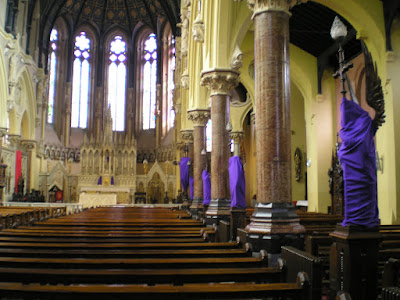
So runs one of the most famous hymns of the Corkonian faith and the Easter Vacation brought me back within the sound of Shandon bells. I thought it would be interesting to take a look at the Lenten preparations in some of the Churches in the centre of Cork City. As you would expect, most of them have retained the loss of the striking symbolism of veiling statues from after the second last Sunday of Lent (Passion Sunday). However, there are signs of a change in the air.

Cork, of course, led the way in the restoration of the Latin Mass with a daily Mass, albeit very discreetly, long before the election of Pope Benedict XVI. Today, the City boasts not only the Sunday Mass in Ss. Peter and Paul's but even a daily Mass during Lent supplemented by Tenebrae each of the three days of the Triduum and the full Holy Week Ceremonies.

However, it is more interesting to see the veils assumed in two other Churches in the City. The Dominicans of Pope's Quay also had the Office of Tenebrae, partly in Latin, with the hearse of fifteen candles left in the centre of the Sanctuary. They also veiled the Altar Cross. This beautiful Church is one of the first that I meet as I come into the City. It contains the tablet: "The Dominican community of Cork inscribe this stone in testimony of their gratitude to Kearns Deane Esq., architect, who with unexampled generosity and public spirit designed this building and directed the progress of its erection, 1832.” The consecration in October 1839 was attended by Daniel O'Connell, barrister and statesman, who had spearheaded the campaign for Catholic Emancipation only ten days before. The crisp ionic portico stands in contrast to the high gothic flourish of the Capuchin Holy Trinity Church on the South Channel of the Lee.


The Franciscans on Liberty Street may have built in the Byzantine style but they veiled the crosses of both the high altar and side altars very much in the Roman manner this year. The Church has the greatest area of mosaics of any church in Europe outside of Rome. The central dome has the feel of Hagia Sophia in Istanbul. The Church is famous for the gifts of wedding rings by the women of Cork for the tabernacle.


Finally, I took some shots of Ss. Peter and Paul's. The gorgeous Gothic Church hidden away behind Patrick's Street is the first collaboration of George Ashlin and Edward Pugin.


[Feel free to use these images but please credit this blog and give proper reference to the locations - Convenor]

Wednesday, 31 March 2010

Tenebrae

Up until the Easter Triduum, the texts of the Masses and Offices of Holy Week are not noticably different from those of the rest of Lent. However, it has long been a custom to celebrate the early morning Offices of Matins and Lauds of the Wednesday, Thursday and Friday of Holy Week on the afternoon before. Those Offices are known as Tenebrae or Darkness.

They seem to be a wake for the three days that Our Lord spent in the tomb. They evoke in the Christian something of the anguish of that first Holy Week, filled with betrayal and confusion. As the psalms are completed, the 15 candles are extinguished, one by one, until only a single candle remains. This candle represents Christ. It is taken down while the congregation makes a thunderous noise in remberance of the moment of Christ's death. The loss of these evocative ceremonies in the Ordinary Form of the Roman Rite, or at least their loss throughout the greater part of the Church, is one of the greatest losses to the Christian Faithful in the recent reform of the Roman Liturgy.


Our first clip is of Tomas Luis de Victoria's setting of the Offices of Holy Week. It is the most familiar polyphonic setting of Tenebrae, perhaps because of the completeness of the text, which was first published in 1585. As a composer of the Tridentine era, the emphasis he gives to the text, in combination with the musical setting, is striking and one of the keys to the impact of his composition. Victoria kept strictly to the text in terms of repetitions and draws out, by means of colour and number of voices, the meaning and the proper impact of the words.


The second clip is the second responsory after the second lesson of the second nocturn in the 1680 composition of Marc-Antoine Charpentier of the Office of Holy Thursday for use at the Abbaye-aux-Bois. While the presentation of the libretto, the text of the Office, still has a directness, we can sense that, a century later than Victoria, the need for mere display in terms of music has already begun to appear, even while the composer must still bow to the requirements of the liturgical text.


The third clip is part of Francois Couperin's 1714 setting of one of the Lessons of the Office of Spy Wednesday for use in the Abbey of Longchamps. In contradistinction to the first two clips, which are austere and relatively simple and direct in sound, Couperin's composition is more florid and senuous. This reflects the change from a Renaissance to a Baroque style. The text of the Lamentations of Jeremiah deplore the destruction of Jerusalem, a symbol of the betrayal, abandonment and Crucifixion of Christ.


Finally, we have two clips of the service itself from Blackfriars in Oxford. The service is performed by Dominicans who, in the first clip sing the preces on Maunda Thursday and, in the second clip sing two responsories of Matins and then the Benedictus of Lauds. You will see the hearse of candles in the centre of the Sanctuary. For those who might question the cantors having their backs to the Tabernacle in the second clip, the Blessed Sacrament has been removed to the Altar of Repose.


Mother of Sorrows, pray for us!

Saturday, 27 March 2010

Mount Melleray Retreat

Members of St. Conleth's Catholic Heritage Association made a retreat in Mount Melleray Abbey again this year. The theme chosen for the retreat was Lectio Divina, to take account of the fact that the Cistercian Abbey where the retreat was being held follows the Rule of St. Benedict (Chapter 48), which gives Lectio Divina an important place in its rule of life, along with Liturgical Prayer and manual labour. Mount Melleray Abbey is situated in the lea of the Knockmealdown Mountains, just to the north of Cappoquin, Co. Waterford. It has been the home of monks of the Strict Observance of the Cistercian Order, known as Trappists, since 1832. The foundation stone of the Monastery was laid on St. Bernard's Day, 20th August, 1833.


"First the tower, austere and massive, gleaming white against the sun,
With its crown of brazen crosses all aflame,
Rose above the circling pine-woods; then the gables, one by one,
To the field of my delighted vision came."

"Now the whole monastic city lay unshrouded to my view,
As a picture on a screen in spendour thrown,
Every snowy arch and angle pointing upward to the blue,
An ecstatic Benedicite in stone."

"Earth's cocoon of light and air,
Wondering Angels peering through,
Find reflections here and there,
Of their home beyond the Blue."


The Abbey Church is in Gothic style and cruciform in plan. Although extended, it follows mainly the lines of the original chapel built by the first community of Cistercian monks. The foundation stone for the new Church was laid by his Eminence John Cardinal McRory on the occasion of the centenary celebration. The Public Church and Monastic Church are the main elements of the magnificent Church-building project undertaken under Dom Celsus O'Connell, O.C.S.O., seventh Lord Abbot of Mount Melleray. The foundation stones were laid on 17th April, 1933, only twelve days after Dom Celsus was elected at Lord Abbot and a few months before the Abbey celebrated its centenary. The Monastic Church, the Church where the monks of Mount Melleray Abbey celebrate the Divine Office every day, was completed and solemnly blessed in November, 1940, but it wasn't until August of 1952, the 120th Anniversary of Mount Melleray, that the Church was solemnly consecrated. Prominent in the monastic Church, as is the custom in all Cistercian churches, was a massive crucifix suspended over the nave and containing relics of St. Bernard and many Irish saints, now, unhappily, removed. The smaller suspended crucifix in the Public Church remains.

The east window seen below is the work of the Harry Clarke studio. The central panel represents Christ the King crowning Our Lady Assumed into Heaven. Each evening at the Office of Compline the lights of the Church are extinguished and, according to Cistercian tradition, the figure of Our Lady is illuminated for the singing of the Salve Regina. To the right of the central panel are St. Catherine of Alexandria and St. Carthage of Lismore, patron of the Diocese of Waterford and Lismore, where Mount Melleray is found, and to the far right are St. Robert, one of the three founders of the Cistercian Order, and St. Patrick of Ireland. To the left of the central panel are St. Brigid of Kildare and St. Columba and to the far left are St. Bernard of Clairvaux, Doctor of the Church and the father of Cistercian monasticism, and St. Malachy of Armagh, who invited St. Bernard to send Cistercian monks to make their first foundation in Ireland.


"...that marvellous melody in whose haunting cadence all the immortal aspirations and emotions of humanity seem to struggle for expression..."

The Consecration of the Monastic Church was carried out by the Ordinary of the Diocese, Bishop Coholan of Waterford and Lismore beginning at 8 a.m. on 20th. The Public Church was consecrated contemporaneously, with Dom Benignus Hickey, O.C.S.O., Abbot of New Mellifont, consecrating the High Altar. During the consecration festival from 20th August to 29th August, 1952, well over 100,000 people visited Mount Melleray, an echo, surely, of the great occasion that was the consecration of the first Cistercian Church in Ireland, at Mellifont in Co. Louth. Mellifont Abbey was founded in 1142, with St. Christian Ó Connarchy as first Abbot. The consecration of the Church, the largest in Ireland at the time, was attended in state by the High King, Murtach Ó Loughlin, together with the flower of the nobility, including MacMurrough, as yet "guiltless of his country's blood." St. Christian, by this time Bishop of Lismore and Papal Legate, presided at the consecration, another direct link, through the Diocese of Waterford and Lismore, to the Abbey at Mount Melleray. Gelasius, Archbishop of Armagh, was principal consecrator, assisted by 17 Bishops.


At Mount Melleray in 1952, the Abbot General of the Cistercians of the Strict Observance, Dom Gabriel Sortais, was liturgically received on the morning of 20th August and His Excellency, the President of Ireland, Séan T. Ó Ceallaigh and Mrs. Ó Ceallaigh were given a liturgical reception that evening. From noon on Thursday, 21st, until Friday, 29th, the law of enclosure was suspended to permit ladies to enter the precincts of the Monastery. On 21st August, the Apostolic Nuncio to Ireland, Archbishop O'Hara, sang Pontifical Mass. On Sunday, 24th, Dom Celsus O'Connell, Lord Abbot of Mount Melleray celebrated Pontifical High Mass in the open air next to the Public Church. On the final day of the festival, Pontifical Vespers in the open air were followed by Benediction and a procession of the Blessed Sacrament through the grounds of the Monastery and was brought back to the High Altar of the Monastic Church for the Office of Compline. The conclusion of the festival was the turning of the key in the lock of the enclosure by the Lord Abbot.


During the course of the retreat conferences, Father McCarthy said that all Catholics should take the words of Pope Benedict XVI seriously when he said: "I would like in particular to recall and recommend the ancient tradition of Lectio divina: the diligent reading of Sacred Scripture accompanied by prayer brings about that intimate dialogue in which the person reading hears God who is speaking, and in praying, responds to him with trusting openness of heart. If it is effectively promoted, this practice will bring to the Church - I am convinced of it - a new spiritual springtime." He said that the starting point for any Lectio divina was the Divinity of Christ. He added that the aim was not to obtain some kind of personal magisterium on the meaning of S. Scripture but rather to converse with God.


Fr. McCarthy introduced the retreatants to the words of Guigo II, the twelfth-century prior of Grande Chartreuse, and spoke about the four elements of Lectio divina: Lectio, to read the Scriptures; Meditatio, to meditate upon them and to settle upon some element that strikes one particularly; Oratio, to pray, the intimate dialogue of which the Pope speaks; and Contemplatio, to contemplate upon all the elements.


Each day was begun with Mass in the Gregorian Rite and concluded with devotions and Benediction of the Blessed Sacrament in the traditional manner. The retreat began on the feast of the Annunciation, carried on through the feast of the Seven Sorrows of Our Lady, and concluded on the Saturday of Passion Week.


The Abbey Guest House accommodated the retreatants throughout and gave direct access to the Public Church, dedicated to the Assumption of Our Lady and Saint Philomena. It was once the National Shrine to Saint Philomena, although her statue was removed when her name was removed from the Roman Calendar. The Guest House formed part of the older monastery complex.


The interior of the Public Church has five bays consisting of aisles on either side and double lancets above. The Sanctuary is decorated in mosaic, both in nave and aisles. The walls surrounding the side aisles being decorated with adoring Angels. The walls of the Sanctuary having the instruments of the Passion in quatrefoils on the lateral walls, the east wall having the Sacred Heart represented to the Gospel side of the east window and St. Joseph to the Epistle side, each having the appropriate monogram in the quatrefoil beneath.


Perhaps one of the most interesting of all sights in Mount Melleray is the Miraculous Bin which is kept in the farm-yard near the Monastery garden. A long wooden structure about 3 metres long by 1 1/2 metres wide by 1 metre deep, it is regarded the greatest wonder of Mount Melleray. On the cover of the bin is a small notice which tells the story as follows: "DURING THE FAMINE OF 1840, THE COMMUNITY AND MORE THAN SEVENTY POOR PEOPLE WERE FED DAILY WITH MEAL STORED IN THE BIN. AFTER THREE MONTHS THE SUPPLY WAS FOUND UNDIMINISHED." The story is one well known to visitors to Mount Melleray. The then Lord Abbot, Dom Vincent Ryan, left instructions that nobody was to be turned away from the monastery hungry during his absence, which was to last three months, beginning just after Easter. The stock of Indian meal in the bin was found to be undiminished upon his return, although the daily measure required for 100 monks and the more than 70 poor people was taken from it each day. Dom Vincent's written and signed statement attesting to the incident is still extant: "Who will not here admire and praise the wonderful dispensation of Divine Providence. A poor and numerous community of religious men, located on the side of a barren mountain, improvided with funds, resources, or human means necessary to support existence, labouring incessantly in the arduous and painful enterprise of reclaiming its stubborn and neglected soil, depending on the casual charity of humane friends, are thus enabled, I will presume to say miraculously, not only to maintain their own existence, but to feed and preserve the lives of nearly five thousand of their fellow creatures during a period of no ordinary calamity and distress!"


The east window of the Public Church is in two levels, above, in the central panel is Our Lady assumed into Heaven flanked by Angels, while below are, from left to right, St. Brigid, St. Malachy of Armagh (who introduced the Cistercian Order to Ireland), St. Bernard of Clairvaux, friend of St. Malachy, greeting him, and St. Patrick. This is a window of old associations. Mention of St. Malachy and St. Bernard draws the mind back to Mellifont and the first Irish foundation of the Cistercians. The seven main panels of this window were originally in the east window of the old Monastic Church.


To the East of the Monastic Church is 'God's Acre,' the monks' grave-yard, where generations of Cistercians lie. The three High Crosses in the foreground (and another two in the distance) mark the graves of the Lords Abbot of Mount Melleray.


"To my ears as thus I pondered came the sweet and soothing sounds,
Of the Abbey chime, from workshop and from cell,
From the field and from the forest, from the grange's distant bounds,
Calling all to choir, for that's the Office Bell."

If you would like to explore a monastic vocation in Mount Melleray Abbey, the Novice Master of Mount Melleray Abbey can be contacted by letter at:

Revd. Novice Master, O.C.S.O.,
Mount Melleray Abbey,
Cappoquin,
Co. Waterford,
Ireland.

Or by 'phone at:

+353 58 54404

Or by e-mail by clicking here.

Thursday, 25 March 2010

The Annunciation - the Waffle day

The day of the annunciation is the feast day that commemorates the Virgin Mary finding out from the angel that she is going to have a Son - the Son of God. This day falls, in most reasonably religious countries, on the 25th of March; in Sweden, however, it falls on the Sunday between the 22nd and the 28th of March - like so many other holidays in Sweden it is celebrated on the nearest weekend. One might say, if one is feeling sinister, that the Swedes like to save religious feasts for the weekends, keeping that sort of thing out of their every day life. One might not even be completely wrong in saying so.

In Sweden, the Holy Virgin's Annunciation Day or Marie Bebådelsedag is usually called Våffeldagen (Waffle day). The reason is, according to some, a sort of vulgarisation of the term Vår fru dagen (literally day of Our Lady). This has the good result that Swedish people mark the Annunciation Day by eating waffles. Most do not really do it to honour the Holy Virgin anymore but it is another way that Swedish customs deliciously keep religious festivals alive. Frasvåfflor, the kind of crispy waffles that are eaten in Sweden are crisp (as you'd expect) and eaten with sweet things like jam and cream. Sometimes this will include lingonberries or cloudberries or other berries that will start to appear with the start of Spring. They can also be served with lemon juice and sugar just like Irish Pancake Tuesday pancakes.

At one level, the Swedish waffle is like the pancake of Shrove Tuesday. It is the occasion when we traditionally would have finished the winter chores and begin the spring/summer with waffles. Incidentally, the Swedish, Irish and English words for pancake are almost identical... just one more Swedish contribution to world culture ;-)

In English, the feast is called Lady Day and was one of the 'quarter days' of the English Calendar. The reason that it is Lady Day (like Lady Chapel) and not Lady's Day is because it is in the old genitive form that no longer exists in modern English.

So, in the Gloucester Chronicle it reads: "Bituene vur leuedi day þe late misselmasse day, Þis folc bisette kaunterbury" and even in the Norwich Chronicle they seem to be a bit like the Swedish: "If our lady day falle on yt moneday yan ye forseid eleccion shal be holden ye werkday þan next folwyng" but then you also have examples like the Chronicle of Nottingham where they use the name Annunciation: "at ye Anounsiacion of oure Lady and Mechelmes". I like Middle English. It makes my spelling look good!

In fact, the Annunciation was the first day of the year in several senses. In the religious sense it is the moment when the Redemption began. In the 'secular' world, it was actually the first day in England up until the time when the calendar of Pope Gregory XIII took over from the Julian Calendar. Some countries still have their tax year beginning around the start of April as a vestige of this and where the quarter days are still used they reflect a calendar year that begins at the end of March. In Tess of the d'Urbervilles it is mentioned as the day when the workers hired at Candlemas move on to their next job.

In Des Hannon's post last year we learned that the Irish call it the Feast Day of Mary in Spring or Lá Fhéile Muire san Earrach.

Tuesday, 23 March 2010

List of Speakers for Fota III

We have been asked by St. Colman's Society for Catholic Liturgy to post the following. We do so with great pleasure:

St. Colman’s Society for Catholic Liturgy is pleased to announce the provisional list of speakers for its third International Liturgy Conference which will be held from 10-12 July 2010. The subject of the Conference is Benedict XVI and Sacred Music.

Further information and registration enquiries should be sent to colman.liturgy@yahoo.co.uk

The Conference will be chaired by Professor D. Vincent Twomey, S.V.D., member of the Ratzinger Schulerkreis, Sursum corda: An Introduction to Ratzinger's Theology of Sacred Music

1. Dr. Andreas Andreopoulos, Unversity of Lampeter, Wales, Music in the Orthodox Liturgy

2. Fr. Sven Leo Conrad of the Fraternity of St. Peter, Germany, Joseph Ratzinger and Johannes Overath: the intellectual connection

3. Don Alberto Domini, professor of Sacred Music at the seminary of Brescia, Italy, Gregorian Chant in the Liturgy according to the mind of Joseph Ratzinger-Benedict XVI

4. Thomas Lacôte of the Conservatoire de Paris, France, Liturgical texts, rites and symbols and contemporary musical creation: an example for the Feast of the Dedication of a Church

5. Fr. Uwe Michael Lang, Cong. Orat., consultor to the office of Pontifical Ceremonies, Rome
Defining Criteria for Sacred Music: from Benedict XIV to Benedict XVI

6. Frank Lawrence of the Department of Music, University College Dublin, Ireland
The Spirit of the Liturgy: Gregorian Chant as mystagogy and exegesis.

7. Kerry McCarthy of Duke University, USA, Listening to William Byrd

8. James McMillan, composer, Scotland, Spirit of the Liturgy: rejoice in tradition and embrace the future.

9. Ite O’Donovan, directress of the Lassus Scholars, Dublin, Ireland, Choral music in the celebration of the Liturgy, a musical heritage of inestimable value, a tradition to be fostered and protected...

10. Fr. Stéphane Quessard of the diocese of Bourges, France, Towards a Renewal of Sacred Music

11. Rev. Samuel F. Weber, O.S.B., founder of theInstitute of Sacred Music, Archdiocese of Saint Louis, U. S.A., Pope Benedict XVI on the Psalms in the Liturgy

Monday, 22 March 2010

Solemn High Mass for the Holy Father’s intentions


We have just been asked to post the following text, which we do with great pleasure.

“St. Colman’s Society for Catholic Liturgy will hold its annual Solemn High Mass, for the Holy Father’s intentions, on Easter Tuesday, 6 April 2010, at Sts. Peter and Paul’s, Cork City, at 11 am.

The proper texts for the Mass will sung in Gregorian by members of the Lassus Scholars, Dublin, under the direction of Miss Ite O’Donovan. The ordinary of the Mass will Orlando de Lassus’ Missa Paschalis with motets for the Easter season. C.M. Widor’s Toccata will also figure among the organ pieces.

Members of St. Colman’s Society are encouraged to attend this Mass which is also open to the general public.

The Society wishes to thank Fr. Patrick McCarthy, Parish Priest of Sts Peter and Paul’s, for having made the use of the church available for this Mass for the Holy Father’s intentions”.

St. Colman Mac Lenine pray for us!

Saturday, 20 March 2010

Saint Lachteen and the Boggera Mountains

In a previous post I wrote about the sights and sites of the valley between the Boggera Mountains and the Nagles Mountains through which the Martin River flows south to Blarney and the Clyda River flows north through Mourne Abbey towards Mallow.

In this post I'd like to take you on a visit to one of the valleys of the Boggera Mountains to the north and west of Blarney. The Martin River meets the River Shournagh at St. Ann's just west of Blarney and shortly thereafter their mingled waters join the River Lee near Ballincollig. One branch of the old Muskerry Railway (1893-1934) used to follow the line of the River Souragh to Donoughmore and it is effectively in the traces of that line, going upstream from Blarney, that I am going to take you today.

Just north of where the Shournagh flows through St. Ann's, it passes through the townland of Loughane West, the site of the old Parish Church of Matehy. I don't mean the present St. Joseph's. One story of this site relates to the long era of the Penal Laws, when Catholicism was illegal and persecuted. As the Priest was celebrating Mass, a soldier entered and, before any of the congregation could react, drew his sword and cut off the Priest's arms. He rushed out of the Church and rode away down the hill. The horse stumbled beneath him, threw him to the ground and he was killed. A companion buried him in the grave yard of Loughane. The following morning, the people found that the dead soldier had left the grave yard, crossed the River, mounted the hill and lay buried instead in the grave yard of the Church at Matehy.

Farther up the river about half a mile north of the village of Donoughmore is the site of St. Lachteen's Well. The Holy Well is said to have dried up and appeared instead at Ballyglass near Lyradane because a woman once washed her clothes in it. The original well was the site where St. Lachteen preached to the people of the area, using the dripping waters of the well to illustrate the dropping down of God's mercy. The Corkman Lachteen had been directed by his guardian angel, Uriel, to the monastic school of St. Comgall at Bangor, where he studied for the Priesthood. The Saint lived near Donoughmore at the beginning of the 7th century. His pattern day is 19 March, on account of which the present well is known interchangably as St. Joseph's Well or Tobar Laichtin. The unfortunate modern Parish Church at Stuake is named for St. Lachteen. Built in the 1990s, it replaced a beautiful Church from the 1830s. It is certainly my least favourite Church in the County.

St. Lachteen also founded another monastery at Kilnamartyra about 8 miles to the west, set between the Sullane and Toone Rivers. Cill na Martra is actually the Church of the Relic, referring to St. Lachteen's hand was venerated. The 12th century 'shrine' or reliquary of his hand, Lámh Lachtaín, was kept locally by the Healy family until the 19th century, when it was sold and came to the Museum of the Royal Irish Academy in Dublin and I think it's now in the National Museum of Ireland. As you can see, it is in the form of an arm with a fist, which is very worn on account of the custom of taking oaths on it. The beautiful old Church of Kilnamartyra (1839) is also dedicated to St. Lachteen.


Passing on through Gowlane Cross, you pass Uctough Mountain, which is the source of the River Shournagh. Next it passes through a very wide moorland, which is probably about 1,000 feet above sea level and as the road turns west to Nad, on the north face of the Boggeras, it passes the great Bweeng Mountain. The River Nad becomes the River Glen and, at Fr. Murphy's Bridge, you suddenly leave the mountains and enter the broad valley of the River Blackwater that sweeps eastward towards Mallow and Fermoy, then on to Lismore and Cappoquin, before turning sharply south and into the ocean at Youghal.

Pastoral Letter to the Catholics of Ireland


Yesterday, 19th March, the Holy Father issued a Pastoral Letter to the Catholics of Ireland. It concluded as follows: "I wish to conclude this Letter with a special Prayer for the Church in Ireland, which I send to you with the care of a father for his children and with the affection of a fellow Christian, scandalized and hurt by what has occurred in our beloved Church. As you make use of this prayer in your families, parishes and communities, may the Blessed Virgin Mary protect and guide each of you to a closer union with her Son, crucified and risen. With great affection and unswerving confidence in God’s promises, I cordially impart to all of you my Apostolic Blessing as a pledge of strength and peace in the Lord."

Prayer for the Church in Ireland

God of our fathers,
renew us in the faith which is our life and salvation,
the hope which promises forgiveness and interior renewal,
the charity which purifies and opens our hearts
to love you, and in you, each of our brothers and sisters.

Lord Jesus Christ,
may the Church in Ireland renew her age-old commitment
to the education of our young people in the way of truth and goodness, holiness and generous service to society.

Holy Spirit, comforter, advocate and guide,
inspire a new springtime of holiness and apostolic zeal
for the Church in Ireland.

May our sorrow and our tears,
our sincere effort to redress past wrongs,
and our firm purpose of amendment
bear an abundant harvest of grace
for the deepening of the faith
in our families, parishes, schools and communities,
for the spiritual progress of Irish society,
and the growth of charity, justice, joy and peace
within the whole human family.

To you, Triune God,
confident in the loving protection of Mary,
Queen of Ireland, our Mother,
and of Saint Patrick, Saint Brigid and all the saints,
do we entrust ourselves, our children,
and the needs of the Church in Ireland.
Amen.
Pope Benedict XVI

Friday, 19 March 2010

Happy Feast Day Holy Father!

Today is the Feast of St. Joseph, Patron of the Universal Church, who is also the Heavenly Patron of Our Holy Father the Pope.


To thee, O Blessed Joseph, we have recourse in our tribulations, and while imploring the aid of thy most holy Spouse, we confidently invoke thy patronage also. By that love which united thee to the Immaculate Virgin, Mother of God, and by the fatherly affection with which thou didst embrace the Infant Jesus, we humbly beseech thee graciously to regard the inheritance which Jesus Christ purchased with His Blood and to help us in our necessities, by thy powerful intercession.

Protect, O most provident Guardian of the Holy Family, the chosen children of Jesus Christ; ward off from us, O most loving Father, all taint of error and corruption; graciously assist us from Heaven, O most power protector, in our struggle with the powers of darkness; and as thou didst once rescue the Child Jesus from imminent peril to His life, so now defend the Holy Church of God from the snares of her enemies and from all adversity.

Shield each one of us with thy unceasing patronage that, imitating thy example and sported by thy aid, we may be enabled to live a good life, die a holy death, and secure everlasting happiness in Heaven. Amen.
Pope Leo XIII

St. Joseph, Patron of the Universal Church, pray for us, pray for the Pope!

Wednesday, 17 March 2010

Hail, Glorious Saint Patrick!


Today, more than ever, Ireland needs the intercession of our glorious Apostle. His own successor is surrounded with controversy and his own children celebrate his feast without acknowledging his mission.


Oh come to our aid! In our battle take part!