Showing posts with label Back on the Rails. Show all posts

Tuesday, 1 December 2015

Back on the Rails VII - The Newmarket Branch Line

Since I'm back on the rails again after a long pause, I hope you won't mind if I take a break from the West Cork line to go north and follow a branch line that covered nearly 9 miles, crossing the River Dalua at Kanturk and down towards the River Blackwater where it meets the main line (still open) between Mallow and Millstreet at Banteer. The Newmarket to Banteer Branch Line was opened in 1889, built by local notables who had formed the Banteer and Newmarket Railway Company. After four years it was taken over by the Great Southern and Western Railway.

A daily service ran until 'the Emergency' when, in 1942, it suffered a temporary closure. Only a goods service recommenced in 1956 and was finally closed in 1963. A few Parliamentary Questions set the scene, in 1946, 1948, in 1954 and in 1956.

We are in the Barony of Duhallow, a land of poetry. It boasts some of the most poetic scenery and some of the most poetic placenames in all of Cork, Lyre and Nadd, Assolas and Knocknanuss.

I started my journey at Newmarket. The town was founded in 1620 by the Aldworth family, to whom it has been granted by James I upon the forfeiture by the MacAuliffes, as their market town.  What remains of the terminus station is a small red-brick building now part of 'the Railway Industrial Park.  It sits in a natural valley just below the town formed by a tributary stream of the River Dalua.  The railway follows the valley of this stream and then the River Dalua down to Kanturk.


St. Mary's Parish Church, Newmarket

The beautiful St. Mary's Church was a benefaction of the Aldworths, who gave both the site and a donation towards the building.  The original Altar was a copy of that of the ancient abbey of Quin.

Newmarket's most famous inhabitants are the Currans, the Philpot Currans, who gave eminent members to the Irish Bar and to Irish History, and whose family plot may be found in the Anglican cemetery here.  Sarah was the sweetheart of Robert Emmet, the darling of Éireann.  Her father, John Philpot Curran, was Master of the Rolls for Ireland, who faught the famous case of Fr. Neale prosecuting Viscount Doneraile at the Cork Assizes, which, since Doneraile had no railway, we may conveniently mention here.

Fr. Neale, the elderly Parish Priest of Doneraile, had condemned from the Altar the adulteries of a parishioner.  The parishioner's sister was mistress of St. Leger St. Leger (sic!), Baron and later Viscount Doneraile, who horsewhipped the Priest, safe in the knowledge that a Protestant jury (Catholic Emancipation was 49 years off in 1780) would never convict him.  However, he did not reckon with JPC, who exposed the falsity of the Viscount's witnesses and turned the jury toward's Fr. Neale's case with his eloquence.  The Viscount challenged JPC to a duel, one of five he is known to have fought.
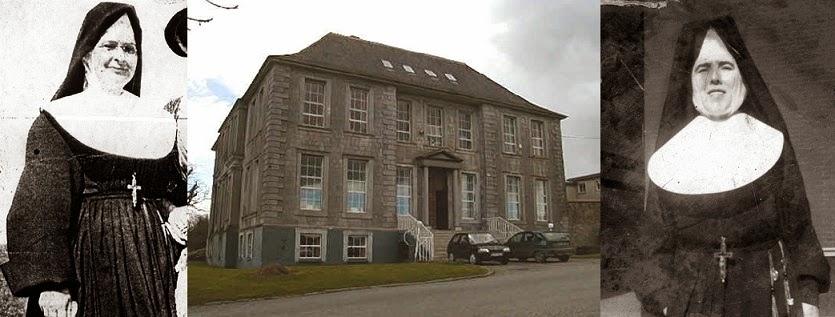

Sisters Aniceta and Petronella, Sisters of Saint Joseph, natives of nearby Meelin and the former St. Joseph's Convent

It's not too far to go to the O'Keefe Institute, built as Aldworth Court or Newmarket House in 1750.  In common with other great houses, it ceased to be a private residence in the 1920s and in 1927, the Sisters of St. Joseph, founded by St Mary of the Cross MacKillop, patroness of the recent Eucharistic Congress (and unofficially who are misunderstood in a good cause by their Priests).

The next stop, the only intermediate stop, on the Newmarket Branch Line is Kanturk.  As the confluence of the Rivers Allua and Dalua (Allow and Dallow, if you prefer) I will come back to Kanturk when I'm exploring the Blackwater and its tributaries.  Sufficing to say that there is a fine remnant of the railway station, if you know where to look on Percival Street below the Church, and the remnants of the bed of the line on either side of the road.

From Kanturk we follow the Railway along the line of the Dallua to where it flows into the Blackwater.  Finally, just crossing the Blackwater we reach the connection between the Branch and the Main Line at Banteer.  Banteer Station, on the main Dublin-Tralee Line, was opened in 1853 and continues as a passenger stop.

Near Banteer is Knocknaclashy, the site of the last open battle of the Confederate Wars.  I have already covered the execution of Bishop Boetius MacEgan in May, 1650.  A year later, in July, 1651, as the forces of the Catholic Confederation fell back behind the Shannon Donagh MacCarthy, Viscount Muskerry and later Earl of Clancarthy, held the last outpost in his native lands.  His forces moved from Killarney towards Mallow in the direction of the stronghold of Limerick.  They were intercepted near Banteer by Broghill's Parliamentarian forces, who won the skirmish.  Lord Muskerry's forces fell back upon Killarney.  From that point, the war was one of siege and the destruction of the Catholic Confederation assured. 

The final Catholic heritage point about Banteer is the dedication of the Church there to St. Fursey who was the son of a Munster Prince but was born in Galway and is best known for his missionary works in Britain, especially East Anglia.

Sunday, 7 September 2014

Back on the Rails Part V - Back Again

Gentle reader, I have undertaken several journeys of moment in the past few years: to the Bar, to the Altar, down the pleasant waters of the River Lee and along the Railways of Cork.  The last proved just too ambitious for me in the midst of the hurly-burly of the first two.  However, by some popular demand, I'm back on the rails again at last and looking forward (dare I even mention it?) to exploring the passage of the River Blackwater at some not too distant date.

Let me remind you, gentle reader, of my fundamental theory.  As I have said before, it is my own but, as with so many of the best ideas, not mine alone or even first.  It is found throughout the writings of Hilaire Belloc.  There is something about a river that delineates a landscape and forms the people and their history.  Follow the river and you will find the people and their history and what formed them both.

In his The Historic Thames Belloc says "Upon all these accounts a river, during the natural centuries which precede and follow the epochs of high civilisation, is as much more important than the road or the path as, let us say, a railway to-day is more important than a turnpike." He also addresses the significance of rivers to human civilization in The Path to Rome and Warfare in England, particularly the first chapter on strategic topography.

Let us return to the Railways.  At the outset of this series, I suggested that Railways, by respecting the topography and maintaining, albeit with increasing alacrity and greater mobility, traditional societies,  reflected and supported the traditional life of old Cork in a way that Motorways and National Road Networks just don't.

In the second part of this series, I looked at the nexus of the network - a greater network that you find today even in Dublin - the beautiful City of Cork.  In the third part, I moved out of the City to the South West and in the fourth part I passed Innishannon along the Bandon line.  You can see the stately pace of history in this Railway journey.  The doors close, the whistle sounds, the green flag waves and we're off again...

Saturday, 17 December 2011

Back on the Rails IV - The Bandon Line

After the Chetwynd Viaduct, the line of the Cork, Bandon and South Coast railway continues westwards to the townland of Waterfall or Tobar an Iarla in Irish, literally Well of the Earl. The Earl in question could have been one of the McCarthy, Eóganacht Lords of Muskerry. Donal MacCarthaigh Mór was created Earl of Glencar by Elizabeth Tudor in 1565 but the title was extinguished with him. Donough MacCarthaigh Mór, Viscount Muskerry, was created Earl of Clancarthy by Charles II. I have posted before about the Catholic zeal of the family in founding Kilcrea Abbey, in defending the Catholic Confederacy at Carrigadroichead, and supporting the Catholic King James II at Bandon.

A large number of physical remnants of the railway line remain. I took photos of an embankment and a railway bridge South of Waterfall. The next station is Ballinhassig or Béal Átha an Chasaigh in Irish, literally the mouth of the ford of the turn. The turn in question being the reverse of a small English force by a force led by Florence MacCarthaigh in 1610. Nine years earlier the Lord Deputy Mountjoy camped here with his forces before the Battle of Kinsale. Between Ballinhassig and Innishannon there is a branch line junction for Kinsale.


Beyond Ballinhassig at Gogginshill the railway enters a long hilltop tunnell, now disused. I wasn't able to get near the tunnel, which is now on private land, but pictures are available here. I did visit the Church of the Most Holy Heart of Mary at Gogginshill.


An excellent example of the elevated and picturesque line that the railway now follows is the Halfway Viaduct that stands above the small village that sat half-way between Cork and Bandon (before the City extended to the South and West).


I want to end this stage of my survey with the Upton/Innishannon Station. It is the fourth station from Albert Quay on the main line of the railway. It is an excellent example of such stations. At the entrance to the property containing the station is the monument to the three men of the IRA who died in the Upton Train Ambush, which happened on 15th February, 1921, as part of the Irish War of Independence. The monument reads:

Fuaireadar bás ar son
Phoblacht na hÉireann
SÉAN Ó FAOLÁIN
Captaen 22 bl
PARTHOLAN Ó TÁILBHE
Saor Óglach 22 bl
PÁDRAIG Ó SUILLEABHÁIN
Leas-Chaptaen 35 bl
Ba leis an gCuigú Chath
Treas Bhriogáid Chorcaí I.R.A. iad
Maraíodh iad san troid ar an 15.2.1921
Ar dheis Dé go raibh a h-anamacha


That is in English:

There died for
The Irish Republic
SÉAN Ó FAOLÁIN
Captain aged 22 years
PARTHOLAN Ó TÁILBHE
Free Volunteer aged 22 years
PÁDRAIG Ó SUILLEABHÁIN
Vice-Captain aged 35 years
Of the Fifth Battalion
Of the Third Cork Brigade
They died in action on 15.2.1921
May their souls be at the right hand of God


On the hill overlooking the station is the Brothers of Charity premises at Upton, a place that has its share of infamy. One claim to fame is that the eldest brother of Little Nellie of Holy God (her picture below) was placed here in 1907 when their mother died. Their father, a soldier on Spike Island in Cork Harbour, was unable to take care of them and all four children were placed in Industrial Schools. Her eldest brother Thomas was sent to Upton, her brother David went to the Sisters of Mercy at Passage West, while Nellie and her elder sister Mary were sent to St. Finbarr's Industrial School of the Sisters of the Good Shepherd at Sunday's Well, Cork City. Little Nellie is rightly revered by the people of Cork and beyond but I often wonder what happened to her siblings. They seem to have slipped quickly into the shadows of obscurity that surrounded so many of the unfortunate children who were sent to these institutions.


Little Nellie of Holy God (1903-1908)
Little Violet of the Holy Eucharist


Saturday, 29 October 2011

Back on the Rails III - The Cork, Bandon and South Coast Railway


Having looked at the Albert Quay Terminus in the last post, I want to look at the sites and sights of the Cork, Bandon and South Coast Railway in this. In fact, part of this line was one of Ireland's first railways, befitting the 'real' capital and, at the time, Ireland's most populous County. It is also the longest of the lines that I'm exploring, so I'm going to cover it in stages. Firstly, the line runs through the suburbs of the city.


From the Albert Quay Terminus the railway travelled along the line of what has now become the South City Link Road. Termus and line begin in the South Parish, one of the two Catholic Parishes of Cork in the early modern period. In fact, the South Chapel is the oldest Church in the City and a rare survival from the period of the Penal Laws when Catholic Church building was technically illegal. The poverty of the construction can be seen from the way that limestone and sandstone are used almost indifferently as they came to hand.

In 1808, the Bishop of Cork, Dr. Moylan was able to open a second Church to the North of the River Lee (already featured on this blog for the Corpus Christi Procession), only the second in the city, giving to the two chapels, as Catholic houses were diminutively and dismissively known by the Anglican ruling class, the titles of 'South Chapel' and 'North Chapel' respectively. Later ages would christen them the 'South Parish Church' and the 'North Cathedral' but they were always known to me by their earlier titles.


Standing on Dunbar Street outside the South Chapel you can see three monuments to our Catholic heritage. Looking North you see the Capuchin Friary, home of the great Father Mathew. To the West is the tower of the Red Abbey of the Augustinian Canons, the last medieval building in Cork.


To the South are the buildings of the South Presentation Convent (there is also a North Presentation Convent across the road from the North Chapel), the first foundation of Nano Nagle and the Presentation Sisters, one of the largest of the Irish Orders of Nuns, another gift of Bishop Moylan to the City. Nano Nagle is buried in the grounds of the Convent that is still, thank God, occupied by the Nuns.


As the City expanded the South Parish became so large that it was necessary to divide it in two by creating the new Parish of Turner's Cross. Continuing south along the line of the old Cork, Bandon and South Coast railway, now the line of the South City Link Road, we pass the famous modernist Church of Christ the King at Turner's Cross, dedicated just a few years after Pope Pius XI created the feast of Christ the King. The Church is stunningly modern and abstract in style and construction but it should also be said that in its modernity it retains the traditional liturgical forms - Sanctuary/Nave - High Altar/Side Altars - Sanctuary Rails/Devotional Shrines - more perfectly than many traditional churches wreckovated since Vatican II. It's an interesting idea to imagine the steam locomotives puffing past Turner's Cross for more than 30 years.

The line next passes through the Parish of Ballyphehane. The Parish Church of the Assumption was one of the 'Rosary' Churches of the City that I looked at this time last year. Ballyphehane Parish includes Cork Airport, which is another reason why the destruction of the railway line wasn't just useless but also a waste of a great potential resource.

Between the City and the Airport the line turns West towards Chetwynd, where is climbs majestically towards Spur Hill. The last two images in this post are the small road bridge crossing the line at Chetwynd, just before the famous Chetwynd Viaduct that carries the line over the Bandon Road, and the viaduct itself, which is occasionally used for a variant of road bowl playing, the unique Cork sport. Mick Barry, still remembered in UCC in my time, was the first to pitch the iron bowl over the viaduct.

Saturday, 8 October 2011

Back on the Rails II - All Rails Lead To Cork

1832 Map of Cork City

1852 Map of Cork City

1872 Map of Cork City

1893 Map of Cork City


When work began on Dargan's Great Southern and Western Railway line from Dublin to Cork in 1844 Cork was the most populous as well as the largest County in Ireland. By the time it arrived in 1849, the devastation of the Great Famine had reduced it to second most populous after Dublin. Cork's first train ran from Ballinhassig to Bandon a few months earlier.

Over the next 20 years the Cork, Bandon and South West Railway (1845), the Cork, Blackrock and Passage Railway (1850), the Cork, Youghal and Queenstown Railway (1854), and the Cork and Macroom Direct Railway (1861) started to throw out routes from Cork City across the County. Lines from Mallow to Kerry and Limerick to the west and to Tipperary and Waterford to the east and the Cork and Muskerry Railway (1883) complete the network, which is slowly reasserting itself through the redevelopment of closed lines and the reopening of closed stations.

Dublin City was circled by railway termini, Broadstone near St. Mary of the Angels, Amiens Street near the Pro-Cathedral, Westland Row near St. Andrew's, Harcourt Street near Whitefriar Street, and Kingsbridge near St. Paul's.

Likewise, as you can see on the above maps, Cork City was gradually circled by up to six railway termini. The first, at Glanmire Road, near St. Patrick's, for the Cork, Youghal and Queenstown Railway, and later also for the Great Southern and Western Railway, Albert Quay near Holy Trinity for the Cork, Bandon and Southern Coast Railway, nearby Albert Street for the Cork, Blackrock and Passage Railway, Capwell the South Chapel for the Cork Macroom Direct Railway, and Western Road near the Franciscans in Liberty Street for the Cork and Muskerry Light Railway. In this post I'll look briefly at Albert Quay, Albert Road and Holy Trinity.

Albert Quay Terminus


Albert Quay was re-named in 1849 in honour of the Consort of Queen Victoria of England on the occasion of the same visit when Cobh was re-named Queenstown. Now known as MacSweeney Quay in honour of the Republican Lord Mayor of Cork, the Quay contains the City Hall re-built after the Burning of Cork by British Crown Forces in 1921, and the terminus of the Cork, Bandon and Southern Coast Railway, opened in 1861. The station was linked to the Glanmire Road terminus by trams that ran over the iron bridge that you can see in the pictures. Trains stopped running into Albert Quay in 1961.

Albert Road Terminus


Just around the corner from the Albert Quay terminus is the Albert Road terminus of the Cork, Blackrock and Passage Railway, which was formerly a little further to the East, as you can see in the 1852, 1872 and 1893 maps. The Albert Road terminus opened in 1873 but closed to trains in 1932. While the Albert Quay building looks to me very like Broadstone Station in Dublin, the Albert Road building looks like a mix between the building that is now the Railway History Society at Heuston Station and some of the 'blind' platform walls on St. John's Road at Heuston Station.

Holy Trinity Church


A few minutes walk down the river from Albert (MacSweeney) Quay is the Capuchin House in Cork where the famous Fr. Theobald Mathew (1790–1856), the Apostle of Temperance, lived and laboured. The Church, which you can see from in front of the Albert Quay terminus, in a very un-Capuchin flamboyant Gothic, is the memorial to Fr. Mathew. The original church was more simple and the soaring facade was added in 1899. Hogan's great statue to Fr. Mathew at the start of Patrick's Street was unveiled in his honour in 1864. Interestingly, the Cork statue portrays him in the kind of street clothes that he would have worn but the statue in Dublin's O'Connell Street has him in his Capuchin habit.