Showing posts with label Bishop Moylan. Show all posts

Saturday, 29 October 2011

Back on the Rails III - The Cork, Bandon and South Coast Railway


Having looked at the Albert Quay Terminus in the last post, I want to look at the sites and sights of the Cork, Bandon and South Coast Railway in this. In fact, part of this line was one of Ireland's first railways, befitting the 'real' capital and, at the time, Ireland's most populous County. It is also the longest of the lines that I'm exploring, so I'm going to cover it in stages. Firstly, the line runs through the suburbs of the city.


From the Albert Quay Terminus the railway travelled along the line of what has now become the South City Link Road. Termus and line begin in the South Parish, one of the two Catholic Parishes of Cork in the early modern period. In fact, the South Chapel is the oldest Church in the City and a rare survival from the period of the Penal Laws when Catholic Church building was technically illegal. The poverty of the construction can be seen from the way that limestone and sandstone are used almost indifferently as they came to hand.

In 1808, the Bishop of Cork, Dr. Moylan was able to open a second Church to the North of the River Lee (already featured on this blog for the Corpus Christi Procession), only the second in the city, giving to the two chapels, as Catholic houses were diminutively and dismissively known by the Anglican ruling class, the titles of 'South Chapel' and 'North Chapel' respectively. Later ages would christen them the 'South Parish Church' and the 'North Cathedral' but they were always known to me by their earlier titles.


Standing on Dunbar Street outside the South Chapel you can see three monuments to our Catholic heritage. Looking North you see the Capuchin Friary, home of the great Father Mathew. To the West is the tower of the Red Abbey of the Augustinian Canons, the last medieval building in Cork.


To the South are the buildings of the South Presentation Convent (there is also a North Presentation Convent across the road from the North Chapel), the first foundation of Nano Nagle and the Presentation Sisters, one of the largest of the Irish Orders of Nuns, another gift of Bishop Moylan to the City. Nano Nagle is buried in the grounds of the Convent that is still, thank God, occupied by the Nuns.


As the City expanded the South Parish became so large that it was necessary to divide it in two by creating the new Parish of Turner's Cross. Continuing south along the line of the old Cork, Bandon and South Coast railway, now the line of the South City Link Road, we pass the famous modernist Church of Christ the King at Turner's Cross, dedicated just a few years after Pope Pius XI created the feast of Christ the King. The Church is stunningly modern and abstract in style and construction but it should also be said that in its modernity it retains the traditional liturgical forms - Sanctuary/Nave - High Altar/Side Altars - Sanctuary Rails/Devotional Shrines - more perfectly than many traditional churches wreckovated since Vatican II. It's an interesting idea to imagine the steam locomotives puffing past Turner's Cross for more than 30 years.

The line next passes through the Parish of Ballyphehane. The Parish Church of the Assumption was one of the 'Rosary' Churches of the City that I looked at this time last year. Ballyphehane Parish includes Cork Airport, which is another reason why the destruction of the railway line wasn't just useless but also a waste of a great potential resource.

Between the City and the Airport the line turns West towards Chetwynd, where is climbs majestically towards Spur Hill. The last two images in this post are the small road bridge crossing the line at Chetwynd, just before the famous Chetwynd Viaduct that carries the line over the Bandon Road, and the viaduct itself, which is occasionally used for a variant of road bowl playing, the unique Cork sport. Mick Barry, still remembered in UCC in my time, was the first to pitch the iron bowl over the viaduct.

Friday, 31 December 2010

Father Prout

Today is the birthday of Francis Sylvester Mahony known as 'Father Prout'. With a nom de blog like mine, the thought came to me that I ought to make some tribute to the author of The Bells of Shandon. As it turned out, his story brings side-lights into many of the stories that I have already published.

The Catholic Encyclopedia gives a good biography upon which the authors of wikipedia have been unable to improve and which the Diocese of Cork and Ross has adopted in its entirity. The most notable points are that having studied with the Jesuits in Clongowes Wood, he spent a few years as a novice with them and became a teacher of rhetoric at his own school, the great Canon Sheehan being one of his pupils, but he was dismissed for leading some of the students on a drunken outing to Celbridge. He studied in a variety of Continental Seminaries and was ordained at Lucca in Italy in 1832, against all advice. He returned to his native Diocese, where he served as a zealous and hardworking hospital chaplain during a cholera epidemic, where he won the life-long friendship and admiration of Father Mathew, the Capuchin Temperance campaigner. Among the ecclesiastical misadventures of 'Father Prout' was to be the attempt to have Father Mathew made Bishop of Cork!

The misadventure that led to Father Mahony's leaving the Diocese - and the active Priesthood - was his campaign to be given the living of 'the brickfield chapel,' that was to become St. Patrick's Church on the Lower Glanmire Road, then a chapel-of-ease to the Cathedral Parish. Father Mahony had been the principal fundraiser for the building of the new Church, which, I think you'll agree, is a fine building, and a magnificent achievement that was virtually the first new Church built in the City in two generations. The disappointment of Father Mahony, who had proved himself apostolic and capable, was understandable, especially when met with the immovable object of Bishop Murphy (r. 1815 - 1847).

He moved to London and held his own amid the literary greats of the time, although his name is now 'writ in water.' We read in The Catholic Encyclopedia: "Dowered with a retentive memory, irrepressible humor, large powers of expression, and a strongly satiric turn of mind, an omnivorous reader, well-trained in the Latin classics, thoroughly at home in the French and Italian languages, and a ready writer of rhythmic verse in English, Latin, and French, he produced... an extraordinary mixture of erudition, fancy, and wit, such as is practically without precise parallel in contemporary literature. The best of his work appeared in "Fraser's Magazine" during the first three years of his literary life. He translated largely from Horace, and the poets of France and Italy, including a complete and free metrical rendering of Gresset's famous mocking poem "Vert-Vert" and Jerome Vida's "Silkworm". But his newspaper correspondence from Rome and Paris is notable chiefly for the vigours of his criticisms upon men and measures, expressed, as these were, in most caustic language."

The Catholic Encyclopedia is not noted for its forgiving tone towards renegades but it expresses itself generously towards Mahony: "Although for thirty years Mahony did not exercise his priestly duties, he never wavered in his deep loyalty to the church, recited his Office daily, and received the last sacraments at the hands of his old friend, Abbé Rogerson, who left abundant testimony of his excellent dispositions."

His roguish humour caused him to adopt the name of a certain Father Prout of Watergrasshill as his nom de plume.

The original Father Prout had been forced from his Diocese (Cashel) on account of a wrangle with Archbishop Butler over his refusal to agree to the amalgamation of his Parish, which he described as "the greatest injustice since the partition of Poland." Fortunately, he was welcomed into the neighbouring Diocese of Cork by Dr. Moylan.

Mahony's fictional Father Prout seems no less sanguine, although he claimed to be a French-educated parish priest, the son of Dean Swift and Stella, who writes works such as The Apology for Lent in scholarly praise of fish!

When he died on 18th May, 1866, as we have read, fortified by the rites of Holy Mother Church, his body was taken back to Cork for a Solemn Requiem Mass in St. Patrick's Church "the church which", in the words of his biographers, "was the dream of his impetuous youth," as his biography says, from where he was taken to his family vault in St. Ann's Churchyard, Shandon, to be buried in the shadow of the bells he immortalized.


The Reliques of Father Prout, is perhaps his most famous work and it is in that collection that his true claim to fame, The Bells of Shandon, is to be found as part of The Rogueries of Tom Moore.

In my opinion, it is the true anthem of Cork, although the words of The Banks and Beautiful City were handed out to every school child in the city by the Lord Mayor last year! The Bells has none of those shameless hussies pressing wild daisies and Beautiful City lifts "the sweet bells of Shandon were dear to my mind." I may stand on a Shandon Belle ticket in the next mayoral election!

The clip consists of that fine ecumenical anthem Iníon an Phailitínigh (a Kerry song, mind you) and a verse of The Bells sung by Seán Ó Sé, whose own voice is another contender to be the true anthem of Cork!

THE BELLS OF SHANDON

With deep affection
And recollection
I often think of
Those Shandon bells,
Whose sounds so wild would,
In the days of childhood,
Fling round my cradle
Their magic spells.
On this I ponder
Where'er I wander,
And thus grow fonder,
Sweet Cork, of thee ;
With thy bells of Shandon,
That sound so grand on
The pleasant waters
Of the river Lee.

I've heard bells chiming
Full many a clime in,
Tolling sublime in
Cathedral shrine,
While at a glibe rate
Brass tongues would vibrate —
But all their music
Spoke naught like thine ;
For memory dwelling
On each proud swelling
Of thy belfry knelling
Its bold notes free,
Made the bells of Shandon
Sound far more grand on
The pleasant waters
Of the river Lee.

I've heard bells tolling
Old "Adrian's Mole" in,
Their thunder rolling
From the Vatican,
And cymbals glorious
Swinging uproarious
In the gorgeous turrets
Of Notre Dame ;
But thy sounds were sweeter
Than the dome of Peter
Flings o'er the Tiber,
Pealing solemnly ; —
O! the bells of Shandon
Sound far more grand on
The pleasant waters
Of the river Lee.

There 's a bell in Moscow,
While on tower and kiosk o !
In Saint Sophia
The Turkman gets,
And loud in air
Calls men to prayer
From the tapering summit
Of tall minarets.
Such empty phantom
I freely grant them ;
But there is an anthem
More dear to me, —
'Tis the bells of Shandon
That sound so grand on
The pleasant waters
Of the river Lee.

Friday, 23 July 2010

The Scandalous Bishop of Cork

The Convenor has been showing off his knowledge of the Bishops of Cork but the most interesting of all is the scandalous Bishop John Butler, who was Bishop of Cork from 1763 to 1787.

The Butlers of Ormonde
John Butler came of the great Butlers of Ormonde, one of the greatest families in the kingdom of Ireland whose titles included a Dukedom, a Marquisate, four Earldoms and a Barony - the Barony was the problem. Under the pressure of the penal laws, members of each branch of the family were forced to 'conform' to the Protestant religion in order to save the family's property. For example, the famous Catholic family, the Butlers of Kilcash, Thomas Butler, who fought for the Jacobite cause, died in 1738. Whatever difficulties oppressed Catholics during life, special penalties were reserved for them at the passage of their estate to their heirs. Thus, Thomas' son, John, 'conformed' in 1739.
Father Butler
It was into this atmosphere of spiritual genocide that our John Butler was born in 1731. He was the third son of Edmond Butler, 8th Baron Dunboyne. While his two brothers, James and Pierce, joined the Wild Geese fighting with the Armies of the King of France, John pursued a vocation to the priesthood by studying at the Irish College in Rome from 1749. While there, he was not entirely passive - or well-behaved - and lost an eye in a duel. By reason of this defect, it required a special dispensation for him to be ordained, which he was on 20 December 1755 at the Lateran Basilica, which had newly acquired its Baroque façade and interior. He then studied at the College of Propaganda Fide, the great missionary college in Rome, and obtained his Doctorate in Divinity.

Father Butler returned to Ireland in 1758 where, under the penal laws, he was required to register as a Popish minister. He was examined before a Justice of the Peace in Whitehaven when he landed. If the Murphys ruled large parts of the Irish Church in the 19th cent., the Butlers held sway in the 18th. Father Murphy returned to his native Archdiocese of Cashel to serve as Parish Priest of Ardmayle, just north of Cashel, under his cousin, Archbishop James Butler. Christopher Butler had been Archbishop from 1712 to 1757, James succeeded him in 1757 and was succeeded by another James Butler in 1774. At his death in 1791, there had been an unbroken succession of Butler Archbishops for 71 years. During four years as a Parish Priest, Father Butler was also the Archbishop's Secretary and Archdeacon of the Archdiocese.

Bishop of Cork
When the Bishop of Cork died, Father Butler was placed dignissimus among the list of candidates submitted by Cardinal Spinelli, in one of his last acts as Prefect of the Propaganda Fide. The Congregation of Propaganda Fide was the Vatican Department of mission territories. Ireland (as well as Scotland, Canada and the United States) came under this Department of the Vatican until the Constitution of 29 June 1909. He was duly appointed Bishop of Cork on 16 April 1763 by Pope Clement XIII (the man who put the fig leaves on the statues of Rome) and he was consecrated the following June.

It is not hard to imagine that his time as Bishop was characterised by adherence to the status quo of the English Protestant ascendency. His Statuta synodalia pro dioecesi Corcagiensi in 1768 made membership of the Whiteboys, the geurilla fighters against the Protestant penal régime, a reserved sin. In 1771, he managed to prevent the introduction of the Ursuline Nuns to Cork by Nano Nagle - a felix culpa that was to see his successor, Bishop Moylan, preside over the foundation of the Presentation Sisters. The Ursulines don't seem to have been the only Order that didn't find Bishop Butler too helpful. The Carmelites of Kinsale had to endure repeated attempts by him to take over their Chapel as a Parish Church. When he couldn't succeed by other means, he withdrew their faculties to hear confessions and administer the Sacraments. Their appeal to Rome was supported by Fr. O'Mahony, the Parish Priest, who declared that the Chapel and Friary were built and owned by the Carmelite Order. Such incidents didn't bode well for the scandalous Bishop of Cork.

The Barons Dunboyne
Bishop Butler's father had died in 1732 and his brother James became the 9th Baron Dunboyne. James died in 1768 and their brother Pierce became 10th Baron. Pierce died in 1773 and his son, also Pierce, became 11th Baron, until his death in 1785. On the death of his nephew Pierce, Bishop Butler became 12th Baron Dunboyne.

This is where the scandal begins and it is the point at which I stop understanding the train of events - or the train of logic of the Bishop. Lord Dunboyne fears for the extinction of his family - he has, after all, outlived his father, brothers, and nephews. In order to preserve his line, he is anxious to have heirs, legitimate heirs, in which the small matter of a vow of celibacy is an obstacle. Thus, he resigns as Bishop of Cork and seeks a dispensation from his vow of celibacy from Pope Pius VI in order to marry and beget heirs to the title. "It is no pleasure for me after a life of celibacy, to share my bed and board," wrote the Reverend Lord Dunboyne. However, when he died in 1800, he was succeeded by a cousin, a nephew of Archbishop James Butler. It may have struck Pope Pius (and it strikes me) was it really necessary for him to marry? Couldn't the cousin have inherited just as well from a Bishop as from a Lord?

The Catholic Dunboynes had been, until that time, merely de facto Barons, since their Letters Patent couldn't be issued until they 'conformed.' It was not until the cousin inherited as 13th Baron that there was the "reversal of outlawries which affected the title, in the Court of King's Bench in Dublin in Michaelmas term 1827, by virtue of His Majesty's warrant dated at Windsor 26 October 1827."

The Scandal Begins
the 12th Lord Dunboyne seemed to think it was necessary that he should marry and after resigning as Bishop of Cork but without the dispensation from his vows from the Pope, he visited Brookley House in Tipperary, the home of some Protestant cousins, where (the worse for drink it is said) he met Miss Maria Butler. At the time, she was 23 and he was 57. By Christmas 1786, Maria's father had informed her that 'the Bishop' had asked for her hand in marriage. The courting began in earnest and they were married by the following April 1787 - need I say - in the Anglican Church. 'The Dunboynes' took up residence at Dunboyne Castle, Co. Meath.

On the 11 August 1787 Archbishop Butler met Lord Dunboyne to give him the Pope's reply (dated 9 June 1787). When he had finished reading the letter Lord Dunboyne is reported to have said “I fear my case has not been fully understood. I am not a young man, nor am I seeking release from my vows for selfish reasons. The Holy Father must be told again that I am solely concerned with the continuation of our family.” Mind you, the small matter of a wife might have made the explanation that much more difficult.

Eight days later, on 19 August 1787 Lord Dunboyne 'conformed' to Anglicanism at St. Mary’s Church, Clonmel before Rev. M.R. Dunlevy. The Catholic people of Clonmel protested outside. Fr. Arthur O’Leary, OFMCap., of Cork published a pamphlet against the apostate Bishop. An anonymous satire was published in Irish.

Nuair a bheas tú in Ifrionn go fóill,
Agus do deora ag silleadh leat,
Sin an áit a bhfuagh tú na scéala,
Cé is fearr sagairt no ministéar.

Later when you’ll be in hell,
And your tears flow,
That's the place that you’ll discover,
Which is better, a priest or minister.

The Dunboyne Marriage
The marriage was not a happy one. Their only child, a daughter, was born deformed and lived only a few minutes. It is said that the child was buried in ruins of the Augustinian Friary in Fethard, Co. Tipperary. A cloud of depression enveloped the couple which they attempted to lift by taking up residence at 18, Leeson Street, Dublin, now the home of the Standards in Public Office Commission. It didn't help their relationship and they soon divorced. Maria married John Moore from Portumna. They had one son, Hubert Butler Moore, and a grandson called Butler Dunboyne Moore, one of whose descendants was the British World War II commander Field Marshal Claude Auchinlech. Lady Dunboyne died in 1860.

Repentence
Lord Dunboyne showed many signs of remorse for his actions. When the Catholic Chapel at Dunboyne was destroyed in 1798, Lord Dunboyne offered to pay for the rebuilding himself. On another occasion he offered his own chalice, dated 1621, to the Parish Priest of Kilusty near Fethard saying "Here is a chalice for you with which I often celebrated Mass in happier days. Take it from my polluted hands." The chalice is still in the possession of the Parish.

From his residence in Leeson Street, Lord Dunboyne sought reconciliation with the Church through Archbishop Troy of Dublin. A letter begging for absolution was sent to Rome. Dunboyne's friend of 20 years, Fr. Gahan, O.S.A., an Augustinian and Prior of their house in John's Lane, was the man chosen by the Archbishop to attend him as he crept towards his judgement. Dr. Gahan was to fall under the shadow of the curse of the apostate Bishop.

Persecution Post Mortem
Dunboyne died on 5 May 1800 and was buried in the ruins of the Augustinian Friary in Fethard, near his infant daughter. He was reconciled to the Church on his deathbed, which made him, in the eyes of English Law "a relapsed Papist," in which condition, legacies of land in his will were automatically voided. Once again, the penal laws acted to persecute Catholics even after death. Dunboyne's will left a large endowment based on land to the recently founded Maynooth College. That endowment was later to form the basis of the Post-graduate Faculty, 'The Dunboyne Establishment.' However, before the endowment passed to the College, the will was challenged by Mrs. Catherine O’ Brien Butler, a cousin.

Dr. Gahan was compelled to appear as a witness in the case and he was required by the Court to reveal the secrets of his conversations with Dunboyne. The most famous of the series of cases, Butler v. Moore, MacNally [1802], 253, decided that Priest-Penitent privilege was not recognised in law, per Sir Michael Smith, MR. Dr. Gahan refused to breach the seal of confession. At the Trim assizes on 24 August 1802 his persistent refusal to testify as to the religion in which Dunboyne had died was ruled by the Chief Justice, Lord Kilwarden (who was caught up in the Robert Emmet rising) as contempt of court. Dr. Gahan was imprisoned but only for a short time.

Remnants
Sir Jonah Barrington in his 'Personal Sketches' says that Kilwarden "had no natural genius, and but scanty general information; his talents were originally too feeble to raise him by their unassisted efforts into any political importance. Though patronised by the Earl of Tyrone, and supported by the Beresford aristocracy, his rise was slow and gradual, and his promotion to the office of solicitor-general had been long predicted, not from his ability, but in consequence of his reputation as a good-hearted man and a sound lawyer."

The famous case of Cook v. Carroll [1945] IR 515, a judgement of Mr. Justice Gavan Duffy, firmly established Priest-Parishioner Privilege in Ireland.

In the end, faced with the prospect of endless litigation, the parties agreed to a division of the property, including the endowment at Maynooth.

Robert Butler, 16th Baron and direct descendant of the brother of Archbishop Butler, was a barrister and Master of the High Court in Ireland. His grandson, Patrick Butler, 18th Baron, was also a barrister (Middle Temple 1947, King's Inns 1966) and an English Circuit Court Judge. His son is the present Baron Dunboyne.

Saturday, 10 July 2010

St. Colman's Liturgy Conference - First Vespers

This evening was held the first liturgical event of the third Liturgical Conference organised by St. Colman's Society for Catholic Liturgy in the Church of Ss. Peter and Paul, Cork.

First Vespers of the Seventh Sunday after Pentecost was celebrated by His Excellency, the Most Reverend Archbishop Raymond Leo Burke, Prefect of the Supreme Tribunal of the Apostolic Signatura.


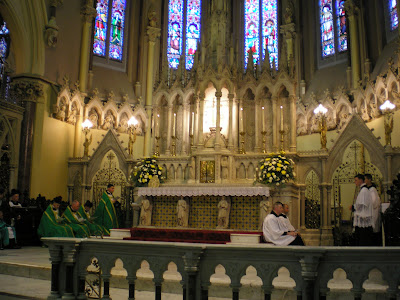


[Feel free to use these images but please credit this blog and give proper reference to the location and occasion - Convenor]

I have previously described this Church but I would like to make one further observation, which is that it is a Church of 'Juniors.'

By that I mean that it was the product of the work of two men, Archdeacon John Murphy and Edward Welby Pugin, who followed in the footsteps of elder relations, an uncle, Bishop John Murphy of Cork and Ross, in the former case, and a father, the great Augustus Welby Pugin, in the latter. I may say also that Archdeacon Murphy's brother, Francis Murphy, S.L., M.P., was a figure of no small interest himself.

However, the figure that interests me today is Bishop John Murphy (1772-1847)(r. 1815-1847). He was a member of the great brewing family of Cork City. Dean Murphy(!) in his life of Bishop Murphy declares: "while yet in his tender years displayed that pious disposition which, combined with attachment to study, determined his attachment to the clerical state." Dean Murphy himself, who was secretary to the Synod of Thurles in 1850, Vicar General of Cork from 1853 and first Dean of the reconstituted Chapter of Cork in 1858, served as Curate in Ss. Peter and Paul's from 1838-'42.

Bishop Murphy's Priestly studies began, by the arrangement of Bishop Moylan of Cork, at the Irish College in Paris in 1787 but rebellion in France forced him to remove from France. His studies were completed at the Irish College in Lisbon, where he was ordained Priest in 1796, with a dispensation on account of his youth.

He served in the Parish of Ss. Peter and Paul as Curate and then, like his nephew after him, as Parish Priest. Bishop Murphy was coadjutor to Dr. Moylan (who was instrumental in the foundation of the Presentation Sisters) but only for less than a month between January and February, 1815, when he succeeded to the See of Cork upon his predecessor's death. He was to consecrate both Bishop Daniel Murphy of Hobart, uncle of 'the Murphy-O'Connors' (as Vicar Apostolic of Hyderabad) and Bishop John England of Charleston.

Unlike his precedessor, Dr. Moylan, Bishop Murphy was vehemently against the proposed veto offered to the British Government in Ireland over the appointment of Irish Bishops in exchange for concessions on the Penal Laws still in force. However, we have it on the authority of no less than Prof. Timothy Corcoran, S.J., that even Bishop Murphy found the vehemence of Father and later Bishop England excessive!

The question of the survival of the Irish Language in Cork is of direct relevance. Bishop Florence McCarthy had been appointed coadjutor to Dr. Moylan in 1803 but died in 1810 without succeeding to the See. It was said at his appointment that Dr. McCarthy did not know Irish but that: "...Irish is not so necessary in Cork and its district." However, when Dr. Murphy was appointed in 1815, he found it necessary to learn Irish: "...without which he could not communicate with his people."

Bishop Murphy is indirectly responsible for the foundation of the Presentation Brothers in his refusal to permit the houses in his Diocese to join the congregation of the Christian Brothers. Although the Cork houses joined the congregation later, the seed of a second sprout was sown by Dr. Murphy's independent line.

Dr. Murphy was responsible for the main fabric of the present North Chapel, the Cathedral of Cork, which was refurbished following a fire in 1820. He was also the first patron of John Hogan, who completed the magnificent apse, which was a veritable riot of statuary. In 1822, Dr. Murphy commissioned 27 statues of Saints and a representation of the Last Supper for the Sanctuary based upon drawings contained in the Bishop's library. They were to be removed, ironically enough, with the body of Dr. Murphy himself, during 'reordering' in 1965. Bishop Murphy's monument, also by Hogan (1853) suffered the same fate - and the oblivion of the rest of the statuary. I should say, however, that the body of Dr. Murphy suffered a kinder fate and was honourably re-interred in St. Finbar's Cemetery!

Bishop Murphy wrote to Hogan: "My dear John, I send you the letter of general recommendation which I promised ... I sincerely wish you good health, a safe journey to Rome and a happy return to your native country ..." In the accompanying letter in Latin, the Bishop wrote: "We think we should commend and do with these presents commended you in the Lord, to all Most Illustrious and most Reverend Lords, Archbishops, Bishops and Clergy and Faithful, who enjoy communion with the Holy See, as one fully known to us, endowed with excellent morals and expecially pious to God, Holy Mother the Church and his parents ..."

What has always interested me most about Dr. Murphy is not his surname, nor that he represents an age when the Murphys ruled the World (or at least large parts of the Church!) - Bishop Timothy Murphy was Bishop of Cloyne and Ross from 1849 (and then just Cloyne from 1850). What interests me is his bibliomania, which was legendary.

An account of one of his many trips to Dublin bookshops relates that he visited the shop of Patrick Kennedy in Anglesey Street: "At last the anxious guardian of past literature is gladdened by the apparition o the gold-headed cane, the silk stockings fitting in the buckled shoes, the waistcoat not innocent of snuff, the loose coat, the broad-brimmed hat, and the kind good natured face under it... If a price was asked which he affected to think was too high, he would stop short, gaze ludiocro-sternly over his spectacles at the culprit and cry out 'Ah? You think to impose on the poor Connaughtman.' He made up the bill as he went along and when he left the shop he left behind him cheerful words and something to meet the rent or the auctioneers bill."

The diaries of Montalembert and Kohl contain descriptions of the Bishop of Cork. Kohl describes his library thus: "The Roman Catholic Bishop of Cork has one of the must interesting collections of books I have ever seen. This learned and industrious man has turned his whole house into a library; not only has he converted his sitting-rooms and dining-room into book-rooms but even in his bedrooms, every available space is filled with books. His attendants, even his maidservants, sleep in little libraries; the staircases are lined with books along the walls and the corridors, which lead from room to room, have full bookcases at their sides; everywhere books are literally piled up, even to the garrets."

As well as books, the Bishop commissioned Gaelic scholars to produce manuscripts for his collection, 120 volumes of which are held in the Russell Library, St. Patrick's College, Maynooth.

The Manuscripts are of particular interest. They include romances, religious and secular poetry, sermons, translations of devotional works, lives of the saints and genealogies. Bishop Murphy was of the generation of the great Eugene O'Curry and had a notable part in the preservation of much Gaelic Irish culture.

Bishop Murphy commissioned numbers of Gaelic scholars to transcribe and copy Irish Manuscripts. Two were Michael Óg O'Longan and his son. Michael Óg came of a great line of Irish scribes. His father Michael had been scribe in residence to the Knight of Glin, but indignantly left that gentleman's service when the Knight conformed to the Protestant religion under the pressure of the Penal Laws and settled at Teampull-geal-na-mona movill, now known as Whitechurch, Co. Cork. In 1836, in his 71st year, Michael Óg composed three quatrains in Bishop Murphy's honour. One of his other poems was the source of 'The Boys of Wexford.'

In the Journal of the Royal Historical anid Archeological Society of Ireland for July, 1882, there appears a translation made by Michael Óg for the amusement of Justin McCarthy of Carrignavar, of Dermot McCarthy's Irish 'Elegy on Lord Mountcashel,' written about 1724 and another translation of his, MacBruodin's Genealogical Poem composed for the O'Keefes, is printed in Cronnelly's Clan Roghan. He also translated the Annals of Innisfallen into English about the year 1831. Joseph, Michael Óg's son, became scribe in residence of the Royal Irish Academy on the death of O'Curry.

One word of interest to those who assert that "alien" Roman devotions imported by Cardinal Cullen drove out Irish spiritual traditions is to be found in the Relatio of Bishop Murphy for 1845 where he finds: "Cork Catholics in general numerous and well-devoted to their religion, " and attributes the peacefulness of the city to the regular attendance of the citizens at just such so-called 'Roman' devotions.

It was Bishop Murphy's dying wish that his library might be preserved and housed in Cork but the 70,000 volumes (save the manuscript collection that found its way to Maynooth) were dispersed to the four winds. It took a full year to complete the auction, many of the books being sold by weight.

'Murphy the younger,' the Archdeacon, after a youthful career of great distinction that would baffle the novelist or film director, was ordained at the age of 48 by his uncle, Bishop Murphy. However, he did not serve in Cork until after the death of his uncle. He was a staunch and zealous pastor in the Irish slums of Liverpool at Copperas Hill, until his was recalled to Cork by Bishop Murphy's successor, Bishop Delaney, as his secretary. He served as Chaplain to the Poor Law Union and the Presentation Convent in Bandon and as Curate at Schull before his appointment to Ss. Peter and Paul's in 1848, where he remained until 1874.

While in that post he was responsible not only for the fine Church of Ss. Peter and Paul but also for the founding of the Mercy Hospital in the former Mansion House, where it is still housed. He became Archdeacon of Cork in 1874 and died at Sunday's Well in 1883. His Requiem Mass was celebrated by Bishop Delaney with the three curates of Ss. Peter and Paul's as deacon, subdeacon and MC - sad to say, not one of them a Murphy!