Saturday, 14 November 2009

November - Month of the Holy Souls

From Quod Hoc Ineunte, the Encyclical Letter of Pope Leo XII proclaiming a Universal Jubilee issued on the 24th day of May, 1824:

"10. Venerable Brothers, Patriarchs, Primates, Archbishops, and Bishops: share in these cares and labors of Ours. Call an assembly, gather the people so that your sons may be eager to receive those gifts which God has entrusted to you for distribution to the chosen. Let them recall that the days of our sojourn here are brief, and We do not know at what hour the Father may come. We must therefore watch, carrying lighted lamps filled with the oil of charity, so that when He does come, We may run with eager love to meet him. You must also discuss carefully how much efficacy there is in indulgences; how great is the fruit of remission, not only of the canonical but also of the temporal punishment due for sins; and finally, how much aid from the treasure of merits from Christ and the saints may be applied to those who died truly penitent before they had made adequate satisfaction for their sins. Their souls must be purified in the fires of purgatory so that entry into the eternal fatherland may open to them. Be alert here, venerable brothers, for there are those who have followed a wisdom which is not from God. Clothed in sheep's clothing, and pretending for the most part a semblance of piety, they have spread falsehood among the people. Now teach the flock what they have to do, what works of piety and charity they must exercise, with what sorrow they are to weigh themselves and their lives. Teach them to eliminate and correct whatever may be defective in their habits, so that they may truly benefit from this holy indulgence."

Friday, 13 November 2009

Roman Pilgrimage Day 4


The third day of our pilgrimage started with mass in St. Agatha of the Goths; my personal favourite of the roman churches, situated just up the road from the convent where we're staying.

We then took the 117 bus to the Piazza dell' Popolo and walked down to Babington's Tea Rooms in the Piazza de Spagna where we stopped for tea. As we made our way back on foot we stopped at San Andrea della fratte and John told us a little bit about he history of the church and how it served as the setting of the conversion of Alphonse Ratisbonne. We went from there to the Fontana di Trevi where it was time for me to make a third attempt at talking in front of Irish pilgrims.


After a lovely lunch we went to see the rooms of S. Luigi Gonzaga and S. Giovanni Berchmans in S. Ignazio then to the rooms of St. Ignazio himself in the Gesu and the day finished with the illumination of the statue of the saint that takes place in the Gesu every day at 17.30.


Roman Pilgrimage Day 3


This morning we had Mass in S. Dominico e Sisto celebrated by Canonico Luzuy of the ICRSP. We sang Mass IX and latin hymns; Veni Creator Spiritus, Jesu Dulcis Memoria, and Salve Regina.


After Mass we went to the general audience with il Papa - they had unfortunately not managed to get us anounced, but it was nice all the same. He talked about the importance of silence and the value of monks.


After lunch at Roberto's in the Borgo Pio we went for Gelati at the Old Bridge and then took the metro to Piazza della Republica and went from there to the Basilica of Mary and the Angels and Martyrs. We proceeded with a quick stop for coffee before exploring the Maria della Vittoria, where Donna O'Connor took the role of guide and gave an excellent presentation that attracted the attention of visitors outside our own little group.


After that we went to S. Susanna where we picked up the tickets for the general audience with the Pope the day before.


My own presentation of the Fontana dell'Acqua Felice was slightly ruined by the fact that it was covered with tarpaulins, being restored. The afternoon continued from there in the footsteps of Sixtus the Vth - whose sister donated a chapel to the church across the road - down the Quirinale with a quick visit to San Carlino and San Andrea dell' Quirinale, where we had Mass once during last year's pilgrimage above the body of S. Stanislaus.

Wednesday, 11 November 2009

Roman Pilgrimage Day 2


The second day of our Roman pilgrimage was a lazy one. After 7 am Mass in S. Peter's we went to see S. John Lateran Basilica. Today is the anniverasry of the dedication of the Lateran Basilica.


Outside we saw the frescos in the loggia or two story porch that was built by order of Pope Sisto V.


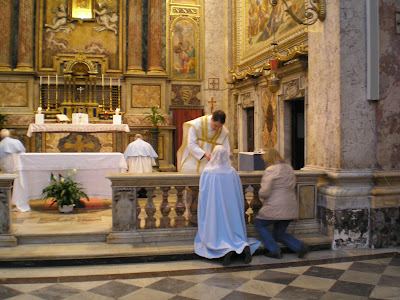
Inside we entered by the transcept and were directly across from the Altar where Our Lord is kept. In the photo you can see the papal high altar to the left.

Tuesday, 10 November 2009

Roman Pilgrimage Day 1

This morning at 7 o'clock we went to mass in St. Peter's Basilica. Mass was celebrated in the old rite at the altar of the transfiguration. There were several Masses going on at side altars all around the Basilica during that time. Many of them were in the old rite. It is really surprising how alive S. Peters Basilica is at that early hour.


After an hour on the train we met up with the pleasant and generous Margareta who took us in her car to see the house of the martyre Santa Maria Goretti. A girl of eleven years who was killed by a man she trusted because she resisted his attempts to rape her.

We came back to Rome just in time to make it to the Gèsu to see the wonderful ceremony of the illumination of the statue of Saint Ignatius. The whole ceremony has the effect of a sermon (in Italian, unfortunately for us) and as each part of the altar lights up some new medidtation is given.

At the end the painting of S. Ignatius is slowly lowered to reveal the statue that is behind it.

Sunday, 8 November 2009

Fourteenth Monthly Mass in the Diocese of Kildare and Leighlin


The fourteenth monthly Mass took place this afternoon in the presence of a congregation of eight. The Mass did not take place in the Church as was usual but in the room behind the tabernacle where some of the congregation usually have tea after Mass. The reason for the change was a display in sand in front of the Altar.

St. Conleth of Kildare, pray for us!

Saturday, 7 November 2009

November - Month of the Holy Souls

From Apostolico Consitutio, the Encyclical Letter of Pope Benedict XIV in Preparation for the Holy Year issued on the 26th day of June, 1749:

13. As everyone knows, several months intervene between the issue at Rome of the Bull proclaiming the year of Jubilee and the actual start of this Holy Year. Continuing the ancient practice of the Church, the holy door is opened on the next vigil of the Birth of the Lord; then the Year of Jubilee begins. We use these intervening months to hold missions in different districts of Rome. We highly recommended their usefulness in Our pastoral Edicts when We were Archbishop of Bologna. These appeared in print and were soon translated into Latin. We impress upon the evangelical labourers in missions to instruct the people in order to explain the Catholic doctrine of indulgences and of the universal Jubilee, rather than in purely academic questions of Apologetic and Moral Theology. The faithful must be fully aware that sin and its eternal punishment are remitted by the Sacrament of Penance if one makes proper use of it; however the entire temporal punishment is very seldom taken away. This must be removed either by satisfactory works in this life or by the fire of Purgatory after death. The holy Council of Trent in session 6, chap. 4, and canon 30 of the same session teaches this under the heading de Justificatione. Inform the Christian people of the unfailing treasury in the Church which was constituted by the immeasurable abundance of the merits of Christ and increased by the merits of His saints. Distribution from this treasury has been entrusted by Christ the Lord to His vicar on earth, the Roman Pontiff; consequently the Pontiff prudently decides when these merits can be applied, either by way of absolution for the living or by way of prayer for the dead, provided that the living have destroyed their sin and its eternal punishment by Penance, and that the dead have departed this life united with God in charity. This distribution of merits is in the form of indulgences. When one obtains one, he is freed from the temporal punishment due to sins to the extent granted and defined by the lawful distributor. This we read in the constitutions of the Supreme Pontiffs and especially in the famous Decretal of Our Predecessor Leo X to Cardinal Tommaso de Vio, otherwise known as Cajetan, when he was serving as Apostolic Legate in Germany. The result is that the practice of indulgences is most beneficial to Christians; hence the evil idea which either denies the benefit of indulgences or deprives the Church of the power of conferring them is to be condemned. This was decided by the Council of Trent, session 25, in the decree on Indulgences. Finally, the Christian people must be advised that the Indulgence of the Jubilee year is a plenary one, but is distinguished from other plenary indulgences also distributed on the occasion of the Jubilee by the fact that in a holy year of Jubilee, confessors designated for this purpose receive a wider power both of absolving from sins and of dispensing from certain bonds and impediments which often ensnare the consciences of penitents.

Sunday, 1 November 2009

How long, O Lord? How long?

Across the Church over the past forty years there have been countless stories of ordinary people attempting extraordinary things in the cause of the Gregorian Rite. Very often, they have been met with opposition from the sources they looked to for leadership and support.

"...the old rite should be granted much more generously to all those who desire it. It’s impossible to see what could be dangerous or unacceptable about that. A community is calling its very being into question when it suddenly declares that what until now was its holiest and highest possession is strictly forbidden and when it makes the longing for it seem downright indecent..." -Joseph, Cardinal Ratzinger

Sometimes, the opposition was overwhelming and they gave up the attempts. Sometimes, God called them to Himself before their efforts could bear visible fruit. Hopefully, they acted in good faith and gained grace through their efforts.

William, Cardinal Leveda, said recently, in the context of the Apostolic Constitution for former Anglicans coming into full Communion with the Holy See that:

"The unity of the Church does not require a uniformity that ignores cultural diversity, as the history of Christianity shows. Moreover, the many diverse traditions present in the Catholic Church today are all rooted in the principle articulated by St. Paul in his letter to the Ephesians: ‘There is one Lord, one faith, one baptism’ (Eph. iv:5). Our communion is therefore strengthened by such legitimate diversity, and so we are happy that these men and women bring with them their particular contributions to our common life of faith."

But then, to paraphrase an oft repeated maxim in the Diocese, Cardinal Leveda doesn't live in Kildare and Leighlin.

To those members of St. Conleth's Catholic Heritage Association who have died, the short illustrated history that follows is dedicated. Of your charity, pray for them. Since no Parish in the Diocese of Kildare and Leighlin that we have asked will permit us facilities to organise a Requiem Mass for the repose of their souls, please pray all the harder for them.


Petition to Bishop Ryan, 1996

In 1996, a petition of over 500 signatures was presented to Bishop Laurence Ryan, Bishop of Kildare and Leighlin, requesting the provision of Mass celebrated according to the 1962 Missal on Sundays and Holydays of Obligation in the Diocese. Bishop Ryan died in 2003. By the time of his death, no such provision had been made.


Letters to Bishop Moriarty, 2004

In 2004, with the encouragement of St. Conleth's Catholic Heritage Association, hundreds of individuals sent letters to Bishop James Moriarty requesting the provision of Mass celebrated according to the 1962 Missal on Sundays and Holydays of Obligation in the Diocese. No response seems to have been received by any of these intrepid souls and no provision was made.


Requests for Mass on Sundays and Holydays, 2007

In 2007, following the coming into force of the Holy Father's Letter Summorum Pontificum, groups of the faithful in seven Parishes wrote to their Parish Priests requesting the provision of Mass celebrated according to the 1962 Missal on Sundays and Holydays of Obligation in their Parishes. Since October, 2008, more than a year after the coming into force of Summorum Pontificum, a single monthly Mass has been provided in one Parish.


Requests for pilgrimage Masses, 2007-2009

Since 2007, St. Conleth's Catholic Heritage Association has requested permission to organise pilgrimage Masses, for the Holy Year of Saint Paul and then the Holy Year for Priests, in Parishes across the Diocese of Kildare and Leighlin. Requests have been made to 21 out of 56 Parishes. Permission has been granted on 7 occasions. In one instance, permission was given for the Holy Year of Saint Paul and permission refused for the Holy Year for Priests. In one instance, permission was given but withdrawn a matter of days later. How long, O Lord? How long until those asking for the Gregorian Rite are not made to feel downright indecent?


Of your Charity, pray for the souls of the deceased members of St. Conleth's Catholic Heritage Association!

Saturday, 31 October 2009

Our Gaelic Christian Heritage (Part 5)

Among the stirring lines that affirm the high endeavour of the Gaelic Race in the cause of Christ, few can equal for sheer force and colour, some anonymous lines urging fidelity to the True Church against the wiles of heresy. Qui legit intellegat!

Ní trácht ar an Ministir Ghollda,
Ná a chreideamh gan bunús gan bhrí,
Mar 'sé ba bhunchloch dá Theampall,
Magairlí Anraoí an Ríogh!


File gan anim

Mass in Rathangan


A brave band of traditionalists ventured forth to brave the weather and the puca this Hallowe'en afternoon to attend Mass in the Gregorian Rite in the Church of the Assumption and Saint Patrick in Rathangan, Co. Kildare.

The Mass was celebrated by Fr. James Larkin, P.P., in whose Parish the Latin Mass Chaplaincy of the Archdiocese of Dublin found a home two years ago. As with the other Masses organised during the Year for Priests, this was a Votive Mass of the Holy Ghost offered for Priests. The Bishop of Kildare and Leighlin had graciously granted the Plenary Indulgence for the Holy Year for Priests to all those who attended the Mass under the usual conditions and the special conditions set by the Apostolic Penitentiary. As usual with the Masses organised by St. Conleth's Catholic Heritage Association, the congregation were encouraged to attend Mass in their local Church and were told of the Sunday Mass times in this Church.


The following article was contained in the 1956 Year Book of the Diocese of Kildare and Leighlin:

Rathangan Builds
The New Church and Schools are a Credit to Ireland

On Sunday, 6th November, 1956, the little town of Rathangan, by the River Spate, with a proud past that can be traced back well over a thousand years, added one more page to an illustrious history of Catholic devotion. For this memorable day witnessed a twin triumphant accomplishment, the laying of the foundation stone of the new Church of the Assumption by his Lordshop, Most Rev. Dr. Keogh, Bishop of Kildare and Leighlin, and the blessing and opening of Rathangan's new schools named in honour of Saint Brigid.

Speaking with characteristic sincerity Most Rev. Dr. Keogh paid tribute to the priests, nuns, and faithful to whose devotion and self-sacrifice the new Church and Schools present so lasting a monument. "The people have dona a grand work in building their Church, the laying of the foundation stone of which symbolises that Christ and Christ's teaching should be the foundation stone of our lives."

And so, almost two hundred and fifty years from the year in which the first humble Church of the Assumption of the Blessed Virgin was built in Rathangan, and one hundred and forty years from the founding of its successor, St. Patrick's Church, this second Church dedicated to the Assumption of Our Blessed Lady into Heaven is rearing its graceful lines to the sky.

The site upon which the new Church and Schools were destined to stand were donated by the local Order of Mercy nuns. Most Rev. Dr. Keogh visited these sites on Monday, 14th February, 1955. One week later fundamental operations were under way. Building started on May 16th. on the 6th November of 1955, the Feast of all Saints of Eire, "under the invocation also of St. Patrick," the cornerstone was solemnly blessed and laid. Already progress is well in evidence, and it seems a foregone conclusion that this beautifully planned Church will be completed well within the scheduled period of 15 to 18 months.

Designed in the Irish traditional style the Church will cost £60,ooo and accomodate a congregation of four figures. One hundred and ninety feet long, sixty feet wide, and fifty two feet high, it will be graced with a belfrey rising to an imposing height of one hundred and twelve feet. Its front elevation shows a dignified proportioned piece of architecure with gentle, graceful lines, the whole effect in perfect taste and symmetry.

Monday, 26 October 2009

Why are Catholic Bishops afraid of their own heritage?

Tim Collard, a retired British diplomat who spent most of his career in China and Germany and an active member of the British Labour Party says that, as an Anglican, he can't understand why Catholic Bishops fear the Latin Mass. He writes in Saturday's edition of the Daily Telegraph.

Saturday, 24 October 2009

Traditional Vocations Blog

Our associated blog promoting vocations to traditional religious congregations has recently hit another milestone, having more than 100,000 hits in slightly more than a year. The blog was established as part of the efforts of St. Conleth's Catholic Heritage Association's efforts to mark the Year of Vocations declared by the Archbishops and Bishops of Ireland.

As of this morning, the blog had received 113,251 hits from 56,626 unique visitors. 12.9% of visitors return more than 5 times. Of the recent visitors, 36.9% are from the United States, 8.7% are from France, 8.3% are from Ireland, 7.4% are from Britain, as well as substantial number from Poland, Canada, Germany, Italy, Spain, and The Philippines.

The Pontifical Commission for Social Communications issued this message for World Communications Day. "The priest and pastoral ministry in a digital world: new media at the service of the word - The essential task of the priest is to announce the Word of God made flesh; made man in human history. The efficacy of this ministry requires that the priest himself should have a profound relationship with Christ, rooted in a deep love and knowledge of Sacred Scripture, the written witness to the divine Word. The Message for the 44th World Communications Day invites priests, during this Year of the Priest and following on the deliberations of the 12th Ordinary General Assembly of the Synod of Bishops, to see the new media as a great resource for their ministry as servants of the Word and encourages them to confront the challenges posed by the new digital culture. The new media, if adequately understood and appreciated, can open up to priests and pastoral ministers a wealth of scholarly and devotional materials that were previously difficult to access and they can facilitate forms of collaboration that were in the past unimaginable. With the support of the new media, those who preach and make known the Word can aspire to reach with their words and images - with a new language specific to these means - individuals and communities across continents and time-zones and to create new communities of learning and dialogue. Used wisely, with the assistance of those who are experts in the technologies and the culture of communications, the new media can become for priests instruments of profound evangelization and communion. They will be a new form of evangelization by means of which Christ can continue to walk the streets of our cities and stand at the threshold of our homes: "Behold, I stand at the door and knock. If anyone hears my voice and opens the door, I will enter his house and dine with him, and he with me." (Rev. 3,20)"

Reminder - Rathangan - Hallowe'en


The Holy Sacrifice of the Mass will be offered in the Gregorian Rite for Priests at 2 p.m. on Saturday, 31st October, 2009, in the Church of the Assumption and St. Patrick, Rathangan, Co. Kildare, Ireland.

The Mass is being organised by St. Conleth's Catholic Heritage Association to honour the Holy Year for Priests.

"O my God, I burn with desire for the sanctification of Thy priests." Fr. William Doyle, S.J., M.C.

Friday, 23 October 2009

Titulars of Churches in the Diocese of Kildare and Leighlin


Interior of Carlow Cathedral c. 1910

In the Irish Ecclesiastical Calendar, today is the feast of the Dedication of the consecrated churches of Ireland except cathedrals, which have their own individual feasts. In any Diocese, the numbers of consecrated churches would have been relatively low. In Kildare and Leighlin, it appears that, certainly until the 1950s, only four churches in the Diocese had been consecrated: Carlow Cathedral, Edenderry, Naas and Newbridge. However, I propose to look at the whole range of dedications throughout the Diocese. Those churches listed with an asterisk have a secondary dedication. Parishes are listed in brackets.

Blessed Virgin Mary
Of the 137 churches in the Diocese of Kildare and Leighlin, it is unsurprising that more are dedicated to the Blessed Virgin under various titles than to anyone else, in fact, 37 Churches.

St. Mary is the most popular dedication with nine churches: Askinagap (Hacketstown), Ballyconnell (Clonmore), Bennykerry (Bennykerry), Broadford (Balyna), Clonaghadoo (Mountmellick), Edenderry (Edenderry), Raheen (Killeigh), Stratford (Baltinglass), Wolfhill (Ballyadams).

Next is the Assumption with six churches: Cathedral (Carlow), Paulstown (Paulstown), Rathangan* (Rathangan), The Heath, (Portlaoise), Tynock (Rathvilly), Vicarstown (Stradbally).

Then the Immaculate Conception with five churches: Allenwood (Allen), Ardattin (Tullow), Cappinan (Daingean) Knockananna (Hacketstown), Walsh Island (Clonbullogue).

There are five churches of Our Lady: Caragh* (Caragh), Killamote (Hacketstown), Naas* (Naas), Prosperous* (Caragh), Sallins* (Sallins).

There are three churches dedicated to the Holy Rosary: Abbeyleix (Abbeyliex), Lugacurren (Ballyadams), Tullow (Tullow).

There are two churches dedicated to the Holy Family: Askea (Askea), Kilshanroe (Carbury).

There are also churches dedicated to the Blessed Virgin Mary, Mayo (Doonane); to Our Lady of the Wayside, Clonmore (Clonmore); Our Lady of Lourdes, Skeoghvosteen (Graiguenamanagh); the Nativity of Our Lady, Newtown (Kilcock); Our Lady of Victories, Kildangan (Monasterevin); Mary, Mother of God, Daingean (Daingean) and Duiske Abbey (Graiguenamanagh), being a former Cistercian Abbey, was dedicated to the Blessed Virgin. An icon of Our Lady of Duiske hangs in the Church there, which may well be the present dedication.

God
Of all the dedications to God, the Sacred Heart is the most popular with eight churches: Arles (Arles), Borris (Borris), Clonbullogue (Clonbullogue), Rath (Emo), Stradbally (Stradbally), The Hollow (Mountrath).

The Holy Trinity and the Holy Cross have both three dedications.

Holy Trinity: Allen (Allen), Derrinturren (Carbury), Goresbridge (Paulstown).

Holy Cross: Killeshin (Graiguecullen), Myshall (Myshall), Ratheniska (Portlaoise).

Christ the King: Cooleragh (Cooleragh)

Saints
Once again, it is no surprise that, in the Diocese of Kildare and Leighlin, that St. Brigid of Kildare, Muire na nGael, tops the list of dedications to saints.

Fifteen churches are dedicated to St. Brigid: Ballinakill (Ballinakill), Ballycomman (Daingean), Clane* (Clane), Clogherinkoe (Balyna), Clonegal (Clonegal), Croghan (Rhode), Curragh (Curragh Camp), Hacketstown (Hacketstown), Kildare (Kildare), Kill (Kill), Milltown (Allen), Rosenallis (Rosenallis), Shanahoe (Raheen), Suncroft (Suncroft), Talbotstown (Rathvilly).

The next most popular saint is St. Patrick with ten dedications: Ballymurphy (Borris) Ballyroan (Abbeyleix), Clane* (Clane), Johnstownbridge (Balyna), Killeigh (Killeigh), Mountmellick (Mountmellick), Newtown (Bagenalstown), Rathangan* (Rathangan), Rathoe (Ballon), Rathvilly (Rathvilly).

After that, St. Joseph, with six, narrowly beats two local saints, Laserian and Fintan, with five each.

St. Joseph: Ballinagar (Killeigh), Ballyadams (Ballyadams), Baltinglass (Baltinglass), Caragh* (Caragh), Prosperous* (Caragh), Tinryland (Tinryland).

St. Laserian: Ballinakellen (Bagenalstown), Drumphea (Myshall), Kildavin (Clonegal), Knock (Ballinakill), Leighlin (Leighlin).

St. Fintan: Ballinabranna (Leighlin), Ballyfin (ballyfin), Mountrath (Mountrath), Raheen (Raheen).

Saints Peter and Paul, either together or apart, have three, two and one dedication respectively.

Ss. Peter and Paul: Ballon (Ballon), Monasterevin (Monasterevin), Portlaoise (Portlaoise).

St. Peter: Rhode (Rhode), Two-Mile-House (Two-Mile-House).

St. Paul: Emo (Emo).

St. Michael has two dedications: Portarlington (Portarlington), Timahoe (Stradbally).

St. Anne has two dedications: Ardclough (Kill), Ballylinan (Arles).

The rest of the Saints (and Angels) have one didication each: Guardian Angels*, Sallins (Sallins); St. Conleth, Newbridge (Newbridge); St. Coca, Kilcock (Kilcock); St. Abban, Doonane (Doonane); St. Finian, Kilquiggan (Clonmore); St. Andrew, Bagenalstown (Bagenalstown); St. Benignus, Staplestown (Cooleragh); St. Brendan, Drummond (St. Mullins); St. Brochan, Bracknagh (Clonbullogue); St. Clare, Graiguecullen (Graiguecullen); St. Coleman, Kilclonfert (Daingean); St. David*, Naas (Naas); St. Fortchern, Rathanna (Borris); St. John the Baptist, Grange (Tullow); St. John the Evangelist, Killenard (Portarlington); St. Manman, Clonaslee (Clonaslee); St. Moling, Glynn (St. Mullins); St. Oliver, Grangecon (Baltinglass); The Irish Martyrs, Ballycane (Naas).

May the Saints of the Diocese and the Angels of the Churches of the Diocese pray for us!

Monday, 19 October 2009

International Clergy Conference

It has been announced that the music for the Liturgies associated with the English Language Clergy Conference for the Holy Year for Priests to take place in Rome in 2010 will be provided by the Lassus Scholars, well know to those attending the Latin Mass Chaplaincy in the Archdiocese of Dublin.

Sunday, 18 October 2009

Thirteenth Monthly Mass in the Diocese of Kildare and Leighlin


The thirteenth Mass took place today, the third Sunday instead of the second Sunday, and only 25 minutes late. There was a congregation of 10, including two small children. That is a joint lowest attendance with June.

However, if all of the 6 people who turned up last Sunday had attended this Sunday as well, the congregation would have been a respectable 14. That would have been the third lowest attendance after June (lowest: 10) and February, July and September (joint second lowest: 13).

Saturday, 17 October 2009

Our Gaelic Christian Heritage (Part 4)

As the Penal Laws took hold through the 18th Century, it was State policy to ensure that the resources of a persecuted Catholic People dwindled. In the Lament for Kilcash, the death of Lady Margaret Butler of Kilcash, and with her, a source of benevolent patronage for Catholics.

The central theme is contained in the lines "bhíodh iarlaí ag tarraingt tar toinn ann, is an t-aifreann binn á rá." Nobles made their way o'er the waves thence, and there the sweet Mass was said. The poem is variously attributed.


Caoine Cill Cháis

Cad a dhéanfaimid feasta gan adhmad?
Tá deireadh na gcoillte ar lár;
níl trácht ar Chill Cháis ná ar a teaghlach
ní bainfear a cloig go bráth.
An áit úd a gcónaiodh an deighbhean
fuair gradam is meidhir thar mhná,
bhíodh iarlaí ag tarraingt tar toinn ann
is an t-aifreann binn á rá.

Ní chluinim fuiaim lachan ná gé ann,
ná fiolar ag éamh sois cuain,
ná fiú na mbeacha chun saothair
thabharfadh mil agus céir don tslua.
Níl ceol binn milis na n-éan ann
le hamharc an lae a dhul uainn,
ná an chuaichín i mbarra na ngéag ann,
ós í chuirfeadh an saol chun suain.

Tá ceo ag titim ar chraobha ann
ná glanann le gréin ná lá,
tá 'smúid ag titim ón spéir ann
is a cuid uisce g léir ag trá.
Níl coll, níl cuileann, níl caor ann,
ach clocha is maolchlocháin,
páirc an chomhair gan chraobh ann
is d' imigh an géim chun fáin.

Anois mar bharr ar gach míghreanní,
chuaigh prionsa na nGael thar sáil
anonn le hainnir na míne
fuair gradam sa bhFrainc is sa Spáinn.
Anois tá a cuallacht á caoineadh,
gheibbeadh airgead buí agus bán;
's í ná tógladh sillbh na ndaoine,
ach cara na bhfíorbhochtán.

Aicim ar Mhuire is ar Íosa
go dtaga sí arís chughainn slán,
go mbeidh rincí fada ag gabháil timpeall,
ceol veidhlín is tinte cnámh;
go dtógtar an baile seo ár sinsear
Cill Chais bhreá arís go hard,
's go bráth nó go dtiocfaidh
an dílená feictear é arís ar lár.

Tuesday, 13 October 2009

Novena in honour of the Blessed Gerard - Day 9

Day Nine - Feast of the Blessed Gerard
Blessed Gerard, Pray for us!

We know little about Blessed Gerard. We revere him as the founder of the Order of Saint John of Jerusalem. There are documents which testify to Gerard’s activity and legends that sought to embellish it.

Through Gerard, ‘the Jerusalem Hospital’ for 900 years has been the basis for defence of the faith and service of the sick - tuitio fidei et obsequium pauperum.

More than in life, Gerard has, like many saints, perhaps had greater effect after his death, after his ‘heavenly birhday’ as the Church was accustomed to call the day of one’s death. The Order of Saint John has given witness to this with its traditions, its international potential, its new initiatives and with the noble character of its particular spirituality.

‘Our confraternity wil be everlasting since the ground, in which this flower has taken root, is the misery of the world and since there will always be people, please God, who will give of themselves to lessen suffering and make this misery more bearable.’ These are likely not the words of Gerard, but they have been attributed to him. It falls to us here and now, as it did to Gerard, to reduce the suffering in our time, to make misery more bearable, so that Jesus Christ may be glorified in all.

Prayer

Jesus Christ, ‘my Lord and my God’ (Jn 20:28). Strengthen in your service our
Holy Father N...., all bishops, priests, deacons and all members of the Order.
Lord hear our prayer.
Assist our Grand Master Fra’ N... and all those in authority in the Order to live out their calling and their mission in the present day.
Lord hear our prayer.
Raise up suitable and devout vocations for the hospitaller Order of Saint John.
Lord hear our prayer.
Let us be faithful and joyful in your service and once our earthly life is ended, lead us to your Easter glory.
Lord hear our prayer.

Our Father... Hail Mary... Glory be to the Father

Pray for us, Blessed Gerard
That we may be made worthy of the promises of Christ.

Let us Pray.
God of unchanging power and everlasting light, look with favour upon the mystery of the entire Church and bring to fulfilment your eternal plan of redemption; then may the whole world observe and know that the fallen have been lifted up, what has grown old is made new and that all has been restored to wholeness through Christ, the source of all things, who lives and reigns for ever and ever. (Prayer after the seventh reading of the Easter Vigil)

Conclusion

Let us pray.
O God, who exalted Blessed Gerard because of his care for the poor and the sick and through him founded in Jerusalem the Order of Saint John the Baptist, give us the grace of seeing, as he did, the image of your Son in our brothers and sisters. We ask this through our Lord Jesus Christ your Son, who lives and reigns with you and the Holy Spirit, one God, for ever and ever. Amen. (Collect for the Feast of Blessed Gerard, Founder of our Order)

Monday, 12 October 2009

Novena in honour of the Blessed Gerard - Day 8

Day Eight
Christ has has died; Christ has risen

With the reform of the liturgy in years following the Second Vatican Council, the acclamation ‘mortem tuam annuntiamus, Domine, et tuam resurrectionem confitemur’ rendered as ‘Christ has died; Christ is risen’, became our profession of faith after the consecration.

This phrase repeats the original credo of the Church, the confession of the death and resurrection of the Lord. It was with this faith too that Blessed Gerard worked in Jerusalem near to the place where the death and resurrection of Jesus Christ occurred, the Church of the Holy Sepulchre in Jerusalem that embraced the the traditional sites of the death, burial and resurrection of the Lord: ’...and if Christ has not been raised, then our proclamation has been in vain and your faith has been in vain...’ (1 Cor. xv:14).

In our own day, we must again become aware of this Easter faith that Gerard lived. During Easter, we, the baptized, are most intimately joined with Christ. ‘God raised us up with Him and seated us with Him in the heavenly places in Christ Jesus’ (Eph. ii:6); ‘so if you have been raised with Christ, seek the things that are above, where Christ is seated at the right hand of God’ (Col. iii:1-2).

Prayer

Lord Jesus Christ, risen from the dead, strengthen us in faith, in trust and in love.
Lord hear our prayer.
Make the Holy Land a land of peace between peoples where your praises may sound.
Lord hear our prayer.
Send us your Spirit that we may proclaim your death and profess your resurrection until you come in glory.
Lord hear our prayer.
Welcome our dead in your heavenly Jerusalem.
Lord hear our prayer.

Our Father... Hail Mary... Glory be to the Father…

Pray for us, Blessed Gerard
That we may be made worthy of the promises of Christ.

Let us Pray.
Let your people, renewed in youth of spirit, O God, rejoice always that those who now take delight in the glory of being your adopted children, may look forward with certain hope to the day of resurrection. We ask this through our Lord Jesus Christ your Son, who lives and reigns with you and the Holy Spirit, one God, for ever and ever. Amen. (Collect for the Third Sunday of Easter)

Sunday, 11 October 2009

Mariana in the South

'Mariana in the South' by J.W. Waterhouse

Dreaming, she knew it was a dream:
She felt he was and was not there.
She woke: the babble of the stream
Fell, and, without, the steady glare

Shrank one sick willow sere and small.
The river-bed was dusty-white;
And all the furnace of the light
Struck up against the blinding wall.

She whisper’d, with a stifled moan
More inward than at night or morn,
‘Sweet Mother, let me not here alone
Live forgotten and die forlorn.’

And, rising, from her bosom drew
Old letters, breathing of her worth,
For ‘Love,’ they said, ‘must needs be true,
To what is loveliest upon earth.’

An image seem’d to pass the door,
To look at her with slight, and say
‘But now thy beauty flows away,
So be alone for evermore.’

‘O cruel heart,’ she changed her tone,
‘And cruel love, whose end is scorn,
Is this the end to be left alone,
To live forgotten, and die forlorn?’

From 'Mariana in the South' by Alfred, Lord Tennyson

A small congregation turned up this afternoon for the thirteenth monthly Mass. As bad luck would have it, it didn't happen. The Church was unlocked but no sign of celebrant, server, organisers. Fortunately, the sacristan happened to be on hand to confirm that a note awaited her saying that the Mass had been cancelled... Well, it's nice that someone knows what's going on.