Tuesday, 1 December 2015

Back on the Rails VII - The Newmarket Branch Line

Since I'm back on the rails again after a long pause, I hope you won't mind if I take a break from the West Cork line to go north and follow a branch line that covered nearly 9 miles, crossing the River Dalua at Kanturk and down towards the River Blackwater where it meets the main line (still open) between Mallow and Millstreet at Banteer. The Newmarket to Banteer Branch Line was opened in 1889, built by local notables who had formed the Banteer and Newmarket Railway Company. After four years it was taken over by the Great Southern and Western Railway.

A daily service ran until 'the Emergency' when, in 1942, it suffered a temporary closure. Only a goods service recommenced in 1956 and was finally closed in 1963. A few Parliamentary Questions set the scene, in 1946, 1948, in 1954 and in 1956.

We are in the Barony of Duhallow, a land of poetry. It boasts some of the most poetic scenery and some of the most poetic placenames in all of Cork, Lyre and Nadd, Assolas and Knocknanuss.

I started my journey at Newmarket. The town was founded in 1620 by the Aldworth family, to whom it has been granted by James I upon the forfeiture by the MacAuliffes, as their market town.  What remains of the terminus station is a small red-brick building now part of 'the Railway Industrial Park.  It sits in a natural valley just below the town formed by a tributary stream of the River Dalua.  The railway follows the valley of this stream and then the River Dalua down to Kanturk.


St. Mary's Parish Church, Newmarket

The beautiful St. Mary's Church was a benefaction of the Aldworths, who gave both the site and a donation towards the building.  The original Altar was a copy of that of the ancient abbey of Quin.

Newmarket's most famous inhabitants are the Currans, the Philpot Currans, who gave eminent members to the Irish Bar and to Irish History, and whose family plot may be found in the Anglican cemetery here.  Sarah was the sweetheart of Robert Emmet, the darling of Éireann.  Her father, John Philpot Curran, was Master of the Rolls for Ireland, who faught the famous case of Fr. Neale prosecuting Viscount Doneraile at the Cork Assizes, which, since Doneraile had no railway, we may conveniently mention here.

Fr. Neale, the elderly Parish Priest of Doneraile, had condemned from the Altar the adulteries of a parishioner.  The parishioner's sister was mistress of St. Leger St. Leger (sic!), Baron and later Viscount Doneraile, who horsewhipped the Priest, safe in the knowledge that a Protestant jury (Catholic Emancipation was 49 years off in 1780) would never convict him.  However, he did not reckon with JPC, who exposed the falsity of the Viscount's witnesses and turned the jury toward's Fr. Neale's case with his eloquence.  The Viscount challenged JPC to a duel, one of five he is known to have fought.
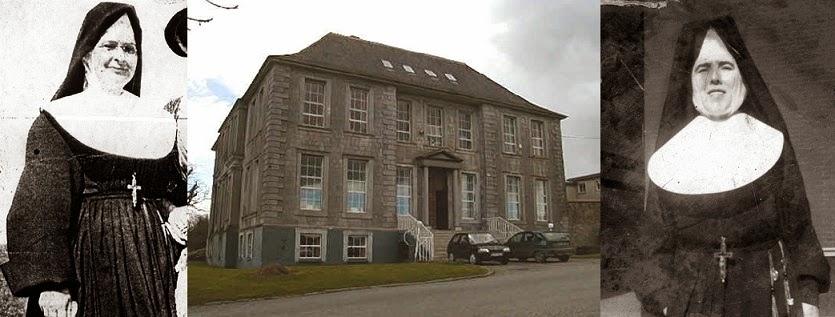

Sisters Aniceta and Petronella, Sisters of Saint Joseph, natives of nearby Meelin and the former St. Joseph's Convent

It's not too far to go to the O'Keefe Institute, built as Aldworth Court or Newmarket House in 1750.  In common with other great houses, it ceased to be a private residence in the 1920s and in 1927, the Sisters of St. Joseph, founded by St Mary of the Cross MacKillop, patroness of the recent Eucharistic Congress (and unofficially who are misunderstood in a good cause by their Priests).

The next stop, the only intermediate stop, on the Newmarket Branch Line is Kanturk.  As the confluence of the Rivers Allua and Dalua (Allow and Dallow, if you prefer) I will come back to Kanturk when I'm exploring the Blackwater and its tributaries.  Sufficing to say that there is a fine remnant of the railway station, if you know where to look on Percival Street below the Church, and the remnants of the bed of the line on either side of the road.

From Kanturk we follow the Railway along the line of the Dallua to where it flows into the Blackwater.  Finally, just crossing the Blackwater we reach the connection between the Branch and the Main Line at Banteer.  Banteer Station, on the main Dublin-Tralee Line, was opened in 1853 and continues as a passenger stop.

Near Banteer is Knocknaclashy, the site of the last open battle of the Confederate Wars.  I have already covered the execution of Bishop Boetius MacEgan in May, 1650.  A year later, in July, 1651, as the forces of the Catholic Confederation fell back behind the Shannon Donagh MacCarthy, Viscount Muskerry and later Earl of Clancarthy, held the last outpost in his native lands.  His forces moved from Killarney towards Mallow in the direction of the stronghold of Limerick.  They were intercepted near Banteer by Broghill's Parliamentarian forces, who won the skirmish.  Lord Muskerry's forces fell back upon Killarney.  From that point, the war was one of siege and the destruction of the Catholic Confederation assured. 

The final Catholic heritage point about Banteer is the dedication of the Church there to St. Fursey who was the son of a Munster Prince but was born in Galway and is best known for his missionary works in Britain, especially East Anglia.

Sunday, 29 November 2015

"Intruders and Desecrators"

This day in the Liturgical Calendar, the First Sunday of Advent, 1969, marked the coming into force of the Novus Ordo Missae. Pope Paul VI, in a General Audience on 26th November, 1969, spoke thus:

"We may notice that pious persons will be the ones most disturbed, because, having their respectable way of listening to Mass, they will feel distracted from their customary thoughts and forced to follow those of others...

"...Not Latin, but the spoken language, will be the main language of the Mass. To those who know the beauty, the power, the expressive sacrality of Latin, its replacement by the vulgar language is a great sacrifice: we lose the discourse of the Christian centuries, we become almost intruders and desecrators in the literary space of sacred expression, and we will thus lose a great portion of that stupendous and incomparable artistic and spiritual fact that is the Gregorian Chant. We will thus have, indeed, reason for being sad, and almost for feeling lost: with what will we replace this angelic language? It is a sacrifice of inestimable price."

* * *

The Sacred Constitution of the Second Vatican Council Sacrosanctum Concilium spoke thus:

"23. That sound tradition may be retained... there must be no innovations unless the good of the Church genuinely and certainly requires them; and care must be taken that any new forms adopted should in some way grow organically from forms already existing."

"36. 1. Particular law remaining in force, the use of the Latin language is to be preserved in the Latin rites... 2. But since the use of the mother tongue, whether in the Mass, the administration of the sacraments, or other parts of the liturgy, frequently may be of great advantage to the people, the limits of its employment may be extended..."

Sunday, 22 November 2015

Pontifical Low Mass - Annual General Meeting

On Saturday, 21st November, 2015, His Grace the Archbishop of Dublin honoured our Association by celebrating a Pontifical Low Mass for the feast of the Presentation in the Capuchin Church, Church of St. Mary of the Angels, Church Street, Dublin 7.  The choir of the Augustinian Church, John's Lane, lent great beauty to the ceremonies with their singing.  The Capuchin Community opened their doors and extended great hospitality to us for the use of the Church for Holy Mass, their refectory for refreshments afterwards, catered by the nearby Cinnemon Café.

Afterwards the Annual General Meeting of the Catholic Heritage Association of Ireland was hosted jointly with our Dublin branch, St. Laurence's Catholic Heritage Association.  Immediately following the election of the Committee of St. Laurence's Catholic Heritage Association, Judge Peter Smithwick introduced a talk by Lord Gill, retired Lord President of the Court of Session of Scotland.  Afterwards, Judge Smithwick made presentations to some of the members of the Association for distinguished service over the years.  The afternoon concluded with Benediction of the Blessed Sacrament given by Fr. Padraig, O.F.M.Cap.


Saturday, 14 November 2015

Saint Laurence O'Toole and Saint Brigid

November 14 is the feast of the twelfth-century saint Laurence (Lorcán) O'Toole. I have only recently begun to research his life and career but have been immediately struck by his links to the holy places of the early Irish church, most famously Saint Kevin's monastery of Glendalough. At my main site today I have published an address delivered in 1880 on the 700th anniversary of the death of Saint Laurence by the then Bishop of Ossory, the future Cardinal P.F. Moran. Interestingly, he begins with an account of the devotion of the family of Saint Laurence to the Irish patroness Saint Brigid:
St. Laurence O'Toole was born about the year, 1125. His father was chieftain of the Hy-Murray territory, which embraced all those fertile and picturesque districts now comprised in the southern half of the County Kildare. St. Bridget was the patron of the family, and her protecting mantle, and her blessing, were in a particular manner extended to the whole of that rich territory. The infant was sent to St. Bridget's shrine at Kildare to receive the waters of Baptism. Many signs and wonders foreshadowed his future greatness. The holy man who baptized him gave him the name of Lorcan, that is to say, one valiant and renowned, foretelling at the same time, that he would one day be magnified on earth and glorified in heaven. 

The rest can be read here. Blessings of the Feast!

Wednesday, 11 November 2015

Monasterevin (Walsh)

The following is from Fr. Thomas Walsh's History of the Irish Hierarchy, published in New York in 1854, chapter xlviii, at p. 488-9:

Monasterevin in the barony of Offaley St Abban founded this monastery to which was annexed the privilege of a sanctuary Abban was of a Leinster family This monastery is supposed to have taken its name from its position as it was contiguous to the river Barrow the Irish word Abhan meaning a river AD 1178 Dermod O Dempsey prince of Offaley founded the Cistercian abbey of Monasterevin de Rosea valle under the invocation of the Virgin Mary and richly endowed it AD 1199 the abbot John was appointed bishop of Leighlin AD 1297 the abbot accused of harboring Irish felons plunderers and robbers of Offaley into his house appeared and pleaded that his monastery was situated in the marches and out of the pale and that he never knowingly received any persons of this stamp The jury however admitting that he had not voluntarily harbored such men nor had the power of resisting or detaining them fined him half a marc because he did not raise the hue and cry The abbot of Monasteverin sat as a baron in parliament At the general suppression this abbey was granted to George lord Audley who assigned it to Adam Loftus viscount Ely It has finally fallen into the hands of the earl of Drogheda by whom it has been modernised still retaining its venerable monastic appearance and is at present known as Moore abbey

Monday, 2 November 2015

Traditional Latin Mass for Deceased Members 2015


Please join us for a Traditional Latin Mass for the deceased members of the Catholic Heritage Association of Ireland, followed by refreshments and our Annual General Meeting.

Sunday, 1 November 2015

Pilgrimage to the grave of Little Nellie of Holy God

To conclude our pilgrimage to Cork City we made a unique and precious pilgrimage to the grave of Little Nellie of Holy God.  This heroic young soul should be know to all but may not yet be known to you.  If you don't know of her, you can find accounts of her life here, here and here.

Fr. Willie Doyle, S.J., visited her grave in 1911.  His account can be found here.

Little Nellie should be better known, better loved, better honoured.  Her memory, like her earthly remains, seems to suffer the same fate as Holy God abandoned in the tabernacle.


Pilgrimage to Cork in honour of Bl. Thaddeus McCarthy

The members and friends of the Catholic Heritage Association made a pilgrimage again this year to the Cathedral of Ss. Mary and Anne in Cork City for a Traditional Latin Mass. The report of the Mass last year can be found here. Several accounts of the life of Blessed Thaddeus can be found here, here and here. One of the insights we received from the sermon at today's Mass was the idea that Blessed Thaddeus, like St. Thomas Becket, was converted by the graces of the Episcopal office from a worldling who co-operated in the use of ecclesiastical authority for worldly conflicts, to one whose sanctity adorned his Episcopal state. Blessed Thaddeus died in the odour of Sanctity in the year 1492 and was beatified by Pope Leo XIII on 26th August, 1895.


The Cathedral of Ss. Mary and Anne is a stunning amalgam of early gothic revival architecture, its elegant traceries carry more than a hint of strawberry hill, and an austere modern gothic sanctuary extension. Details of the history and architecture of the Cathedral can be found here, here and here.


Monday, 19 October 2015

Blessed Thaddeus McCarthy Pilgrimage


Latin Mass Pilgrimage to Sligo

Members and friends of Saint Assicus' Catholic Heritage Association made their pilgrimage to the Cathedral of the Immaculate Conception in the afternoon of Saturday, 17th October, for a Traditional Latin Mass.

The Cathedral was designed by English architect George Goldie (1828-1887), who was also responsible for the design of Churches in Bohola (1859), Ballymote (1859), Strokestown (1860), Gurteen (1866), and Killasser (1868).  The Cathedral's design was 1867.  Building took place between 1867 and 1875.  It was opened on 26th July, 1874, by Paul, Cardinal Cullen and consecrated by Cardinal Cullen on 1st July, 1897.

The design is in a massive Lombard Romanesque, the only 19th Century Irish Cathedral in the Romanesque style.  It is in a basilican style with the triforium gallery extended across the transepts. This effect can also be seen, 'though less correctly and with much less effect, in a Gothic context, in Ss. Peter and Paul's, Cork City.  The tower reaches a height of 70 meters.  The interior is 69 meters wide at the transepts and 19 meters high.  The aisles continue under the triforium right through into a fine ambulatory with a corona chapel that is now a baptistery.  The High Altar, surmounted by a statue of Mary Immaculate is intact under a brass baldachino.  Some of the stained glass is by Lobin of Tours.