Saturday, 16 April 2011

Mass for the Pope's Birthday

This afternoon Mass was celebrated in the Gregorian Rite for the Pope's intentions on the occasion of his 84th birthday in St. Andrew's Church, Bagenalstown (Muine Bheag), Co. Carlow.

Bagenalstown is a town of about 2,500 souls, although it didn't see any noticable increase in population between 2002 and 2006. The town's motto is 'The Irrepressible Number,' which seems to be 65, the number of Bagneltonians who turned out today to celebrate the Pope's birthday with the members of St. Conleth's Catholic Heritage Association.

The body of the Church of St. Andrew c. 1817 is attributed to Thomas Cobden, the architect of Carlow Cathedral. The Church was renovated, with the addition of the steeple, and was rededicated on 9th October, 1893. Dr. Shennan, Bishop of Waterford and Lismore (r.1892-1915), preached the sermon on the occasion in the presence of Dr. Lynch, Bishop of Kildare and Leighlin (r. 1888-1896). The porches were added in 1917, and the Sodality Chapel was added for the Marian Year, 1954.

The Sanctuary extension is the work of William Hague (1836-1899), the Diocese's most prolific architect, who had already completed Churches at Clane (1876-1884), Monasterevin (1880), Rathvilly (1883-1887), White Abbey, Kildare (1884-1889), Rathanna (1885), Rathoe (1885-1889), The Hollow (1887), and commenced at Abbeyleix (1892-1895) before working on the Sanctuary of St. Andrew's, Bagenalstown (1893) for Very Revd. Fr. Edward Burke, P.P., who had been a Professor in Carlow College when Hague had built a new wing (1879) and a College Chapel (1885-88)(now a library!) After Bagenalstown, Hague went on to build the Parish Church at Stradbally (1893-96). He had submitted designs for additions to the Parish Churches of Kildare Town and Newbridge. Certainly Kildare had reason to wish they had accepted his design, as the proposal that was accepted included a statue that fell upon and killed the Parish Priest, Dr. Kavanagh, who had rejected Hague's design as too expensive.


Walter Bagenal (1670-1745) of nearby Dunleckney House laid out the town in an attempt to establish a profitable trade route through his land based upon the River Barrow. It is laid out on a grid pattern lying upon the River Barrow in imitation, it is said, of Versailles. However, the only evidence of the 'New Versailles' planned is the fine old Courthouse overlooking the river that is built in the form of a small classical temple modelled on the Parthenon in Athens. Bagenal had been able to regain the family estates from the Crown by perverting to the Church of Ireland. He was the father of the famous rake Beauchamp Bagenal. References to 'the Lord Bagenal' appear to have arisen from the 'lordly bearing' of Beauchamp. There was never a title in the family.

Walter's father, Colonel Dudley Bagenal (1638-1712) had his Carlow estates, lost previously under the Cromwellian regime, restored by King Charles I. He fought in the Battle of the Boyne as a Colonel of an Infantry Regiment, was declared a traitor by William of Orange and his estates were again forfeit. He was Gentleman Usher to King James II at the Stuart Court in Exile at St. Germains.

Walter's grandfather, and namesake Colonel Walter Bagenal (1614-1652) was executed by Cromwellian troops. He had been Governor of County Carlow in 1641 and Colonel in the Leinster Army of Catholic Confederacy. Walter the elder was the son of George Bagenal (d. 1625), who built Dunleckney House, and Lady Joane Butler, daughter of James Butler, 11th Earl of Ormonde and 4th Earl of Ossory (1569-1632). One of the famous Butlers of Kilcash, James was known as James of the Beads for his great devotion to the Rosary and the Catholic Faith. We spent many years imprisoned in the Fleet Prison in London for opposing James I's disposition of the Butler estates to a cousin who had married one of his Protestant favourites.

George's father, Dudley (d. 1587), who was the grandfather of Walter the elder and the great-great grandfather of Walter the younger (who laid out and built Bagenalstown) was the first of the Bagenal family to come to Carlow and was engaged in a long-running feud with the Kavanaghs of Borris, who were original owners of the lands. Dudley's father, Sir Nicholas Bagenal (c. 1590), was an English adventurer from Newcastle upon Lyme who fled England after killing a man in a brawl in 1539 to became a mercenary for the O'Neills of Ulster. He was pardoned by Henry VIII, who granted him lands in Newry, Co. Down, and created him Marshal-General of the Army in Ireland from 1550 to 1553, a post he held again under both Mary I and Elizabeth.


Happy Birthday Holy Father!

On this day in 1927, Our Most Holy Father, Pope Benedict XVI, was born in Marktl, Bavaria.


HAPPY BIRTHDAY HOLY FATHER!

Monday, 11 April 2011

Beatification Report - The London Oratory Church

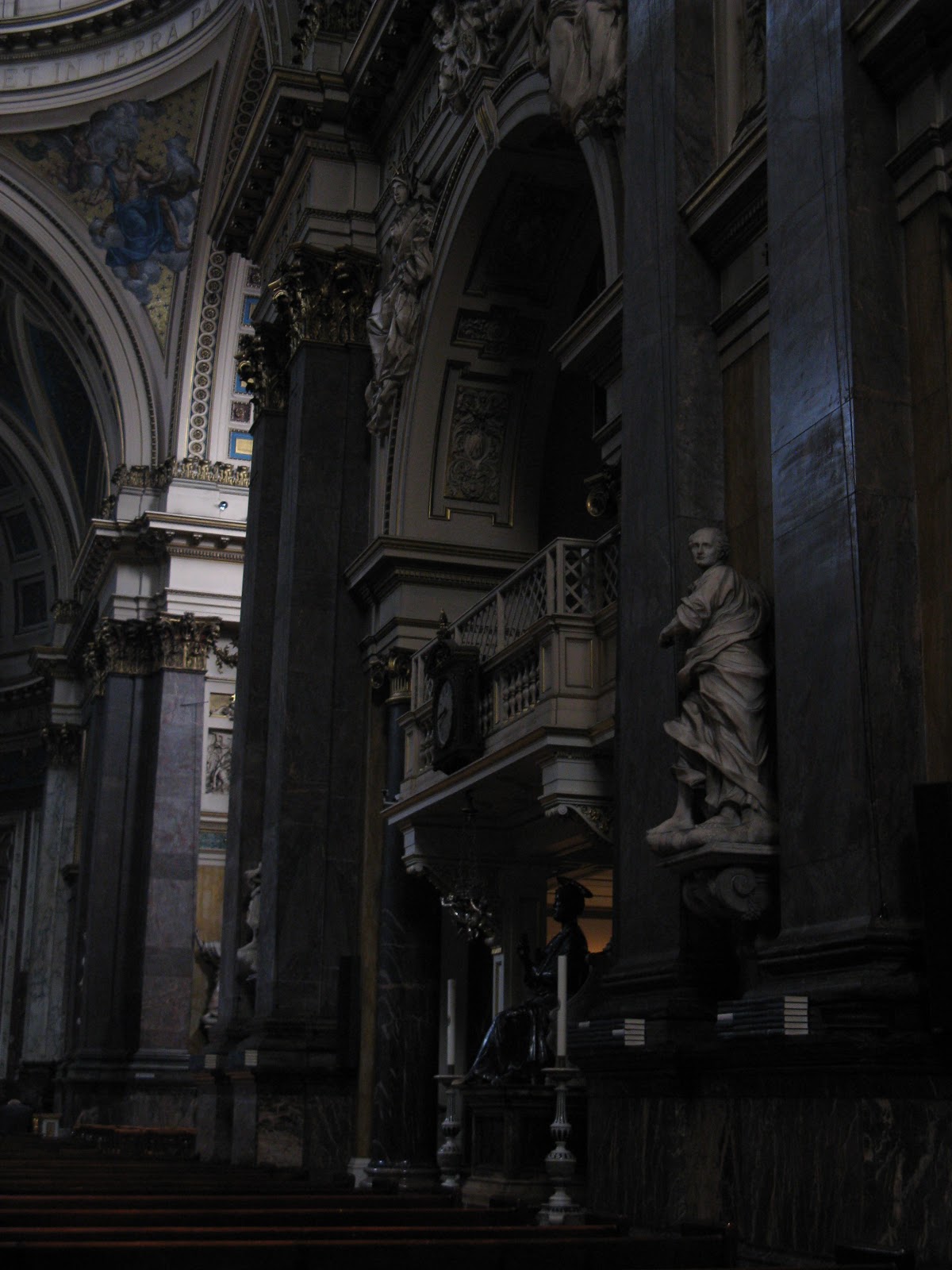
The London Oratory was founded in 1849, the year after John Henry Newman established the Birmingham Oratory, by Frederick Faber and some companions. However, it was not until 1854 that the community moved to its present site, then the outskirts of London, described by Father Faber as "The Madeira of London". By contrast, today sees its nestled amongst trendy stores and coffee bars, a quick stroll from Harrods, with the constant bustling of London traffic outside and the rumbling of tube trains beneath. The present church was consecrated in 1884 built to the design of a recent convert, Herbert Gribble, although the facade on the south end was not finished until 1893 and the dome completed in 1895. Building the Oratory cost £93,000 with a further £14,000 spent during the next decade. Until the opening of Westminster Cathedral in 1903, the London Oratory was the venue for all great Catholic occasions in London, including the funeral of Cardinal Manning in 1892. The Oratory is both internally and externally, a splendid building but the decoration we see today owes much to an Italian architect and local resident, Commandatore CTG Formilli who both designed and carried out the work between 1927-1932. The Oratory is dedicated to the Immaculate Heart of Mary.
Oratory Church

View of the North Transept and Pulpit
Mater Dolorosa Chapel
S. Philippo Neri Altar
Our Lady's Altar, originally from the Chapel of the Rosary in the Church of San Domenico, Brescia
Central Dome
Sacred Heart Chapel
West End of Nave
St. Peter and Newman Shrine
Arch, Entableture, Nave Window
St. Wilfred's Chapel

St. Wilfred's Chapel
St. Wilfred's Altar
Fr. Faber's Monument
Dome in St. Wilfred's Chapel
Side Altar and Tomb
Funerary Chapel in St. Wilfred's Chapel
Side Altar in St. Wilfred's Chapel
Side Altar of the English Martyrs
Our Lady of Mount Carmel Altar
Towards the Rear
Side view of Our Lady's Altar from St. Wilfred's Chapel

Saturday, 9 April 2011

Beatification Report - Newman Chapel at The London Oratory

As part of the celebrations for the beatification of John Henry Newman the London (Brompton) Oratory, commisioned a new chapel dedicated to its founder. The new chapel was designed by Russell Taylor who had already been responsible for refurbishing St. Joseph's Chapel, the central chapel on the North side of the nave, where many of the early morning Masses take place. The estimated cost of the new chapel of Blessed Cardinal Newman was £109,020. It is found behind the shrine to St. Peter on the South side of the nave just next to the dome, beneath the organ loft. I was told that it replaced the Calvary chapel. The chapel has a low ceiling and efforts have been made to offset this in it's design. The focal point that draws the eye into the shadowy recess of the chapel is a copy of Sir John Everett Millais’s portrait of John Henry Newman in Arundel Castle. Underneath the portrait is the motto from his grave cross: Ex umbris et imaginibus in veritatem (out of shadows and phantasm into truth) and on the font of the altar are Blessed Cardinal Newman’s arms and his motto Cor ad cor loquitur (heart speaks unto heart). The two small windows either side of the shrine have trellis screens that diffuse the light that makes the Chapel darker but also more accessible. This may be as impressions of it seem somewhat overshadowed by the grandeur of other aspects of the very impressive building. The chapel is also somewhat understated in comparison to the new shrine at Birmingham Oratory. However, this is perhaps unsuprising given that with the exception of his time in Ireland, it was at Birmingham that Newman spent almost the entirety of his life as a Catholic.

The Nave and Dome


Saint Joseph's Chapel


The Shrine of St. Peter and Choir Gallery from the side


Shrine of Saint Peter and Choir Gallery from the front


View of Our Lady's Altar and St. Wilfred's Chapel beyond from the Newman Shrine


View down the side Chapels from the Newman Shrine

Saturday, 2 April 2011

Masses for the Holy Father

After three years of trying, we have at long last been given permission to organise a Mass for the Birthday (16th) and Anniversary of the Election (19th) of Our Holy Father, Pope Benedict XVI. The Mass will be celebrated in the Gregorian Rite on Saturday, 16th April, at 2 p.m. in St. Andrew's Church, Bagenalstown, Co. Carlow.


St. Colman's Society for Catholic Liturgy asks us to inform you that its annual Solemn High Mass in Latin for the intentions of Pope Benedict XVI will be celebrated at Sts Peter and Paul’s church, Cork City, on Easter Monday 25 April 2011 at 12.30 pm. The members of the Society are encourage to attend and to pray for the Holy Father as he begins the seventh year of his Pontificate. The music for the Mass will be provided by the Lassus Scholars, Dublin, under the direction of Miss Ite O’Donovan. All are welcome to participate at this liturgical celebration. Enquiries to the Society’s secretary at colman.liturgy@yahoo.co.uk or at tel. 021 4813445

Ad Multos Annos, Sancte Pater!