Sunday, 19 September 2010

Beatification Report - Beatification of Cardinal Newman


Today saw the beatification of John Henry Newman by Pope Benedict XVI, he is the first person to beatified by the present Holy Father in person. This honour is perhaps due to the fact that the he is said to admire Newman deeply and indeed to have been a follower of his work since the seminary. But it marks another first, as Newman is the first Englishman, except for the martyrs, to have been beatified since the Reformation. The Holy Father spoke today about Britain’s history of martyrs:

"England has a long tradition of martyr saints, whose courageous witness has sustained and inspired the Catholic community here for centuries. Yet it is right and fitting that we should recognize today the holiness of a confessor, a son of this nation who, while not called to shed his blood for the Lord, nevertheless bore eloquent witness to him in the course of a long life devoted to the priestly ministry, and especially to preaching, teaching, and writing."

The ceremony took place at Cofton Park in Birmingham, very near to the Oratory Retreat House where Newman was buried. It is estimated that over 50,000 people attended the event, with coach loads of pilgrims coming from all over the country. Some visitors including a number of OratoriansI have been lucky enough to meet over the last week had travelled from all over the world.


So much will and indeed already has been written about today in addition to the extensive TV coverage that means that so many of you reading this will have seen much of the Mass for yourselves. Therefore it seems that there is little I can add without making this a more personal account of the event.

Certainly most if not all of the pilgrims had an early start. When we boarded our coach (our rucksacks and stools attracting curious stares from the revellers still leaving nearby nightclubs) for most the excitement was overcoming any feelings of tiredness. This was heightened when one of the Priests onboard lead prayers for the day during the journey. I was amazed when we arrived at the venue and I saw the incredible number of coaches already parked up and huge throngs of people crowding the road on the walk up to the park. I don’t think I have ever been at an event with even close to the number of people and I hadn’t comprehended the reality of the sheer numbers.


There was an overwhelming feeling of friendship and companionship throughout the event. From arriving at the pick-up point right through the day people chatted easily with their neighbours whether they were strangers or friends. It was great to get to speak to so many people who had travelled from overseas for the event. In particular I was struck by my neighbours for the Mass itself. Oratorians from New Jersey, one described the significance of the beatification to him with what felt like as much of sense of excitement and kinship to Newman as I have heard from those from Newman’s own Oratory.


In the true tradition of English weather it rained and the morning started bleakly. Even after the sun began to rise the cold and wet remained and after a couple of hours this was beginning to dampen some of the outward signs of enthusiasm. At 8am the event began and spirits began to lift despite the weather. The BBC were recording for Radio 4’s Sunday Worship from the park. This appeared to inject energy into the gathering and with the pilgrims joined in enthusiastically singing along.


The large screens positioned at the front of the park worked well and allowed us all to have a good view of proceedings. A recording of the Holy Father boarding the helicopter earlier in the morning was shown and the crowd erupted into flag waving and cheers. This was repeated when a helicopter hovered over Cofton Park but it was sadly false hope, more of which occupied the next few minutes as helicopters abounded; the security services were clearly keeping a very close eye on the venue. However, at this point the rain with an immaculate sense of timing started to clear, as many people remarked, almost in anticipation of the Holy Father’s arrival at Cofton Park.


When footage came up of the Holy Father touching down near the venue the park erupted. For a few minutes the crowd followed his progress being driven from his landing site to the Park itself with a palpable and growing excitement. Once in the park after some greetings with officials and dignitaries he boarded the Pope Mobile and drove amongst the excited crowds who were thronging around the paths.


With all the priests and guests in place we waited some minutes for the Pope to take his place in the Sanctuary for Mass. The ceremony took place in a mixture of Latin and English, you can read the full text here from page 127 and the homily here. Quite a number of Newman’s works featured within it and one of the Deacons was Jack Sullivan, an American whose cure from a spinal condition was the miracle that led to today’s ceremony.


Father Richard Duffield, Provost of the Birmingham Oratory, spoke briefly about Newman's Life. I was surprised at how short the actual Rite of Beatification was but the response from the crowd to the Pope’s confirming the beatification was tremendous. At this point the backdrop for the Sanctuary changed and in addition to the colourful background we were graced with a huge image of Newman, almost surveying the assembled pilgrims that had gathered on the grounds where he once walked. I heard much positive comment throughout the day about that fact that his feast day was to be ninth of October, the anniversary of his conversion rather than the anniversary of his birth or death.


The Pope talked not only about Newman the scholar but also Newman the Priest. He lived out that profoundly human vision of priestly ministry in his devoted care for the people of Birmingham during the years that he spent at the Oratory he founded, visiting the sick and the poor, comforting the bereaved, caring for those in prison.

He went on to touch on the esteem in which he was held by many in his adopted city. In the run up the beatification I have read much of Newman and heard many peoples’ perspectives; those of Newman scholars and biographers and those of others like me attending the various events. It felt appropriate to me that the Holy Father chose to remind people of this, the aspect of his life that seems least talked about, indeed sometimes forgotten for the scholar, the writer and the theologian.


One image that particularly stood out for me was the rows of Priests making their way out into the crowds of pilgrims to distribute communion. This was carried out remarkably quickly and efficiently given the huge numbers involved but still respectfully. Another enduring recollection will be the reverential silence that punctuated the Mass. Silence is perhaps a strange thing to focus on in relation to an event that had more people at it than any I have ever attended but thus the quiet of so many people was I think was even more startling. Linked to this for me was the new experience of being part of so many people praying together both in person and with a shared goal.


Despite seeing some comments about the organisation in the run up to it that made me concerned, with the exception of the regrettably early start I thought the whole day was very well organised and ran smoothly. This was a huge occasion and even with some experience of managing events I can only begin to imagine the logistical nightmares involved so credit goes to all those responsible. I don’t profess to sufficient knowledge or understanding of Newman to be able to conjecture with any credibility on what he might have thought of today. However, I certainly think that it was a day on which he was truly honoured and revered and one he could be proud of.

Beatification Report - Performance of The Dream of Gerontius

Last night, following the beatification conference was a performance of The Dream of Gerontius at Birmingham Town Hall. Newman's poem set to Edward Elgar's music first premièred in this venue one hundred and ten years ago.

Elgar was clearly very proud of work and felt it an "honour to attempt to set it to music." At the end of the score which he presented to the Birmingham Oratory he wrote "This is the best of me."

Written in 1865 The Dream of Gerontius tells the story of man near to death and the journey of his soul after his death, you can find the text here. Newman wrote of it "On the 17th of January last it came into my head to write it, I really cannot tell how. And I wrote on till it was finished on small bits of paper, and I could no more write anything else by willing it than I could fly. These were probably for the waste-paper basket.

Richard Hutton in his biography of Newman said "The Dream of Gerontius though an imaginative account of a Catholic's death, touches all the beliefs and hopes which had been the mainstay of Newman's life, and the chief subjects of his waking thoughts and most vivid impressions. It is impossible to read it without recognizing especially that Newman had always and steadily conceived life as a Divine gift held absolutely at God's will, not only in regard to its duration, but also in regard to the mode and conditions of its tenure."

The programme for the event told us "Newman, like his patron St Philip, was well aware of the power of music to express the most profound ideas and draw people to God. Indeed he was himself a talented musician."


The event was well attended with special guests including the Lord Mayor of Birmingham and Her Royal Highness Princess Michael of Kent. In opening the event Father Richard Duffield Provost of Birmingham Oratory commented that the opportunity to hear one of Newman's great works was excellent preparation for the following day's beatification.

The performance was given by Birmingham's Ex Cathedra choir and the Orchestra of the Age of Enlightenment who use period instruments.


Saturday, 18 September 2010

Beatification Report - J H Newman by his Biographers, Official Beatification Conference


Come and hear the most renowned scholars on Cardinal Newman assess the man, his career, his message and his enduring significance" was the billing for this event at Birmingham's International Convention Centre. Over a hundred people attended, those from further afield including a group from the Cardinal Newman Society of America and Oratorians from around the world.

The biographers in question speaking on the day were Father Ian Ker, Oxford University, Father Michael Lang of the Vatican's Congregation for Divine Worship and Professor Sheridan Gilley of Durham University, who also gave the lecture on Newman and Birmingham earlier this week. They were joined by Father Keith Beaumont of the Oratory of France and the author of the official beatification biography which was launched at the conference.

The conference was opened by Father Richard Duffield, the Provost of the Birmingham Oratory who reminded us of the Holy Father’s comments on the plane about Newman’s awareness of the problems and culture of his own age. He went on to observe that the Holy Father may have chosen to beatify Newman personally as in him he may see a kindred spirit; a man who had messages in the nineteenth century that echo those that he himself wants to be heard today.

Professor Gilley was the first speaker, reflecting much of the content of his lecture earlier in the week. The Professor reminded us that Newman’s contemporary Cardinal Manning was often depicted as practical ‘Martha’ to Newman’s contemplative Mary. He concluded his session by saying "Newman’s strength as a master of the intellectual and spiritual life remains to inspire us."


Father Ian Ker reflected on the fact that Newman had anticipated much of the Second Vatican Council. He talked about Newman’s belief that Church Councils were times of great trial and that a living idea cannot be isolated from intercourse with the world around it. He reminded us of Newman’s words with a quote that later speakers also echoed "It is indeed sometimes said that the stream is clearest near the spring. Whatever use may fairly be made of this image, it does not apply to the history of a philosophy or belief, which on the contrary is more equable, and purer, and stronger, when its bed has become deep, and broad, and full."

Father Ker also talked about Newman being drawn to St Philip Neri’s Oratory with its more individualistic approach than other orders. Newman described St Philip Neri as having "the breadth of view of St. Dominic, the poetry of St. Benedict, the wisdom of St. Ignatius, and all recommended by an unassuming grace and a winning tenderness which were his own."


Father Michael Lang talked about Newman’s relationship with the early Fathers of the Church and the intimate connection between his study of them and his spiritual journey. He described Newman’s reflections on doctrinal development as one of his principle contributions to Catholic theology.


Our final speaker was Father Keith Beaumont who was launching his book on Newman, the official beatification biography. We discovered at this point that we had been joined by another distinguished visitor for the launch, Her Royal Highness Princess Michael of Kent.

Father Beaumont who lives in France treated us to a whistle stop tour through the French perspective on Newman over the years. This included some amusing examples from the first (and unauthorised!) French translation of Newman’s work which was done by a lady with a limited grasp of both English and theology. My apologies but I was laughing too much to capture them! (Father Beaumont if by some chance you read this perhaps you will post them?) Some of his challenges in writing an official biography were shared with us as well as that of trying to write a short account without oversimplifying much about Newman.

Father Beaumont shared with us his belief that whilst Newman is the object of a great deal of devotion, fervour and piety but also his concern that few read and study his work thoroughly rather than focusing on extracts. Newman was said to be a thinker, theologian and spiritual guide but foremost a pastor of souls who would urge people not only to think about God but to seek him. He went on to tell us that Newman placed theology in the service of spirituality and renewed the concept of what it meant to be a Christian by returning to the Bible and early Church Fathers.

He told us that Newman’s approach was to speak to people and advise them with a view to deepening their relationship with God and that whatever honour Newman felt personally in being made a Cardinal he was more interested in the status it would give to his work.


Father Duffield thanked all the speakers and HRH Princess Michael. He complimented Father Beaumont on his deep understanding of Newman which came across in the book and his appreciation for that fact so many of Newman’s words were allowed to speak for themselves in the carefully chosen extracts. He closed the conference with an instruction to the delegates to both enjoy and pray hard at the beatification.


The conference was followed by a civic reception attended by Birmingham's Lord Mayor and a private viewing of the Newman Exhibition at the Birmingham Museum. You can see photos of the exhibits in my earlier post.

The conference was filmed by EWTN so do check their schedules if you would like listen to the speeches. All I have been able to do is capture a few scant snippets from the extensive sessions and these have been limited somewhat by poor understanding of some of aspects of the sessions on my part and also an inability to take accurate legible notes at speed!

Thursday, 16 September 2010

Beatification Report - Cardinal Newman Exhibition

To coincide with the beatification Birmingham Museum and Art Gallery is playing host to an exhibition of ”rarely seen items from the life of Cardinal John Henry Newman”. Amongst the exhibits are many not generally on public view. Most items are loaned from Birmingham Oratory’s own collection and were in Newman's rooms at the Oratory. Below are photographs of the exhibits.

Cardinal's robes, hat and shoes @ 1879. Newman reputedly complained that it was very expensive to be fitted out as a cardinal!


Pectoral cross and chain, silver gilt with garnets, 19th Century.


Crozier, 1860. Silver inset with semi precious stones and micro mosaic.


Jewelled mitre, 1879, presented to Newman when he became a cardinal. Silk and gold thread inset with semi precious stones. I can't even begin to tell you how incredible the workmanship is, but the photographs really don't do this justice!


Oil portrait on canvas of Newman by William Thomas Roden, 1879. This portrait was commissioned to celebrate his appointment as a Cardinal although Roden chose to depict him as an ordinary priest.


Shell engraved with the Immaculate Conception of the Blessed Virgin Mary, 19th Century.


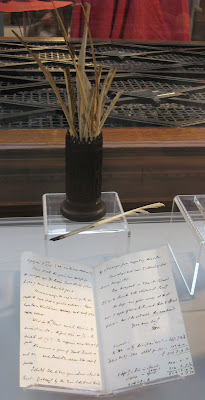
Metal pot with used and sharpened quill pens from Newman's study at the Birmingham Oratory. Also a letter from Newman to a printer dated 1840 concerning the production costs.


Statuette bust of St Phillip Neri, founder of the Congregation of the Oratory. Ivory turned on wooden base.


Portrait of 'The Virgin in Glory' @ 1860. Oil paint on ivory in silver mount.


Portrait bust of Newman by Richard Westmacott, 1841. The sculptor was at school with Newman in Ealing.


The number of items included in the exhibition was less than I was expecting but it does offer a unique opportunity to view some beautiful relics one is not normally able to see.

For those that would like to visit, the exhibition runs until 6th January 2011, entry is free of charge and you can find more information about the venue here.

Tuesday, 14 September 2010

Beatification Report - Newman and Birmingham Lecture

Newman and Birmingham was the title of the first of a series of events taking place in Birmingham leading up the beatification of John Henry Newman. Around 300 people attended the lecture, on Monday 14th September, hosted by Birmingham University's Barber Institute and organised in conjunction with Birmingham Oratory. The speaker was Professor Sheridan Gilley, former lecture in theology at the University of Durham and author of ‘Newman and His Age’ This biography was written whilst the Professor was an Anglican though he has since followed Newman to the Catholic Church.

The lecture touched on many aspects of Newman’s life and that of his contemporaries as well as his links with Birmingham. The Professor’s words painted a vision of the city of Newman’s age, one in which he spent a significant portion of his later life as a Catholic.

He told us that, being close to the centre of the industrial revolution, Birmingham was the heart of the ‘Workshop of the World’. The population of the city grew rapidly during this period with the need for labour being fed both from surrounding areas and further afield. In 1851 just one quarter of its population were regular churchgoers.

Birmingham was at the centre of the Catholic revival thanks at least in part to the charismatic Cardinal Wiseman (founder of the Dublin Review) and to Oscott College which was within easy reach of the city. Indeed St Chads, built between 1839 and 1841, was the first cathedral to be built in England after the Reformation.

The Catholic population of the city was largely made up of Irish immigrants, many of who fled the hardships of Ireland during the potato famine to seek work in England’s increasingly industrialised cities

Newman’s original city location for his Oratory was in Alcester Street. It opened on February 2 1849 in a former gin distillery and here he taught Sunday school and classes in the evening. Funds were scarce with the community living on a frugal diet of salt beef and salt cod; poor Irish immigrants would have made up much of Newman’s early congregations. All of this was a far cry from his life as an Anglican Minister eating at High Table in the colleges of Oxford.

Despite this Newman seems to have developed a love for the city and its people. Indeed he famously declined an invitation to preach in Rome:

'The Oratory, Birmingham: July 25, 1864.
'Dear Monsignore Talbot,—I have received your letter, inviting me to preach next Lent in your Church at Rome to "an audience of Protestants more educated than could ever be the case in England."

However, Birmingham people have souls; and I have neither taste nor talent for the sort of work which you cut out for me. And I beg to decline your offer.
'I am, yours truly,
JOHN H. NEWMAN'


What stood out for me from this lecture and my other reading is that Newman was clearly a man who thrived in a diverse range of environments gaining respect and affection from people of all backgrounds and beliefs; from the slums of an industrial city to Oxford’s Colleges, from the more affluent environs of the London Oratory to Dublin society. Surely to be able to do so in his time was a greater achievement than even it would be in our own?

Father Richard Duffield, Provost of the Birmingham Oratory, thanked Professor Gilley for such an interesting opening to the week of events leading up to the beatification. He left the audience with the thought that in these times we should follow Newman’s words and have “clear heads and holy hearts” and St Paul's guidance ”to hold fast to that which is good”.

Feasts dependant on the Exaltation

It was interesting for me to read how the Exaltation has been treated like a mini Good Friday to place feasts that would otherwise fall in Lent. The most obvious of course, is Our Lady of Sorrows, which formerly fell on the Third Sunday of September (and thus after the Holy Cross) until St. Pius X fixed it for September 15.

But another interesting feast that depends on the Holy Cross is the Transfiguration on August 6. 40 days before the Holy Cross as, according to tradition, the Transfiguration took place 40 days before Good Friday - but that would place it in Lent. Unlike the later mediaevel and Renaissance eras, people then were finicky about including feasts in Lent - it was the custom of the Fathers that it be solely for penitence. So they decided to have it forty days before the Holy Cross. You'll also note that a number of martyrs are placed around this feast and that the Stigmata of St. Francis occurs in close proximity to it.

This tradition is also why the Gospel of the Second Sunday of Lent is that of the Transfiguration.

Published in September, 2007

Summorum Pontificum - Tres Abhinc Annos


This day brings together three themes that have figured in the mind recently. The first, the Most Holy Sacrament, and the honour due to it. The second, Our Most Holy Father, Pope Benedict XVI, as he begins his visit to Britain. The third, the third anniversary of the coming into force of Summorum Pontificum. For all his many gifts, especially those wrought through Our Holy Father the Pope, thanks be to God!

Monday, 13 September 2010

Beatification Report - Life of John Henry Newman

John Henry Newman was once described as the most dangerous man in England. The words he chose for his memorial read ‘ex umbris et imaginibus in veritate; out of shadows and phantasm into truth’. Perhaps both are equally valid for a man who has caused and continues to cause controversy and yet also to inspire.


John Henry Newman was born in 1801 into an Anglican family and from a young age he felt drawn to religion. After graduating from Oxford University he was ordained as an Anglican minister. In the following years as a minister in Oxford he wrote extensively as he did for much of the rest of his life and was openly critical of Catholicism.

Newman travelled throughout Europe during 1832 visiting Rome which he said was "the most wonderful place on earth". Whilst on these travels he became seriously ill and on his recovery returned to England in the belief that God had work for him to do there. Over succeeding years Newman was a leader of the Oxford Movement which sought to reform Anglican doctrine based on its descent from the early Church and combat the State’s influence over the Anglican Church. Throughout the period Newman became increasingly drawn to the Catholic Faith, beginning to draw parallels between Anglicanism and heresies of the early church.


In 1841 Newman he began living an almost monastic existence with close friends at Littlemore, a period he described in his Apologia as “on my death-bed, as regards my membership with the Anglican Church”. February 1843 saw him publish a retraction in a local paper of all his previous condemnation of Rome and this was followed in September by his resignation of his living as an Anglican minister.

In 1845 Newman was received into the Church by Blessed Dominic Barberi. The conversion of perhaps the best known Anglican minister to Catholicism in a country still rife with prejudice created huge shock. For the remainder of his life Newman experienced misunderstanding and distrust from both Catholics and Protestants.


Of his conversion The Tablet said “…the Anglican Establishment has been deprived of the largest mind and the most penetrating intellect lately to be found, at least among her ecclesiastical children. The least part of what has occurred is that a man informed by profound genius has passed from heresy to the Church; has brought over to the camp of truth the stores of his profound learning, of his active and disciplined intelligence.”

Newman went to Rome to study for the priesthood in 1846 and whilst in Rome he discovered the Oratory founded by Saint Philip Neri in the sixteenth century. On his return to England in 1848 he set up the first English Oratory at Maryvale just outside of Birmingham. Three years later the Birmingham Oratory moved to its present site in Edgbaston on what is now the outskirts of the city centre. Newman along with his fellow Priests, worked with the poor of the city which was rapidly expanding as a result of the industrial revolution.


Newman also went on to establish the London Oratory under Father Faber as well as a school linked to the Birmingham Oratory. A prolific author Newman published a huge array of works, in later life sometimes writing for up to 17 hours a day.


Newman lived out his life at the Birmingham Oratory with the exception of a period in Dublin. In 1851 Newman was invited by the Bishops of Ireland to be rector of a new Catholic University, the formation of what is now part of University College, Dublin. 1855 saw the commencement of the building of the University Church on St Stephen’s Green which Newman felt would “recognise the great principle of the university, the indissoluble union of philosophy and religion”. Whilst the University was not a successful venture the Church remains, a monument to his time in Dublin. I think you can see a certain likeness between the style of University Church in Dublin and the cloister of the Birmingham Oratory


In 1879, when Newman was seventy eight, Pope Leo XIII named him a Cardinal, a rare honour for an ordinary priest. He obtained a dispensation to remain at the Birmingham Oratory. He adopted the motto ‘cor ad cor loquitur’; heart speaks to heart, the theme also chosen for Pope Benedict XVI's visit to the UK.


On 11 August 1890 Newman died at the Birmingham Oratory. On his death the Cork Examiner stated: ‘Cardinal Newman goes to his grave with the singular honour of being by all creeds and classes acknowledged as the just man made perfect.’


It was reported that 15,000 people lined the streets to see Newman’s cortege travel to Rednal where he is buried. This is next to Cofton Park where the beatification is taking place. He is said to have wished to hasten the process of decomposition with the addition of compost to the grave, in obedience to ‘Dust thou art, and unto dust shalt thou return’. It appears this wish was granted; when the coffin was recently exhumed as part of the beatification process no remains of his body were found.


The Times once wrote of Newman ‘whether Rome canonizes him or not he will be canonised in the thoughts of pious people of many creeds in England’. Declared venerable in January 1991 by Pope John Paul II, the 19th September sees his beatification. Should Newman go on to be canonized he would be the first English Saint since the Reformation not to have been a martyr
.

Saturday, 11 September 2010

Stop Host Desecration e-petition to YouTube

The American Society for the Defense [sic] of Tradition, Family and Property has an online petition here that you are strongly encouraged to sign. It asks YouTube to enforce their hate speech policy and remove from their site the videos of desecration of the Holy Eucharist, which Catholics recognize as the body of Jesus Christ, the central figure in our Religion.

Wednesday, 8 September 2010

Masses in Kildare


Mass in Newbridge, Co. Kildare

The Holy Sacrifice of the Mass in the Gregorian Rite will be celebrated according to the Missal of Blessed John XXIII (1962) in Cill Mhuire (not shown above), Newbridge, Co. Kildare, at 6 p.m., on Friday, 15th October, 2010, with the kind permission of the Very Reverend Parish Priest of Newbridge. The Mass will be followed at 8 p.m. by the Annual General Meeting of St. Conleth's Catholic Heritage Association in St. Anne's Parish Centre, Station Road, Newbridge, Co. Kildare.

St. Conleth of Kildare, pray for us!

Mass in Kilcock, Co. Kildare

A Requiem Mass in the Gregorian Rite will be celebrated according to the Missal of Blessed John XXIII (1962) in the Church of St. Coca, Kilcock, Co. Kildare, at 11 a.m. on Saturday, 20th November, 2010, with the kind permission of the Very Reverend Parish Priest of Kilcock. The Mass will be offered for the deceased members of St. Conleth's Catholic Heritage Association.

St. Coca of Kilcock, pray for us!

Thursday, 2 September 2010

Abhinc Duos Annos

So tomorrow is the feast of Pope St. Pius X. St. Pius X is remembered for many things - his promotion of frequent communion, his motu proprio Tra le Sollecitudini on sacred music (whose prescriptions encountered enough evasion even in his day, but I'll leave that for another time), his encyclical Pascendi and the Anti-Modernist Oath. Possibly the latter two were in mind when the author of his collect wrote "the strength of an apostle to defend the Catholic faith"? In any case, I think he must be best remembered for that- it certainly earned him a society.

One of the things he is not remembered perhaps so well for is his role as a reformer. Perhaps nowadays reformer has a decidedly negative connotation for some. I think in some ways he was a bit of a purist. He initiated the original reform which, in addition to touching on various aspects such as sacred music, the purity of liturgical art (no more depictions of the Blessed Virgin dressed in priestly garments), also touched on the liturgical year and the breviary and the missal. I've always been interested in that, particularly since so little information seems to be available about the work of his commission.

In any case, truthfully or no, every pope from Pius XII to John Paul II, have attributed their reforms as a continuation of his work particularly as espoused in his letter Abhinc Duos Annos. The encyclical was written months before his heavenly birthday (23 Octobris 1913): AAS 5 (1913), 449-450.

ABHINC DUOS ANNOS, cum Constitutionem Apostolicam ederemus Divino afflatu, qua id proprie spectavimus, ut, quoad fieri posset, et recitatio Psalterii absolveretur intra hebdomadam, et vetera Dominicarum Officia restituerentur, Nobis qui dem alia multa versabantur in animo, partim meditata, partim etiam inchoata consilia quae ad Breviarii Romani, susceptam a Nobis, emendationem pertinerent; sed ea tamen, cum ob multiplices difficultates tune exsequi non liceret, differre in tempus magis commodum compulsi sumus.
Etenim ad compositionem Breviarii sic corrigendam ut talis exsistat, qualem volumus, id est numeris omnibus absoluta, ilia opus sunt:
-Kalendarium Ecclesiae universalis ad pristinam revocare descriptionem et formam, salvis tamen pulcris accessionibus, quas ei mira semper Ecclesiae, Sanctorum matris, fecunditas attulerit;
-Scripturarum et Patrum Doctorumque idoneos locos, ad genuinam lectionem redactos, adhibere;
-sobrie Sanctorum vitas ex monumentis retractare;

Liturgiae plures tractus, supervacaneis rebus expedites, aptius disponere lam vero haec omnia, doctorum ac prudentum iudicio, labores desiderant cum magnos, turn diuturnos; ob eamque causam longa annorum series intercedat necesse est, antequam hoc quasiaedificium liturgicum, quod mystica Christi Sponsa, ad suam declarandam pietatem et fidem, intelligenti studio conformavit, rursus, dignitate splendidum et concinnitate, tamquam deterso squalore vetustatis, appareat.
Interea ex litteris et sermone multorum Venerabilium Fratrum cognovimus ipsis et permultis sacerdotibus esse optatissimum, ut in Breviario una cum Psalterio nova ratione disposito suisque rubricis adsint mutationes omnes, quae ipsum novum Psalterium vel iam secutae sunt vel sequi possunt. Quod cum instanter a Nobis peterent, simul significarunt se vehementer cupere, ut et Psalterium novum usurpetur frequentius, et Officia Dominicarum serventur ea studiosius, et incommodis Officiorum translationibus occurratur, et alia quaedam quae bonum videatur mutari, mutentur. Huiusmodi Nos vota, utpote rerum veritati innixa Nostraeque admodum consentanea voluntati, grate equidem accepimus: iis autem obsecundandi nunc esse tempus arbitramur. Certiores enim facti sumus officina Aores libraries, qui sacrorum Rituum Congregation! inserviunt, exspectantes dum Breviarium Romanum decretorio modo ac definitive corrigatur, in eo esse ut novam interim ipsius Breviarii editionem adornent. Hac uti occasione visum
(he goes on to list several reforms later incorporated into the breviary, such as Sundays, psalms during Octaves and other stuff)

TWO YEARS AGO, in publishing Our Apostolic Constitution, Divino Afflatu, We had especially in sight the recitation, as far as possible in its entirety, of the Psalter on weekdays, and the restoration of the ancient Sunday offices. But Our mind was occupied by many other projects – some mere plans, others already on the way to realization – relating to reform in the Roman breviary.
However, because of the numerous difficulties preventing Us from executing them, We has to postpone them for a more favourable moment. To change the composition of the Breviary to make it in accordance with Our desires, that is, to give it a finished perfection in every part would involve:
-restoring the calendar of the Universal Church to its original arrangement and style, retaining meanwhile the splendid richness, which the marvelous fruitfulness of the Church, the Mother of Saints, has brought to bear upon it.
-utilising appropriate passages of Scripture, of the Father and doctors, after having reestablished the authentic text;
-prudently correcting the lives of the Saints according to documentary evidence

Perfecting the arrangement of numerous point of the liturgy, eliminating superfluous elements. But in the judgment of wise and learned persons, all this would require considerable work and time. For this reason, many years will have to pass before this type of liturgical edifice, composed with intelligent care for the spouse of Christ to express her piety and faith, can appear purified of the squalidness brought by time, newly resplendent with dignity and fitting order.
In the meantime, through correspondence and conversations with a number of bishops, We have learnt of their urgent desire – shared by many priests – to find in the Breviary, together with the new arrangement of the Psalter and its rubrics, all the changes which have already come or which might come with this new Psalter. They have repeatedly asked Us, indeed they have repeatedly manifested their earnest desire that the new psalter be used more often, that the Sundays be observed more conscientiously, that provision be made for the inconvenience of transferred offices, and that certain other changes be affected which seem to be justified. Because they are grounded in objectivity and completely conform to Our desire, We have agreed to these requests and We believe the moment has come to grant them.

Most of the reforms envisioned in this Apostolic Constitution were not carried out. But it is not difficult to see the rationale in this letter for the reforms of the 1950’s and the early 1960’s, even to an extent of the Liturgia Horarum though I’m pretty sure he would have balked at the extent of the latter. Calendar correction, “superfluous elements”, emphasis on the documented vita of the saints for the II Nocturn. Most shocking, perhaps, (at least, for me it was) his description of the Office as “squalore”, squalid (keep in mind this is the breviary used until John XXIII). It is quite a strong word, perhaps one that might occasion a lot of criticism today.I had thought of a super ending to this post, but I can't remember it now. Drat. In any case, contemplating our liturgy today (as a whole and not just the breviary), can we say that the reforms of the 60's have brought us "dignity and fitting order"? Lord God, you filled Pope St. Pius with wisdom and gave him the strength of an apostle to defend the Catholic faith and to renew all things in Christ. Grant that we may follow his example and teaching and so come to our reward in heaven. Through our Lord Jesus Christ, your Son, who lives and reigns with you and the Holy Spirit, God, forever and ever. Amen.

Lex Orendi, lex credendi. Holy Pius, pray for the defense of the Catholic faith especially through an authentic renewal of the liturgy.

Published in August, 2007

Wednesday, 1 September 2010

St. Pius X - Part IV


On this day one hundred years ago, St. Pius X issued the Oath Against Modernism to be sworn to by all clergy, pastors, confessors, preachers, religious superiors, and professors in philosophical-theological seminaries.

Sancte Pie Decime, Gloriose Patrone, ora pro nobis!