Saturday, 20 February 2010

St. Brigid of Kildare - Seventh Annual Pilgrimage


This afternoon the seventh Annual Latin Mass Pilgrimage to the Shrine of St. Brigid of Kildare took place. The procession to and from St. Brigid's Well, Tully, Co. Kildare, took place as usual at 12.30 p.m. After the procession, at 2.30 p.m., Revd. Fr. Desmond Flanagan, Ord. Carm., celebrated Mass in the Gregorian Rite in the Parish Church of St. Brigid, Kildare Town. Three servers and a congregation of forty four were also in attendance.


In his sermon, Fr. Flanagan said that we are extremely lucky in this Country to have so many associations with the Faith everywhere we look. Kildare is a great centre of the Faith in Ireland but is neglected today. St. Brigid is perhaps our greatest native Saint who founded a great ecclesiastical city in Kildare that she ruled with St. Conleth as Bishop. Her glorious example of sanctity and religious life spread throughout Ireland. The Irish missionaries brought the great tradition of religious life begun by St. Brigid to the rest of Europe and later to the whole world.


Another fine heritage we have from St. Brigid is the sanctuary lamp. It was she who began the perpetual flame of Kildare to signify the presence of God who is always with us. Every time that we come into a Church and see the flame of the Sanctuary lamp, we know that Jesus Christ, True God and True Man is really, truely and substantially present in the Tabernacle under the appearance of bread. What a glorious gift to countless generations of Catholics this is. How many of us have been consoled in this vale of tears by the sight of St. Brigid's lamp ever-burning before the Blessed Sacrament? This is another gift of St. Brigid to the Church and another great example for us, that of devotion to the True Presence of Our Lord in the Blessed Sacrament.


Ireland was indeed the Island of ancient Saints and Scholars but is is still so today? St. Brigid was a sterling Saint, a woman of Faith and a woman of prayer but she also was a woman who lived the Faith by her example of charity towards her neighbour. He said that the Faith was very much in decline today but that the answer is in our own hands. If each of us in our own lives lives is able to live truely Christian lives not just on pilgrimage and not just on a Sunday morning but seven days a week, we would have made a great start towards bringing our Country back to the Faith.


After Mass, Fr. Flanagan gave Benediction of the Blessed Sacrament in the traditional form. Adoremus in Aeternum Sanctissimum Sacramentum!


St. Brigid of Kildare, pray for us!

Friday, 19 February 2010

Latin Mass Statistics

Rorari Caeli has pointed out recently released statistics for the availability of the Traditional Latin Mass across the World (except Ireland, for some reason) as of February 2010. The raw statistics and methodology are available here (in French).

A few headlines are that:

The United States has 289 episcopally authorized every Sunday Latin Mass sites out of a total of 359 (approved + SSPX) with a total Catholic population of 64.6 million. That is 1 episcopally authorised every Sunday Latin Mass site per 223,000 Catholics.

Switzerland has 21 episcopally authorized every Sunday Latin Mass sites out of a total of 45 (approved + SSPX) with a Catholic population of 3.2 million. That is 1 episcopally authorised every Sunday Latin Mass site per 152,000 Catholics.

Britain has 37 episcopally authorized every Sunday Latin Mass sites out of a total of 53 (approved + SSPX) with a total Catholic population of 4.8 million. That is 1 episcopally authorised every Sunday Latin Mass site per 129,000 Catholics.

Germany has 49 episcopally authorized every Sunday Latin Mass sites out of a total of 88 (approved + SSPX) with a Catholic population of 26,297,000. That is 1 episcopally authorised every Sunday Latin Mass site per 537,000 Catholics.

Austria has 11 episcopally authorized every Sunday Latin Mass sites out of a total of 19 (approved + SSPX) with a Catholic population of 5,755,000. That is 1 episcopally authorised every Sunday Latin Mass site per 523,000 Catholics.

Canada has 23 episcopally authorized every Sunday Latin Mass sites out of a total of 39 (approved + SSPX) with a Catholic population of 13 million. That is 1 episcopally authorised every Sunday Latin Mass site per 568,000 Catholics.

Australia has 17 episcopally authorized every Sunday Latin Mass sites out of a total of 28 (approved + SSPX) with a Catholic population of 5,239,000. That is 1 episcopally authorised every Sunday Latin Mass site per 308,000 Catholics.

New Zealand has 6 episcopally authorized every Sunday Latin Mass sites out of a total of 10 (approved + SSPX) with a Catholic population of 459,000. That is 1 episcopally authorised every Sunday Latin Mass per 79,000 Catholics.

Population figures are as in the Pontifical Year Book for 2005.

Ireland had a Catholic population of 4.2 million according to the same statistics. Ireland has 6 episcopally authorised every Sunday Latin Mass sites out of a total of 11 (approved + SSPX). That is 1 episcopally authorised every Sunday Latin Mass site per 694,000 Catholics.

Holy Patrons of Ireland, pray for us!

Tuesday, 16 February 2010

Vatican Two Hundredth


Today we've seen our two hundredth visit from the Holy See to this blog. Welcome back, your Holiness!

Monday, 15 February 2010

From the Pontifical Commission Ecclesia Dei


The Polish New Liturgical Movement blog and later the main New Liturgical Movement blog have published a clarification from the Pontifical Commission Ecclesia Dei dated 20th January, 2010, which states:

Easter Triduum in the Extraordinary Form of the Roman Rite

1. If there is no other possibility, because, for instance, in all churches of a diocese the liturgies of the Sacred Triduum are already being celebrated in the Ordinary Form, the liturgies of the Sacred Triduum may, in the same church in which they are already celebrated in the Ordinary Form, be additionally celebrated in the Extraordinary Form, if the local ordinary allows.

Celebrating a normal scheduled Mass in the Extraordinary Form of the Roman Rite

2. A Mass in the usus antiquior may replace a regularly scheduled Mass in the Ordinary Form. The question contextualizes that in many churches Sunday Masses are more or less scheduled continually, leaving free only very incovenient mid afternoon slots, but this is merely context, the question posed being general. The answer leaves the matter to the prudent judgement of the parish priest, and emphasises the right of a stable group to assist at Mass in the Extraordinary Form.

Scheduling Mass in the Extraordinary Form of the Roman Rite in the absence of a request from the faithful celebrated even for those unfamiliar with the Extraordinary Form

3. A parish priest may schedule a public Mass in the Extraordinary Form on his own accord (i.e. without the request of a group of faithful) for the benefit of the faithful including those unfamiliar with the Usus Antiquior. The response of the Commission here is identical to no. 2.

The use of the 1970 Calendar, Readings and Prefaces Forbidden in the Extraordinary Form of the Roman Rite

4. The calendar, readings or prefaces of the 1970 Missale Romanum may not be substituted for those of the 1962 Missale Romanum in Masses in the Extraordinary Form.

Readings in the Vernacular in the Extraordinary Form of the Roman Rite

5. While the liturgical readings (Epistle and Gospel) themselves have to be read by the priest (or deacon/subdeacon) as foreseen by the rubrics, a translation to the vernacular may afterwards be read also by a layman.

Laudetur Jesus Christus in aeternum! Amen!

Sunday, 14 February 2010

Seventeenth Monthly Mass in the Diocese of Kildare and Leighlin


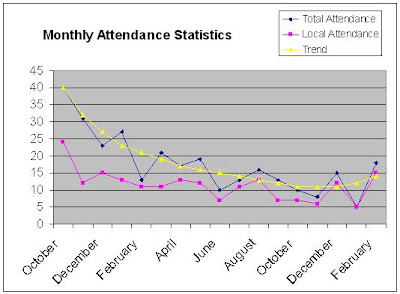
In a spectacular reversal of fortune, eighteen people attended the monthly Mass this month. This is the highest attendance since May, 2009, and it stabalises the monthly average attendance for the past 7 months at 12. It is the second time in the past 9 months that the attendance has exceeded 15. It is also the first time that our consultant statistician has had to adjust the trend upwards.

Saturday, 13 February 2010

The Tombs of Saints Brigid and Conleth at Kildare

Below is the famous description of the church at Kildare from the Life of Saint Brigid by Cogitosus. In it the hagiographer describes the tombs of Saints Brigid and Conleth, as well as painting a fascinating picture of the church and its practices. Cogitosus was himself most probably a monastic at Kildare and his Life is usually dated to the third quarter of the seventh century.

Neither should one pass over in silence the miracle wrought in the repairing of the church in which the glorious bodies of both - namely Archbishop Conleth and our most flourishing virgin Brigit - are laid on the right and left of the ornate altar and rest in tombs adorned with a refined profusion of gold, silver, gems and precious stones with gold and silver chandaliers hanging from above and different images presenting a variety of carvings and colours. Thus, on account of the growing number of the faithful of both sexes, a new reality is born in an age-old setting, that is a church with its spacious [site] and its awesome height towering upwards. It is adorned with painted pictures and inside there are three chapels which are spacious and divided by board walls under the single roof of the cathedral church. The first of these walls, which is painted with pictures and covered with wall hangings, stretches width-wise in the east part of the church from one wall to the other. In it there are two doors, one at either end, and through the door situated on the right, one enters the sanctuary to the altar where the Archbishop offers the Lord's sacrifice together with his monastic chapter and those appointed to the sacred mysteries. Through the other door, situated on the left side of the aforesaid cross-wall, only the abbess and her nuns and faithful widows enter to partake of the banquet of the body and blood of Jesus Christ. The second of these walls divides the floor of the building into two equal parts and stretches from the west wall to the wall running across the church. This church contains many windows and one finely wrought portal on the right side through which the priests and the faithful of the male sex enter the church, and a second portal on the left side through which the nuns and congregation of women faithful are accustomed to enter. And so, in one vast basilica, a congregation of people of varying status, rank, sex and local origin, with partitions placed between them, prays to the omnipotent Master, differing in status, but one in spirit.


S. Connolly and J-M Picard, 'Cogitosus's Life of Saint Brigit - content and value' in JRSAI, 117, (1987), 25-6.

This post was first published here.

Thursday, 11 February 2010

St. Gobnait of Ballyvourney

Twin towns fascinate me. I don't mean towns twined with foreign towns but two towns that are so close to each other that as they grow, they grow until they are almost one town. In Cork we have two good examples, Enniskean and Ballinkeen on the road to Bandon (where even the pigs were Protestant, it used to be said) and Ballyvourney and Ballymakeery that lie along the Sullane River and on the road thatt takes you from Macroom by way of Coolea over the top of Coom towards Kilgarvan in Kerry.

Bandon was a plantation town. That is, in the 17th century the native Catholic Irish were dispossessed of their lands and Protestants were planted in the locality instead. Over the gate of Bandon the following words were placed by the Planter inhabitants that "Turk, Jew or Atheist may enter here, but not a Papist". It wasn't long before native wit wrote the reply. "Whoe'er wrote this/ hath written well/ for the same is writ/ o'er the gates of hell".

St. Gobnait, another 6th century Saint, lived just to the south of Ballyvourney. Every year on this day and also at Pentecost there are large pilgrimages to do the "turas" or rounds of the beds of her church and to drink the water and a medieval wooden statue of her is displayed for veneration in the Parish Church.

Go mbeannaighe Dia dhuit,
a Ghobnait Naomhtha,
Go mbeannuighe Muire dhuit
is bheannuighim féin dhuit.
Is chughat-sa a thánag ag
gearán mo scéil leat,
Is a d'iarraidh mo leighis
ar son Dé ort.

That means in English:

May God bless you,
Holy Saint Gobnait,
And may Mary bless you,
And I bless you myself.
For it is to you that I come,
To plead my case with you,
To request my healing,
From you on God's part.

She made her foundation in fulfilment of a prophesy. She had fled from home to the Aran Islands to escape persecution but she was told that "her resurrection" was not to take place there but only in the place where she found nine white deer grazing. She returned to the mainland and began her pilgrimage. It is said that at various places she saw white deer grazing along her path but never nine together until she crossed the Sullane River at Ballyvourney and so she settled there and was buried there to await "her resurrection".

It is told of her that when a plague threatened, she marked the boundary of the Parish with her stick and the people of Ballyvourney were spared.

The beehive is the symbol of St. Gobnait because, when a pagan chief was attempting a cattle raid, she took up one of the beehives of the convent and directed it at the raiders. The thieves fled and the cattle were saved.

In the ruins of her church there is a smooth round iron ball set into the wall, known as St. Gobnait's Bowl. It is said to have been used to destroy a fort built by a pagan chief on the hills north of Ballyvourney and was said to have returned to the Saint each time she threw it. Those who have grasped the bowl in the wall will know the miraculous nature of this feat. The grave of Séan O'Riada, the famous musician of Coolea, is here.

A few miles north of Ballyvourney, close to the Foherish River that feeds into the Sullane near Macroom, is Liscarrigane where 'An tAthair Peadar' or Canon Peter O'Leary was born in 1839. His great purpose was to revive the Irish language that he knew as a living language (and which remains a living language in that part of Cork to this day). He wrote "Séadna" and the autobiography "Mo Scéal Féin" which give a vivid impression of the countryside around Liscarrigane and Muskerry.

The Glendav of "Séadna" is to be found at the head of the Foherish valley where Mullaghanish Mountain rises to a height of over 2,000 feet, towering over the Derrynasaggart Mountains that shelter Cork from Kerry but are now punctuated by wind turbines just as a broadcasting mast stands atop Mullaghanish.

He was an outstanding member of the Gaelic League and received the Freedom of buth Cork City and Dublin as well as an honorary Doctorate from the National University of Ireland. He died away to the north east of the County as Parish Priest of Castlelyons just a few months before the achievement of Independence at the height of the Black and Tan persecution.


Devotion to St. Gobnait was given international standing in 1601 when Pope Clement VIII granted an indulgence for pilgrims to her shrine and in 1602 he published a proper office for her feast.

These dates are not coincidental for they mark the last stands of the Irish princes against the English with the help of the Kings of Spain. In 1602 the Irish princes were defeated at the Battle of Kinsale. It spelled the end of the Catholic cause in Ireland for more than three centuries and the end of the the power of the native Irish princes forever. Donal O'Sullivan Beare held out in his castle at Dunboy on the Beara Penninsula for another year but was finally starved into retreat. His famous winter march brought him to the territory of the princes of Ulster, O'Neill and O'Donnell, who were themselves forced into complete exile on the continent in 1607.

O'Sullivan Beara continued to uphold the honour of Ireland while in exile in Spain, where he was assassinated in 1618 by an Englishman. He founded the Irish College at Santiago. His nephew Philip O'Sullivan Beare was both soldier and scholar, publishing Historiae Catholicae Iberniae Compendium, a Catholic History of Ireland in 1621 among other works in an attempt to reply to the English writers who attacked the Irish, just as their compatriots attempted to destroy our native culture and its texts.

Friday, 5 February 2010

The Standing Stone: Clonenagh Church and Cross Slabs, Co. Laois

Before getting to the subject of today's post I just want to answer some of the questions that were asked in the comment box concerning Ardristan and other topics. I felt the questions needed some proper thought and the proper space to deal with them that the comment box doesn't provide.

JTS wrote: ‘Has Ardristan been included on any heritage preservation list? If not why not? Does the standing stone have a view on this?’

All archaeological sites in Ireland are protected under the National Monuments Acts of 1930 and 2004. If an owner of an archaeological site wishes to interfere with or carry out work near that site 2 months notification must be given to the relevant Minister and the National Monuments Service will assess if and how this work can be carried out. Unfortunately this doesn’t protect a site from simply falling down which is sadly the case at Ardristan. There are four basic strategies that are employed when dealing with historical sites.

1. Restoration – This is probably the best option even if the real motiv
ation is earning money from tourism. It ensures that work is carried out to make a place safe and stable and we get a fairly accurate glimpse of a place as it once was.

2. Conservation – This makes a place safe and stable with no rebuilding being carried out. It preserves places in their current state for future generations.

3. Ignore the site – This is the most common practice and is exactly what is happening to Ardristan.

4. Demolition – The site is destroyed. Fortunately this costs money so doesn’t happen too often. Road building is mostly to blame for sites being destroyed.

I would like to see more done for sites. We are fortunate to have so much archaeology in Ireland left for us today but it is rapidly disappearing from our landscape. Basic conservation work could stop a lot of this but it is, of course, a costly exercise. Most restoration that is carried out is done to sites in private ownership. For example, there is the trend in Ireland to convert castles into hotels. However tasteless this may appear it does prevent further destruction to the site. I have been told by many sites owners, who are seeking to carry out restoration or conservation work, that it is very hard to get permission to do so because of the amount of ‘red tape’ that has be worked through. In recent years it has become easier to restore and co
nserve sites because of the involvement of the EU who are keen to preserve sites in Ireland for tourism.

I apologise for the lengthy answer.

Random Thinker wrote: ‘Looks like an unspoilt site. Is it just a good came
ra angle or is this really a site that is not under threat from development?’

As far as I am aware there are no plans to develop near Ardristan. It is largely farm land surrounding the site. There are two standing stones to the North of the church and one to the south so I would imagine that developing anywhere in the area would be difficult.

Alice W wrote: ‘Do you take a view on the preservation of these sites and their relevance to the modern inhabitants to them? Clearly there is some ambivalence in the modern attitude to them, possibly informed by increased materialism/secularism/distance from a common rural heritage. At the same time, it doesn't appear that the Irish have embraced such sites even after emancipation from penal oppression. In fact, it would appear that t
here was a flight from associations with oppression from early on in the Roman Catholic revival in 19 cent. Ireland. Any views?’

In regards to the preservation of sites please read the answer I gave to JTS above. I totally agree that there is ambivalence in the modern attitude. Modern materialism may have something to do with this as you suggest. We have gone through such a rapid change in the past 30 years that we may have become too obsessed with being modern and this has come at the expense of our history. I don’t believe secularism has had a negative effect on historical sites because the ambivalent attitude you mentioned is not confined to ecclesiastical sites. Castles, churches, ancient tombs and more modern fortified houses are victim to the same attitude. Secularism has allowed for a plurality of views and attitudes when dealing w
ith historical sites. The lack of a rural heritage amongst communities may be part of the problem as people no longer feel any connection to a site whether it be positive or negative. These places have now just become part of the scenery so to speak. Maybe in time as the memories of oppression fade people will begin to find a new found interest in these sites. Hopefully it will not be too late.

I hope I didn’t spend too long on these questions and that I answered them sufficiently for you. I look forward to your response.

Please enjoy this week’s article which deals with the fascinating site of Clonenagh in Co. Laois.


Location
– On the N7 between Mountrath and Portlaoise. The church is located on one side of the road while the cross slabs are on the other. Parking is easy here. The church is located at OS: S 387 956 and the cross slabs are located at OS: S 389 958.

Description and history – Little remains now of this once important ecclesiastical site. Now divided by the N7 this is all part of the one complex allegedly founded in 548 by St. Fintan. Nothing remains of the original structure which was destroyed in 838 by the Vikings. The site was plundered again in 937 by the King of Cashel and the Danes of Waterford. Legend says that 7 churches have been located at this site in its history with the remains of one still there and archaeological evidence for 2 others. The present remains are of a 16th century church which was later used as a Protestant church and the graveyard is still used. A holy well, now destroyed, was associated with the site as is a holy tree located there. Before the tree collapsed some years ago, the water that collected in the trunk was thought to have healing properties. The tree collapsed due to severe metal poisoning. It was traditional to hammer coins into the tree as a votive offering. Fortunately new branches have started to grow from the remaining stump, but the coins still persist. I would advise that you don’t hammer coins into the tree and pull out any that you can.

As you would expect of an important site there are many stories surrounding the complex. One interesting story is about a Protestant minister, Rev Sandys, who, after appearing drunk in the pulpit was expelled from the Church of Ireland. He, however, convinced his parishioners that he was still the serving minister and began to offer marriages at any time for the price of 1 pound. He didn’t even require witnesses in order to write out a marriage certificate. Eventually, nearby ministers made sure that Sandys was found out and he was sentenced to death which was reduced to a short term of imprisonment. He was forcibly removed from Clonenagh. As a form of revenge on the Church of Ireland he eventually became a Catholic priest.

Two interesting stories involve St Fintan himself. One tale is that St Fintan would quarry the sand for the building of the church late at night from the Downs in Portlaoise. The local people wondered where he got the sand from and one man set to find out. One morning he saw Fintan returning from the Downs with his horse who he was guiding with a stripped holly branch. The man asked Fintan where he got the sand from. Fintan was so angered at this display of mistrust that he turned the horse into stone and threw the holly stick down which grew into a holly tree. The location of this stone horse is rumoured to be between Clonenagh and Ballyfin but locals who know of its location will not divulge its location to others.

The second tale is that one day Fintan was returning from the Downs once again with his cart full of sand and met a woman who was building a house. She asked for some sand but Fintan refused saying he needed it for his church. She asked if he would give a thimbleful to her and he agreed and when the thimble was full all the sand was gone.

Onto the church and cross-slabs...

Church – Dating to the 16th century, little now remains of this sandstone and limestone building. It is roughly 9m in length and 6.5m wide. Around the arches there are some fine examples of hammer-dressed limestone. In the surrounding churchyard is a stone carved with a human face and another with a skull and crossbones. I was unable to locate these two stones because of the long grass.

Cross Slabs – These recently discovered stones are a wonderful sight and give you a glimpse into the art of the early church in Ireland. These stones date to the 6 and 7th centuries and have a variety of decoration on them. On some stones there are some more modern designs carved onto the early stones and these designs date to the 17th century. These stones are rare in Laois and are important for the county. However, there are fast eroding and when compared to photographs taken only 15 years ago the amount of erosion is shocking. As a matter of conservation they need to be removed to the safety of a museum. The graveyard in which they are kept is poorly maintained and the stones are surrounded with rubbish that had been thrown in by people stopping in the car park. These stones will not be around much longer unless conservation work is carried out.

Difficulty – These two sites are easy to get to and are located directly on the N7. Be careful of the traffic as cars race around this area. The graveyards are poorly maintained and there are many low grave markers that can be easily tripped upon.

This post appeared originally on 'The Standing Stone' and can be found here.

This is the 16th century church. It is in a poor condition with a lot of rubble inside.

This window is in the East end of the church. It was added in the 17th century and is a nice example of a standard Gothic revival window in Ireland. We have little genuine Gothic architecture in Ireland.


The pictures do not do these slabs justice.


This is what remains of the holy tree after years of poisoning by coins.

Saturday, 30 January 2010

Saint Fine, Abbess of Kildare

This is the first in a series of posts on saints of the Diocese of Kildare and Leighlin from my blog Under the Oak. My site is dedicated to the saints of Ireland and I explore their lives and the spiritual legacy of the early Irish church. I use as a primary source the Lives of the Irish Saints by John, Canon O'Hanlon, supplemented by other sources and more recent scholarship.

O'Hanlon has a very short entry for Fine or Finia, an eighth-century abbess of Kildare, whom the great 17th-century Irish hagiologist, Father John Colgan, believed had reposed on January 9 in the year 800, an event recorded in the Irish Annals:

St. Finia or Fine, Abbess of Kildare. [Eighth Century.]

Because truth and innocence of life distinguish holy virgins, they live without stain before the throne of God. We are informed by Colgan, that Finia, Abbess of Kildare, died on the 9th of January, a.d. 800. The same year is set down for the death of this Fine, in the Annals of the Four Masters.

Although it is not expressly stated, Colgan seems to regard this day as dedicated to her memory.

It seems impossible to discover much else about this particular successor to Saint Brigid as an individual, but Christina Harrington, in her valuable work on the role of women in the Irish church, can place the office of abbess into a context for us:

The sources of material on Irish abbesses are extremely patchy, and the overall quantity of evidence quite slim. The Irish left no guiding or prescriptive texts on this office; there is no surviving correspondence such as is found in Anglo-Saxon England and which proves so illuminating for the abbess’s position there. There is a small but important quantity of legal material in which are found occasional notes concerning abbesses’ rights and privileges; there is a large amount of hagiography containing anecdotes about abbesses; and there are annal entries for abbesses of the most famous houses...

In female saints’ Lives, the characterization of the foundress serves repeatedly to restate the holy ideal not only for the ordinary nun, but also for the abbess, since in Ireland the major female saints were abbesses. As the spiritual heir of the foundress saint, the abbess was supposed to manifest at least in part her patron’s virtues and be in her own lifetime a role model in the religious life. The Lives also offer insights into the practicalities of an abbess’s duties, both to her own nuns and also to the outside world. Thus the foundress formed the prototype for the abbess’s role, both spiritually and practically....

In her community of nuns, the abbess too was the supervisor and governor, domina and mother. In the female Lives, the abbess is the person who is directly responsible for ensuring the monastery’s survival. She decides if the community is to move location. She procures food and beer in times of scarcity, and organizes help in fending off attackers in times of danger. It is she, for example, who asks for charitable help from clerics, monasteries, and other nunneries when her own community runs into difficulty.

Decisions on who joined the familia were within the abbess’s remit: it was she who approved the intake of novices and the adoption of fosterlings and abandoned babies. She was responsible for the maintenance of the moral standard and adherence to the rule. Then there were matters of discipline, and in the Lives the abbess appears as inspector, judge, and setter of punishments.

Like the foundress saint whose heir she was, the abbess had to strive to embody the seemingly contradictory qualities of world-renunciation and temporal dominion. She was to uphold the ascetic tradition whilst at the same time shoring up and even expanding her church’s sphere of control...

One of the abbess’s most important tasks in the continued work of aggrandizing her church was the provision and reception of hospitality, which in early medieval Ireland formed one of the major currencies of social interchange, social cohesion, and assertion of power and status. Failing to provide hospitality to those whose rank warranted it brought dishonour upon the failed host; providing abundantly brought status, and fulfilled economic and/or ecclesiastical obligations...

The ideal abbess was a provider of abundance to all the religious superiors who came to her community. A poem attributed to St Brigit from the tenth or eleventh century, shows her as the giver of hospitality: the feast she provides is one of spiritual nourishment, and her overlord is none less than Christ and the hosts of heaven. Hospitality was a Christian virtue and Brigit its exemplar, just as Monenna was treated as an exemplar of the discipline of fasting.

C. Harrington, Women in a Celtic Church- Ireland 450-1150 (Oxford University Press, 2002), 165-169.

Harrington has much more to say about the office of abbess, and has a particularly interesting analysis of the power that these women were able to wield in both the secular and the ecclesiastical spheres. Irish law did not see women as legally competent and some of the sources upheld the need for all women to have a male 'head'. In theory this would seem to create a problem for Abbesses as the equivalent of male 'heads' of religious communities. Yet the sources also indicate that this was not necessarily so in practice. Harrington sees the accounts of abbesses acting as confessors or soul-friends as especially important to the question of 'headship', although of course an Abbess could not hear confession in the sacramental sense. Indeed, some Abbesses were even prized as soul-friends by men, Saint Samthann of Clonbroney is one famous example. Abbesses like Fine were also drawn from the Irish aristocracy of the day and thus derived some of their authority from their connections to powerful ruling families. In her case this authority was bolstered by the fact that Fine was the heir to a foundress of exceptional sanctity, and it is surely a mark of how important a figure the Abbess of Kildare was felt to be that the Irish Annals continued to record the deaths of the successors of Saint Brigid for centuries after her passing.

This post was originally published here.

Tuesday, 26 January 2010

Pilgrimage in honour of St. Brigid of Kildare

Pilgrimage in honour of St. Brigid of Kildare on Saturday 20th February 2010.

Procession to St. Brigid's Well, Tully, departs from St. Brigid's Parish Church Kildare Town at 12.30 p.m.

Mass in the Traditional Latin Rite in St. Brigid's Parish Church Kildare Town at 2.30 p.m. followed by Benediction.

A Map of the locality can be found here.

Saturday, 23 January 2010

Mass @ St. Paul's

St. Conleth's Catholic Heritage Association organised a Mass this morning for Christian Unity Octave, or Week for Christian Unity, in St. Paul's Church, Arran Quay, the home of the Irish San Egidio Community. This was the second time that we had been to St. Paul's, the last being last January, during the Holy Year of Saint Paul.

This year the celebrant was Fr. James Larkin, P.P., who gave a magnificent sermon on Christian Unity that, he said, was not the work of human dispute resolution like the Labour Court or the result of a compromise on the essentials of the Faith, but was the work of the Holy Spirit, which was why we need to pray, especially during this Christian Unity Octave, for the unity of all who believe in Christ.

The soloist during the Mass was the magnificent Miss Máire Mullarkey, who was able to lead the congregation in singing the common of the Mass and traditional hymns, as well as singing the Mozart Ave Verum (k. 618) and Panis Angelicus from César Franck's famous Messe à trois voix. Miss Mullarkey is a well-known wedding singer among other professional singing engagements. We were all deeply moved by her singing.


Friday, 22 January 2010

The Standing Stone: Ardristan Church, Co. Carlow.

This will be the first in a series of posts about some of the ecclesiastical ruins in the Kildare and Leighlin Diocese which I hope will be informative and not too boring for you. I run a small website called ‘The Standing Stone’ which deals with places of historical interest in the midland region. I was kindly asked to contribute to this blog with information and history about certain places. I have followed the format that I use on my own site. First, I will give the location of the site with Ordinance Survey co-ordinates. Second, I will give a description of the site along with any history that is known and finally I will mention how difficult it is to visit the site. For my first post I have selected Ardristan Church in county Carlow. It is in a poor state and will give you an indication of the condition of some of our history.

As for myself, I am a biblical historian and run my website purely out of interest in our wonderful heritage in my spare time.

I hope one day we will meet amongst the ruins…

Ardristan Church, Co. Carlow.

Location – On the N81 just S of Tullow. OS: S 842 711 (map 61).

Description and History – This ruined church is in a very poor state in one of the worst kept graveyards that I have visited. This is very unfortunate since some of the graves are still visited and it must be upsetting for the relatives to have to battle the undergrowth to get to the grave of their loved one. I visited this site in November and it was all but impenetrable so in the height of summer it must be a nightmare. The church is in a poor condition but there was probably more to see under the brambles. I couldn’t even get into the church to see. The foundation of West gable is exposed and consists of some massive boulders. The nave and chancel was divided by a pointed arch which collapsed in the 1940’s – luckily the E gable is still standing to a height of about 4m. The church would have been about 17m in length and 7m wide. It is hard to date this church since little is known about it but it clearly medieval and built in the Gothic style.

Difficulty – Easy to find and has a small lay-by for parking. There is a memorial to people who died in the 1798 rebellion there and steps leading to the graveyard. Effort, at some point in time, was put into this site but it has clearly not been kept up which is sad.

Ardristan Church, Co. Carlow.

Ardristan Church, Co. Carlow.

Ardristan Church, Co. Carlow.

This article was originally posted on 'The Standing Stone' and can be found by clicking here.

Reblog this post [with Zemanta]

Saturday, 16 January 2010

A Tale of Two Towers

A view of Arran Quay from the West where the River Liffey flows
under Mellows Bridge with the Campanile of St. Paul's Church
and the Dome of the Four Courts Building on the skyline.

Two further pilgrimages for the Holy Year of Priests will be made on Saturday, 23rd January, to St. Paul's Church '@Smithfield' , Arran Quay, Dublin 7, for Mass in the Gregorian Rite at 11 a.m., and on Saturday, 1st May, to the Cathedral of the Assumption, Carlow, for Mass in the Gregorian Rite at 11.30 a.m.

Last year, we had Mass in St. Paul's to mark the Holy Year of St. Paul during the Octave for Christian Unity and we are glad to have the permission of the Administrator of the Church to return again during the Octave.

The details of the pilgrimage to take place in March will be announced later.

The Mass on the feast of Saint Joseph the Worker will be the first celebrated there in the Gregorian Rite in more than 40 years. The funeral of Bishop Thomas Keogh in 1969 would have taken place before the publication of the Novus Ordo Missae but the Liturgy would have followed the reforms of 1965 and 1967.

The Campus of Carlow College with the Cathedral of the Assumption.

Sunday, 10 January 2010

Sixteenth Monthly Mass in the Diocese of Kildare and Leighlin

Five unfortunates made their way through hazardous conditions today to attend the regular monthly Mass in the Gregorian Rite celebrated by a Priest of the Priestly Fraternity of Saint Peter, to be told that it had been cancelled the day before, although nobody bothered to tell even those local people who have attended faithfully for many months. It was the only Mass cancelled today in the Parish of Newbridge.


If consolation can be drawn from these figures, it is that the new low is only slightly lower than previous lows. 8 persons attended the Mass in November. 10 persons attended the Mass in October. 10 persons attended the Mass in June.


Approaching the town of Newbridge from the Bog of Allen, one crosses the Railway at Mooney's Bridge. The first sight is the distant clock tower of Newbridge College run by the Dominican Order since 1852, the same year as the completion of the Parish Church. The Dominicans have a long and proud association with the area since the year 1356. The FitzEustace family were the first patrons of the Dominicans in Kildare, which is one source of the devotion to St. Eustace, who is the patron of the Dominican Church. The symbol of St. Eustace, the stag with the cross between its antlers, familiar to patrons of Jägermeister beer, is found in several places in the Church and adjoining Priory.


This is a closer view of the same scene. It looks down towards the clock tower from the west from the top of Mooney's Bridge, which crosses the Railway Tracks between Mount Carmel Estate and Ailsbury Park Estate.


The Church of St. Eustace staffed by the Dominican Order is the third to stand on the site, having been consecrated in 1966 by Michael Cardinal Brown, O.P., who had been Rector Magnificus of the Angelicum, Master of the Sacred Palace, Master General of the Dominicans, and who served the Church with great credit during the Second Vatican Council. The Church was built in a traditional plan with the choir at the 'eastern end. The High Altar has as much space in front as behind, indicating that it was built to accomodated Masses celebrated both versus Deum and versus populum.

The Church has a set of stained glass windows depicting scenes from the book of the Apocalypse and has a large number of works by Fr. Henry Flanagan, O.P., who was a member of the Dominican Community in Newbridge for many years. He is responsible for the Stations of the Cross, the Calvary scene above the High Altar, the Statues of Our Lady within and of St. Dominic and Blessed Peter O'Higgins, O.P. without the Church. Five Sunday Masses were celebrated here today - none were cancelled.


Walking towards the Parish Church along the River Liffey, looking back upstream towards the Dominican Church and Newbridge College.


A view of Newbridge College from 'The Bridge' of Newbridge. The Church tower can just be seen over the trees to the left. The clock tower of Newbridge College can just be seen over the trees to the right.


The campanile of the tower of St. Conleth's Parish Church, Newbridge, County Kildare, where five Sunday Masses were celebrated today - none were cancelled.


St. Conleth's Parish Church, was built close to the banks of the River Liffey (from where this photo is taken). St. Conleth himself lived not far from here until called to become Bishop at the nearby Ecclesiastical City of St. Brigid at Kildare.


St. Conleth's Church Parish Church was built on land donated by the local Mansfield family in a very prominent spot, unlike so many Irish Catholic Churches of the period that are hidden away in back streets our outside the centre of towns on account of the prejudice of the powerful Protestant minority.

Construction began in 1847, at the height of the Great Irish Famine, and was completed in 1852. The Transepts and Sanctuary are later additions. The stone was carried by the local people by horse-drawn cart from the hill of Boston several miles away. The local people of Newbridge know how to thrive in difficult circumstances.

Next to the Parish Church is the Patrician Brothers' Primary School. The Congregation was founded in the Diocese by Bishop Daniel Delaney of Kildare and Leighlin in 1808. The school, in red brick, was completed in 1914. The Patrician Brothers took over the Boys National School in 1939.


Cill Mhuire (The Church of Our Lady) where three Sunday Masses were celebrated today - the only Mass to be cancelled there was the monthly Gregorian Rite Mass, cancelled without warning to the Congregation.

You are welcome to use the images in this post but please credit this blog when doing so.

Our Lady of the Snows, pray for us!

Saturday, 9 January 2010

Making the News (Part 4)

In this Part, I'm going to take a look at coverage of other religious events in Ireland by Pathé newsreels.

Corpus Christi Processions

The Corpus Christi Procession was a feature of Catholic life not only in Ireland but throughout the Church since the establishment of the feast in the 13th Cent. However, Ireland took a particular pride in honouring Our Lord in the Blessed Sacrament, for example, in Galway in 1924, in Artane in 1924 and 1925, the Irish Defence Forces in the Curragh Camp in 1925, Navan in 1930, in Bandon in 1941,

May Processions

As with Corpus Christi Processions, usually in June, the Irish made great efforts to honour Our Lady in her month of May. Good examples are found at Inchicore in 1921, then at Mount Argus in 1922 and 1923. However, Inchicore returned to pride of place again in 1924, 1927, 1928, 1929 and 1931.

Other Events

Pathé also covered the procession of the Franciscan Third Order in Killarney in 1921 and, in 1926, the celebrations marking the centenary of the arrival of the Dominicans in Waterford. In 1926, Sodalities are shown processing into St. Andrew's Church, Westland Row, Dublin. The Mullingar Confraternity processes in 1927.

The Patrician Year

In 1961, Ireland celebrated the 1,500th anniversary of the death of St. Patrick. Pathé newsreels cover the celebrations in Dublin and Armagh. I would also include the coverage of St. Patrick's Day for 1950.

Sunday, 3 January 2010

Traditional Mass in Celbridge


After the success of the Traditional Mass on the feast of the Immaculate Conception, the Parish of Celbridge, Co. Kildare, has decided to have another Traditional Mass at 7 p.m. on Wednesday, 6th January, the feast of the Epiphany of Our Lord.

Well done Celbridge!

Saturday, 2 January 2010

Making the News (Part 3)

Back in August, 2009, I posted twice on the Pathé newsreels available online. Part 1 covered the Bishops of Kildare and Leighlin (Drs. Foley, Cullen and Keogh). Part 2 covered Archbishop Byrne of Dublin (although this clip of his enthronement in 1921 was omitted). In Part 3, I want to look at the newsreel coverage of other Irish Prelates.

Archbishops of Armagh

Michael, Cardinal Logue (1840-1924) was elevated to the Archiepiscopal and Primatial See of Armagh in 1887. He was created Cardinal in 1893. He is shown attending the meeting of the Irish Hierarchy at Maynooth in 1921 and shown again before entering the Conclave that was to elect Pope Pius XI. His death in 1924 was the subject of a newsreel.

Patrick, Cardinal O'Donnell (1856-1927) succeeded Cardinal Logue as Archbishop of Armagh in 1924. He is seen here visiting Dundalk, a town in his Archdiocese, in 1926, the year he was raised to the purple of the Cardinalate. Also in 1926, his Eminence attended the famed Eucharistic Congress in Chicago. There are some outtakes from the same scene. His funeral, the following year, was also covered in newsreels.

Joseph, Cardinal McRory (1861-1945), was elevated to Armagh in 1928 and to the purple in 1929. In 1938, his Eminence blessed the new Mother House of the Columban Missionaries, the Maynooth Mission to China, at Dalgan Park, Navan, Co. Meath. In 1942, he was in Dublin to celebrate Mass in celebration of the Episcopal Jubilee of Pope Pius XII.

John, Cardinal D'Alton, Archbishop of Armagh (1882-1963) was appointed Archbishop of Armagh in 1946 and was created Cardinal in 1953. His death was marked both in Dublin and in Armagh.

In 1963, in the last ceremony in the Traditional Rite, Archbishop, later Cardinal, Conway, was enthroned as Archbishop of Armagh.

Archbishop of Cashel and Emly

In 1910, Most Reverend Dr. Fennelly, the Archbishop of Cashel and Emly, conducted a ceremony at the Rock of Cashel.

Archbishop of Melbourne

It's hard to say where the Archbishops of Melbourne stood in order of precedence in the Irish Hierarchy but Archbishop Mannix stood head and shoulders above them all. In 1920, protests about the outrageous mistreatment he received at the hands of English Armed Forces was protested in London. He visited a partly free Ireland in 1925. The principal consecrator of Dr. Mannix was Dr. Fogarty of Killaloe (see below for Ardagh and Clonmacnoise).

Lord Abbot of Mount Melleray

In 1931, Dom Stanislaus Hickey received the Abbatial Blessing as Lord Abbot of Mount Melleray Abbey in the Knockmealdown Mountains just to the North and East of Cappoquin, Co. Waterford. It is interesting to note that the Blessing took place in the old Abbey Church, which was soon to be replaced. Dom Stanislaus, likewise, was to be replaced in April of 1933 by the noted Dom Celsus O'Connell. Mount Melleray celebrated its centenary in August 1933, on which occasion Cardinal McRory (see above) laid the foundation stone of the new Abbey Ahurch. Preparations for building were started immediately, but the actual work did not start until January 1935. The striking new Church was completed and solemnly blessed in November of 1940.

Bishop of Kilmore

In 1937, Most Reverend Dr. Michael Lyons (d. 1949) was consecrated Bishop of Kilmore at the then Cathedral Church of St. Patrick in Cavan Town, Co. Cavan. Dr. Lyons also celebrated the centenary of the Little Sisters of the Poor in 1939.

Dr. Lyons was responsible for the building, between 1938 and 1942, of the present Cathedral in Cavan, the Cathedral of St. Patrick and St. Felim. It was, thus, one of the last cathedrals to be built in Ireland. It post-dates the Cathedral of Christ the King, Mullingar, the Cathedral Church of the Diocese of Meath, by three years. Only Galway's Cathedral of Our Lady Assumed into Heaven and St Nicholas, consecrated on its titular feast, 15th August, 1965, post-dates it.

Cavan Cathedral has the almost unique distinction among Irish Cathedrals in having the full length of its Altar Rails intact. Mirabile Dictu! Like its near neighbour, Longford Cathedral, the Cathedral Church of the Diocese of Ardagh and Clonmacnoise (see below), it uses the column as a principal feature.

Bishop of Cork

In 1920, the Most Reverend Dr. Daniel Coholan, Bishop of Cork, presided at the funeral (also here) of Terence MacSwiney, Lord Mayor of Cork, who had died a prisoner of the English. He is to be seen from about 2 minutes and 14 seconds in the first and at 2 minutes 50 seconds in the second. Dr. Coholan himself died in 1952 and was buried from his Cathedral Church. Dr. Coholan was at the heart of the struggle for Independence, witnessing not only the escalation of the War of Independence but also the ravages of the Black-and-Tans who shot and harrassed his Priests and People as well as burning a large area of the City of Cork in reprisal for the efforts of the Irish Volunteers.

Bishop of Ardagh and Clonmacnoise

In 1927, the funeral of Bishop Hoare of Ardagh and Clonmacnoise was filmed at the Cathedral Church of the Diocese in Longford Town, Co. Longford. Dr. Hoare having been appointed to the See in 1895, was 32 years as Bishop of Ardagh and Clonmacnoise.

One of Dr. Hoare's early acts as Bishop was to establish scholarships to the Diocesan College, St. Mel's College. He was equally concerned with the state of the library system that was being developed through the Carnegie Trust. He wrote: "I think the Organising Committee should have nothing to do with the Carnegie institution unless it allows you to select your own books," which was a measured compared with that taken by his confrere, Dr. Fogarty of Killaloe:

"I will have nothing to do with a Carnegie Library. I have seen some of these institutions. They are storehouses of wretched novels and semi-pagan stuff of the same cultural level as penny illustrated papers from England, which, I am sorry to say, our people buy and smoke like opium, with the same narcotic effect on their brains and better life. We have enough of that poison without taxing the people to supply more of it. What advantage are the ratepayers, already overburdened, from the mountains of Kinnitty to the bogs of Edenderry, going to get from supplying out of their slender purse lounges and novels to the cigarette-smoking, idle, mooning youths of Tullamore and like towns; for no one else is going to resort to your fanciful treasure houses? Any money that Ireland has to spare, even to the extent of millions, should be first of all put into making secure that cardinal industry on which her life depends. When that essential structure is made perfect, then we can think of libraries."

Dr. Fogarty, although he was 'only' the Bishop of Killaloe, was, in fact, an Archbishop and reigned in Killaloe from 1904 to 1955.

Dr. Hoare was succeeded as Bishop of Ardagh and Clonmacnoise by Dr. McNamee who was to participate in the Second Vatican Council and die in office in 1966, having reigned over the Diocese for 39 years.

Friday, 1 January 2010

St. Connat of Kildare

Today is the feast given in the Martyrology of Donegal for St. Connat or Comnat or Comnantan who was Abbess of Kildare in succession to St. Brigid until her death in the year 590.

Nothing is recorded of her life but it is an excellent opportunity to recall to mind the many excellent women of the Convent of Kildare, particularly her sister Abbesses, St. Darlaugdach, Abbess of Kildare, who was the immediate successor of St. Brigid and lived for but a year after the great foundress, St. Tulalla, a near contemporary of St. Connat, St. Sebdana, Abbess of Kildare, who died in the year 726, St. Affrica, Abbess of Kildare, who died in the year 738, and St. Finnia, Abbess of Kildare, who died in the year 801.

All ye holy Abbesses of Kildare, pray for us!