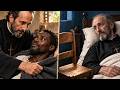
Sunday, 11 October 2009

Novena in honour of the Blessed Gerard - Day 7

Day Seven
Lord

In Blessed Gerard’s time, the title ‘Lord’ (Dominus) was used only for popes, bishops, emperors, kings and other distinguished persons; and yet Gerard was also called Dominus (in a document of 1112 regarding a foundation established for the honour of God by several bishops, which was dedicated to the Holy Sepulchre and the Hospital). The title ‘Lord’, as a term of honour, can only be justified if we recognize that all power and glory and honour belong to God alone, as we sing in the Gloria of the Mass: ‘You alone are the holy one, you alone are the Lord, you alone are the most high, Jesus Christ’. (Tu solus Sanctus, tu solus Dominus, tu solus altissimus, Iesu Christe). Perhaps it is time to reflect upon these words and our own relationship with the one Lord, Jesus Christ.

Prayer

Jesus Christ, holy one, Lord most high, may we recognize you in our lords the sick.
Lord hear our prayer.
Grant that we may see our responsibility as you would see it.
Lord hear our prayer.
Grant that all who hold office and authority in politics and business may contribute to
the good of all.
Lord hear our prayer.
Send your Holy Spirit that we may rightly judge our strengths and our weaknesses.
Lord hear our prayer.

Our Father... Hail Mary... Glory be to the Father…

Pray for us, Blessed Gerard
That we may be made worthy of the promises of Christ.

Let us Pray.
Grant, we beseech you, almighty God, that we who have received the grace to know the Lord is risen, may, through your Spirit’s love, rise to newness of life. We ask this through our Lord Jesus Christ your Son, who lives and reigns with you and the Holy Spirit, one God, for ever and ever. Amen. (Collect for Friday in the Octave of Easter)

Saturday, 10 October 2009

Novena in honour of the Blessed Gerard - Day 6

Day Six
Servant and Helper of the Hospital

Gerard described himself in 1101 as ‘servant (servus) of the Hospital of Holy Jerusalem’ in a document given to Pope Paschal II and the Patriarch Daimbertus;

And again, in 1110, to the Abbots of Cluny and of Moissac as ‘ servant and minister of the hospital’. ‘Servus’ means not only ‘helper’ or ‘servant’, but also ‘slave’, although we should keep in mind that even though slaves were not freemen, they were not, according to Roman Law, entirely without rights. ‘Minister’ is not a term of authority, as we might be led to think; minister, in this context, is to be understood much more as one who carries out the Lord’s will. Helper, servant, slave, assistant, executor of the Lord’s will: Who would be that today?

Gerard was and is thereby a call upon our obedience to God, to the Church, and the Superiors in our Order.

Prayer

Jesus Christ, obedient unto death, even death on a cross, strengthen and sustain us as your followers.
Lord hear our prayer.
Grant that we may recognize our responsibility for human life from its beginning.
Lord hear our prayer.
Bless all those who provide service in hospitals, homes for the aged and hospices.
Lord hear our prayer.
Help all people to serve you and their neighbour in the strength of the Holy Spirit.
Lord hear our prayer.

Our Father... Hail Mary... Glory be to the Father…

Pray for us, Blessed Gerard
That we may be made worthy of the promises of Christ.

Let us Pray.
Almghty and everlastingGod, who in the paschal mystery established the covenant of reconciliation with all mankind, grant that we may show forth in our lives what we solemnly profess. We ask this through our Lord Jesus Christ your Son, who lives and reigns with you and the Holy Spirit, one God, for ever and ever. Amen. (Collect for Friday in the Octave of Easter)

Friday, 9 October 2009

Novena in honour of the Blessed Gerard - Day 5

Day Five
Servant of God

“Dei servus”, helper, servant of God (in a document of Bishop Ademar di Rodez, 1120): This description of Blessed Gerard is a description often used by the Church for her members, the baptized. During the beatification process, as a declaration of heroic virtue, of an exemplary life, the candidate is accorded the title of ‘Servant of God’. The servant of the servants of God, ‘servus servorum Dei’, is also one of the titles of the Holy Father. We are all, therefore, servants of God; by his actions, Gerard demonstrated this fact to us in an exemplary fashion.

Prayer

Jesus Christ, Emmanuel, Messiah, preserve us from arrogance and selfishness.
Lord hear our prayer.
Keep us in your service.
Lord hear our prayer.
Grant that we may know our duty in the Church and in the world – and to fulfill it.
Lord hear our prayer.
Direct our hearts and minds towards the things of heaven.
Lord hear our prayer.

Our Father... Hail Mary... Glory be to the Father…

Pray for us, Blessed Gerard
That we may be made worthy of the promises of Christ.

Let us Pray.
O God, you dispose the hearts of the faithful as one in their desire; grant that your people may love what you command and desire what you promise, that amid the varied changes of this world, our hearts may be fixed where true joys may be found. We ask this through our Lord Jesus Christ your Son, who lives and reigns with you and the Holy Spirit, one God, for ever and ever. Amen. (Collect for Sunday XXI of the Year)

Thursday, 8 October 2009

Novena in honour of the Blessed Gerard - Day 4

Day Four
Guardian of Christ’s Poor

Gerard was called the ‘guardian of Christ’s poor’ (procurator pauperum Christi – in a document of Bishop Ademar di Rodez, 1120). Procurator can mean administrator or governor, but also representative, who acts on someone’s behalf in court. Through his works, Gerard was the defender of the poor, the weak, the abandoned. The term ‘Christ’s poor’ shows us that obsequium pauperum is a service rendered not only to the poor but also to Christ himself: “for I was hungry and you gave me food, I was thirsty and you gave me something to drink, I was a stranger and you welcomed me, I was naked and you gave me clothing, I was sick and you took care of me, I was in prison and you visited me” ( Mt. xxv:35-37).

Prayer

Lord Jesus Christ, Saviour, Redeemer, let us recognize you in the poor, the sick and the stranger.
Lord hear our prayer.
Bless and protect all the goods of the earth and give to all their daily bread.
Lord hear our prayer.
Call forth vocations for your service alone.
Lord hear our prayer.
Grant unto us the strength of the Holy Spirit to give of ourselves for the persecuted and oppressed, whether it suits us or not.
Lord hear our prayer.

Our Father... Hail Mary... Glory be to the Father…

Pray for us, Blessed Gerard
That we may be made worthy of the promises of Christ.

Let us Pray.
O God, you show to those in error the light of your truth that they may return to the right path; grant that all who profess the Christian faith may reject those things which are contrary to that name and follow such things that are appropriate to it. We ask this through our Lord Jesus Christ your Son, who lives and reigns with you and the Holy Spirit, one God, for ever and ever. Amen. (Collect for Sunday XV of the Year)

Wednesday, 7 October 2009

Novena in honour of the Blessed Gerard - Day 3

Day Three
Father of the Hospital

In the year 1120, King Baldwin of Jerusalem described Gerard as the’father’ (pater) of the Jerusalem Hospital.

A good father watches over his children with love and also with strictness when required. He is present when his family needs him. Gerard directed his foundation and regarded his paternal responsibility as a gift from God, as a talent to be used. In our days, we must never presume to set ourselves up as fathers, teachers or instructors on our own account (cf. Mt 23:9-11), but rather see our duties asparents, as superiors or as academics before God and man: All who exalt themselves will be humbled and all who humble themselves will be exalted. (cf. Mt. xxiii:12)

Prayer

Jesus Christ, God and man, Son of the Father: Help our families to see ever more clearly their duties as the domestic Church.
Lord hear our prayer.
Help couples to remain united in fidelity in a world hostile to marriage.
Lord hear our prayer.
Help parents and children to understand one another.
Lord hear our prayer.
Help academics, researchers and teachers to fulfil their duties responsibly in your sight.
Lord hear our prayer.

Our Father... Hail Mary... Glory be to the Father…

Pray for us, Blessed Gerard
That we may be made worthy of the promises of Christ.

Let us Pray.
O God, in love of you and of our neighbour, you have established everything that the sacred laws decree; grant unto us that, in keeping your commandments, we may enter into eternal life. We ask this through our Lord Jesus Christ your Son, who lives and reigns with you and the Holy Spirit, one God, for ever and ever. Amen. (Collect for Sunday XXV of the Year)

Tuesday, 6 October 2009

Novena in honour of the Blessed Gerard - Day 2

Day Two
Provider and Almoner

The term ‘provider’ (provisor: Paschal II, 1113) describes Gerard as a man capable of planning and foreseeing what the pilgrims, the poor and the sick would need and where help was required. Prudent organization put Gerard in the best possible position to fulfill his duties as an ‘almsgiver’ (elemosinarius: in a document of Count Adalbert de Perigord, 17th September 1116).

In today’s world, we stand in need of efficient organization of the Order* and its aid services which are active throughout the world. But organization must not become an end in itself or be smothered in paperwork. Its objective must be to act to bring assistance promptly and effectively.

We must never forget what the Lord says to us: whenever you give alms, do not sound a trumpet before you...let your alms be done in secret; and your Father who sees in secret will reward you (cf. Mt. vi:2).

Prayer

Lord Jesus Christ, friend of the poor and of the sick:
Grant to all people in this world an increase of peace and freedom.
Lord hear our prayer.
Give us a ready ear and open hand for those in want.
Lord hear our prayer.
Grant that we may never be entangled in worldly considerations, techniques and
statistics.
Lord hear our prayer.
Grant that all projects and planning maybe for the love of our neighbour.
Lord hear our prayer.

Our Father... Hail Mary... Glory be to the Father…

Pray for us, Blessed Gerard
That we may be made worthy of the promises of Christ.

Let us Pray.
Almighty and merciful God, let not the concerns of this world keep us from hastening towards your Son but let the guidance of heavenly wisdom make us into his companions, who lives and reigns with you and the Holy Spirit, one God, for ever and ever. Amen. (Collect for the Second Sunday of Advent)

*The Order in question is the Sovereign Military Hospitaller Order of Saint John of Jerusalem, of Rhodes and of Malta.

Monday, 5 October 2009

Novena in honour of the Blessed Gerard - Day 1

NOVENA IN HONOUR OF THE BLESSED GERARD
Founder of the Order of Saint John of Jerusalem


Coinciding with the end of our own Annual Novena for the perpetuation of the Traditional Latin Liturgy, and following upon an article in the most recent issue of our journal CHRISTVS REGNAT, the following novena was sent to me. I post it, not only because of the excellence of the subject but also on account of the introduction, which deserves to be more widely read.

Introduction

Specific rules and forms are helpful and indeed indispensable for the spiritual life of man. This principle applies in a particular way to the celebration of the liturgical year but also to prayer formulas which can be repeated to assist us in living our baptismal faith, even when our hearts may not be filled with the spirit of Easter.

The novena is a very ancient and most human form of devotion. In classical Roman times, there were novendialia - nine days of diverse sacrifices or nine days of preparation for a feast. The term novendialia is still used today with reference to the nine days of solemn liturgies following the death of a pope and the nine days between the Feast of the Ascension and the feast of the Descent of the Holy Spirit at Pentecost, which were always days of particular prayer (once called Expectation Week) for the Church.

The present form of the novena appeared in the 17th century. As a series of prayers to be completed in nine days, either privately or in common, its object was to ask a particular favour of God in conformity with Jesus’ teaching: “I will do whatever you ask in my name, so that the Father may be glorified in the Son” (Jn. xiv:13)

It is a good exercise in one’s prayer life to pray a novena individually while being spiritually united with others who are praying the same prayer at the same time.

Novenas are frequently made for a particular need. The novena here presented in honour of Blessed Gerard is offered in a specific way for the Order and all its works with a particular urgent prayer for vocations to the consecrated life.
In this way, we pray to be like the first Apostles at Pentecost :

All these with one accord were constantly at prayer, together with a group of women and Mary the mother of Jesus and his brothers (Acts i:14), that is to say, his next of kin (his “brothers” according to the language of the time) in company with all those who, through baptism, have become sisters and brothers of the Kyrios, the Lord, Emmanuel, the Saviour, the Redeemer, the Risen Christ.

The theme of the novena from day one to day seven is a contemporary interpretation of the life of Blessed Gerard, the historical information being based primarily on Alain Beltjens, Aux origines de l’Ordre de Malte, Brussels, 1995.

The Life of Blessed Gerard

Gerard was born between 1035 and 1040, some say to a noble Provencal family, or more probably in the city of Scala (Amalfi) where the powerful patrician families maintained particularly close ties with the Holy Land and had seen to the foundations of monasteries and small houses for the reception of pilgrims in Jerusalem.

It is possible that the terrible menace of Norman invasions started the young Gerard on his journey towards his future vocation, but it is more likely that he went to Jerusalem in order to be of assistance to pilgrims, thanks to the influence of a merchant named Mauro.

This charitable mission could be carried out easily under the role of the Caliphate of Egypt. However, in the battle of Manzikert (1071), the Byzantines were heavily defeated by the Seljuk Turks and 30,000 churches (among which the Basilica of the Holy Sepulchre in Jerusalem) were destroyed during the reign of the insane Caliph Hakim.

The ensuing persecution of Christians and obstruction of pilgrims provided Godfrey de Bouillon with the motive for taking Jerusalem on the 15th July 1099.
Help was provided to the crusaders by Gerard in the form of information and foodstuffs. Legend has it that he threw down bread from the walls of the city to the Christians who were besieging Jerusalem, but that the bread turned into stones when he was discovered. Gerard thereafter undertook the construction of a large hospital with the result that the name “Hospital” came to be the very name of his confraternity.

Possessed of a remarkable talent for organization, building a hostel for pilgrims and a church in honour of Saint John the Baptist, handling administration, reception, boarding and pastoral assistance for numerous wayfarers, caring for the wounded and infirm, Gerard was known even then as the “Master of the Sick”.

Gerard also appears to have organized pilgrimages to the Holy Land, personally.
The starting point was probably the Order’s branches in Italy and southern France by means of which Gerard had already given his community a European base.

Pope Paschal II placed the ‘Jerusalem Hospital’ under the protection of the Holy See on the 15th February 1113 and the Kings of Jerusalem, Portugal, Castille and Leon, along with many other princes and bishops, lent Gerard their support.

Gerard died on the 3rd September 1120. It is clear that his directives and his own example were the inspiration behind what is, by tradition, the first written Rule of the “Order of the Hospital of Jerusalem” enacted by Raymond du Puy between 1145 and 1153.

Day One
Founder and Superior of the Pilgrim’s House

With the Bull Pie Postulatio Voluntatis of 15th February, 1113, Pope Paschal ll placed the newly founded hospice under the protection of the Holy See. In it, he described Gerard as the “Founder and Superior of the Jerusalem Hospital” (Institutor ac praepositus Hierosolymitani Xenodochi).

The word ‘xenodochium’ stood for much more than ‘hostel’ means today. It was a shelter for strangers, for visitors and for pilgrims. Assistance to pilgrims in the Holy Land thereby became a responsibility of the Knights of Saint John at that time, as it later became along the “Way of Saint James” to Compostela or during the Holy Year 2000 in the Roman Basilicas of Saint Peter, Saint John Lateran, Santa Maria Maggiore and Saint Peter Outside the Walls.

In Gerard’s shelter, pilgrims were cared for in both body and spirit. So that their journey might be without incident, both the House and several of the roads used by pilgrims were watched and protected from the very beginning by armed men under the command of Gerard; but the fundamental element was spiritual fortification. In this, Gerard was the model – a man of action and a man of prayer.

Prayer

Jesus Christ, Lord of time and eternity:
Grant that all people may recognize the light of your truth.
Lord hear our prayer.
Grant that we may understand events in the light of the holy Spirit
and with your help persevere in goodness and compassion.
Lord hear our prayer.
Grant that we may recognize people’s needs in or own day and come to their aid.
Lord hear our prayer.
Send helpers to our side and do not abandon us in our earthly pilgrimage.
Lord hear our prayer.

Our Father... Hail Mary... Glory be to the Father...

Pray for us, Blessed Gerard
That we may be made worthy of the promises of Christ.

Let us Pray.
Direct our actions, O Lord, with your inspiration and accompany them with your aid, that all our works may at all times begin in you and through you reach their end. We ask this through our Lord Jesus Christ your Son, who lives and reigns with you and the Holy Spirit, one God, for ever and ever. Amen. (Collect for Thursday after Ash Wednesday)

Saturday, 3 October 2009

Our Gaelic Christian Heritage (Part 3)

The figure of High King Brian Boru stands astride the history of Gaelic Ireland like a colossus. Although not of the Uí Neill dynasty that had ruled Ireland since Niall Noígiallach (Niall of the Nine Hostages) in the 5th Century, Boru showed himself to be the strongest and most fit for the throne. It is a testimony to the cultural stability of Gaelic Ireland that Máel Sechnaill II, who had abdicated the High Kingship in his favour, was also his successor when his line was extinguished at the Battle of Clontarf on Good Friday, 23rd April, 1014.

Perhaps the greatest 'what if' in Irish history is 'what if Brian Boru had survived the Battle of Clontarf'. It is conceivable that Ireland could have taken a great leap forward towards unity or feudalism at a moment when Robert the Pious struggled to maintain his throne, even against his own sons, and when St. Henry II found it difficult to gain recognition for his claim to the Imperial throne. At the time, Spain was struggling for survival against the Moors and Richard, Duke of Normandy, grandfather of William the Bastard, was withstanding a revolt of peasants. An Ireland united culturally and spiritually under the leadership of a powerful and dynamic dynasty would surely have been a very different one from the one seen from Bannow Bay in 1169.

While a good deal of romanticism surrounds our perceptions of Boru and Clontarf - and over-simplification of issues - it should be noted that Gaelic Ireland avoided the fate of England, which received Canute as King the following year. It was another class of Viking, the Normans of Wales, who descended a century later to begin the most sorrowful chapters of Irish history.

The following is a poetical account by William Kennealy of the address of King Brian, holding aloft the Crucifix, to his troops before the Battle of Clontarf:

"Stand ye now for Erin's glory! Stand ye now for Erin's cause!
Long ye've groaned beneath the rigor of the Northmen's savage laws.
What though brothers league against us? What, though myriad be the foe?
Victory will be more honored in the myriads' overthrow.

"Proud Connacians! oft we've wrangled in our petty feuds of yore;
Now we fight against the robber Dane upon our native shore;
May our hearts unite in friendship, as our blood in one red tide,
While we crush their mail-clad legions, and annihilate their pride!

"Brave Eugenians! Erin triumphs in the sight she sees to-day-
Desmond's homesteads all deserted for the muster and the fray!
Cluan's vale and Galtees' summit send their bravest and their best-
May such hearts be theirs forever, for the Freedom of the West!

"Chiefs and Kernes of Dalcassia! Brothers of my past career,
Oft we've trodden on the pirate-flag that flaunts before us here;
You remember Inniscattery, how we bounded on the foe,
As the torrent of the mountain bursts upon the plain below!

"They have razed our proudest castles , spoiled the Temples of the Lord,
Burned to dust the sacred relics, put the Peaceful to the sword,
Desecrated all things holy, as they soon may do again;
If their power to-day we smite not, if to-day we be not men!

"On this day the God-man suffered - look upon the sacred sign;
May we conquer 'neath its shadow, as of old did Constantine!
May the heathen tribe of Odin fade before it like a dream,
And the triumph of this glorious day in our future annuals gleam!

"God of heaven, bless our banner, nerve our sinews for the strife!
Fight we now for all that's holy, for our altars, land and life,
For red vengeance on the spoiler, whom the blazing temples trace,
For the honor of our maidens and the glory of our race!

"Should I fall before the foeman, 'tis the death I seek to-day;
Should ten thousand daggers pierce me, bear my body not away,
Till this day of days be over, till the field is fought and won;
Then the holy Mass be chanted, and the funeral rites be done.

"Men of Erin! men of Erin! grasp the battle-ax: and spear!
Chase these Northern wolves before you like a herd of frightened deer!
Burst their ranks, like bolts from heaven! Down, on the heathen crew,
For the glory of the Crucified, and Erin's glory too!"

Tuesday, 29 September 2009

14th Annual Novena

“Each year, the Association shall keep a novena for the perpetuation of the Traditional Latin Liturgy from 29th September to 7th October.” From the Statutes of St. Conleth’s Catholic Heritage Association.

In 1996, in preparation for their first request to the Bishop of Kildare and Leighlin for the regular provision of the Traditional Latin Mass for the people of the Diocese on Sundays and Holydays of Obligation, a novena of prayer and penitence was made. The letter was delivered to the Bishop’s House on the last day of the novena. Incidentally, that request remains unfulfilled.

This year, the theme of the novena is: "O my God, I burn with desire for the sanctification of Thy priests." Fr. William Doyle, S.J., M.C.

You are invited to join by your prayers and penances in this novena for the perpetuation of the Gregorian Rite – particularly in the Diocese of Kildare and Leighlin.

Saturday, 26 September 2009

Ember Days or Quarter Tense

Today is the Ember Saturday in September. Etymologically speaking, however, the word is another example of the theological superiority of the Irish Gaelic language over the Saxon. In Latin, the term is Quatuor Tempora, the Four Times. French, German, Italian, Portuguese and Spanish, as may be expected of Romance Languages, retain this form. However, even German retains this root in description of the four periods of fasting that equate roughly with the four seasons of the year.

In English, however, the term 'Ember' derives from the connection of the two roots ymb (meaning around), and ryne (meaning a circuit or course). From this, it might be thought that there is a confusion with Rogation Days. However, it seems to refer instead to the distribution of the days throughout the year. The potential for confusion with Rogations is the greater in Welsh, however, which speaks of Ember Weeks as Wythnos y cydgorian (the Week of the Processions). Quarter Tense, a more arcane English term, follows the general usage of Christendom.

Irish Gaelic, on the other hand, retains the general reference to the Four Times in referring to Laethanta na gCeithre Thráth or the days of the Four Times.

Guéranger assigns the practice of Quarter Tense to the Prophet Zacheriah, Chapter viii, Verse 19: "Thus saith the Lord of hosts: The fast of the fourth month, and the fast of the fifth, and the fast of the seventh, and the fast of the tenth shall be to the house of Juda, joy, and gladness, and great solemnities: only love ye truth and peace."

The Douay-Rheims version notes for this verse that: "They fasted, on the ninth day of the fourth month, because on that day Nabuchodonosor took Jerusalem, Jer. 52. 6. On the tenth day of the fifth month, because on that day the temple was burnt, Jer. 52. 12. On the third day of the seventh month, for the murder of Godolias, Jer. 41. 2. And on the tenth day of the tenth month, because on that day the Chaldeans began to besiege Jerusalem, 4 Kings 25. 1. All these fasts, if they will be obedient for the future, shall be changed, as is here promised, into joyful solemnities."

The Irish understanding of the four quarters of the year needs no explanation for anyone familiar with the Gaelic calendar.

Some point to specific Celtic origins, linked to the Celtic custom of observing various festivals at three-month intervals: Imbolc, Baeltaine, Lughnasadh and Samhain. The quarterly or seasonal nature of Ember Time is typical of a society living in harmony with its environment and a society that recognises the inherant links between the spiritual and the natural.

Is it going too far to say that traditional Catholicism retained this sense of harmony but that it has been lost since Vatican II? Perhaps it is no coincidence that there has been a rise in interest in paganist practices and language relating the spiritual to the natural since the majority of Catholics have been deprived of traditional Catholic devotions.

A Latin rhyme gives the timing of the four Ember Weeks:

Dant Crux, Lucia, Cineres, Charismata Dia
Ut sit in angariâ quarta sequens feria.


An old English rhyme translates it as follows:

Fasting days and Emberings be
Lent, Whitsun, Holyrood, and Lucie.


There has been plenty of discussion on the blogosphere this week about the fact that the calendar rubrics of John XXIII place the September Ember Week after the third Sunday rather than after 14th September or "Holyrood".

Mention of the Irish links to Ember Days would not be complete without some mention of the Irish spirit of ascetisism and fasting. For example, in the Manuscript Materials of Irish History by Professor O'Curry there is reference to Laethanta na gCeithre Thráth in the Rule of St. Carthage, in that part where the Saint speaks of the order of refection and of the refectory, at line 114 he says:

A tredan [three days total fast] every quarter to those
Who fast not every month,
Is required in the great territories,
In which is the Faith of Christ.

Interestingly, it would appear that the Holy See dispensed from the abstinence from flesh meat on Ember Saturdays outside Lent in Ireland in 1912.

Fota III International Liturgy Conference

The following Press Release was sent to us yesterday by St. Colman’s Society for Catholic Liturgy:

Following on the two highly successful liturgical conferences held in 2008 and 2009, St Colman’s Society for Catholic Liturgy is pleased to announce that its Third International Liturgy Conference will take place from 10 to 12 July 2010 in Cork and Fota.

The title of the Conference is “Psallite sapienter: Benedict XVI on Sacred Music”. The expression “Psallite sapienter”, literally translated “Sing ye wisely”, is found in Psalm 46 of the Vulgate. According to Joseph Ratzinger, this text synthesises what Sacred Scripture has to say about the kind of music that befits worship. Such music must be in accordance with wisdom, and therefore with reason and, ultimately, with the revealed word that comes from God, with the Word made flesh. In this way, it becomes capable of touching the human heart and raising it to communion with God, as it did in the case of St Augustine: “Greatly did I weep at the beauty of your hymns and canticles, moved deeply by the sweet chants of your Church’s music. The voices flowed into my ears and truth was poured forth into my heart, from which the emotion of my devotion overflowed: tears ran from my eyes and I was blessed in them” (Confessions, IX, 6, 14).

Unfortunately, recent decades have witnessed an impoverishment of liturgical music in many parishes and religious communities. All too often, church music has been reduced to the trivial and the banal, providing a poor substitute for the musical entertainment easily obtainable elsewhere and sadly failing to raise the heart and mind to God. Many factors have contributed to this situation, including an inadequate understanding of the kind of music appropriate to a liturgical setting, the banishment of the Church’s extraordinary heritage of plainchant and polyphony to concerts and recordings, a superficial interpretation of “active participation” which has effectively eliminated specialised choir music in the name of congregational singing, where such exists, and a pastoral pragmatism that has led to the adoption for worship of the mass-produced melodies of popular music.

Mindful of these problems, Joseph Ratzinger has addressed the question of sacred music in various writings, especially in his liturgical trilogy, “The Feast of Faith”, “A New Song for the Lord” and “The Spirit of the Liturgy”. In these he indicates the principles which underlie its historical development, he describes the qualities which should characterise all forms of liturgical music and he proposes a way forward, which is in line with the Church’s musical tradition, while encouraging genuine creativity.

The Society’s Third International Liturgical Conference seeks to promote the ideas advanced in the Holy Father’s writings on liturgical music. It also provides a forum for a younger generation of liturgists and musicians who are presently engaged in the recovery of the Church’s musical heritage for liturgical use or in composing beautiful new and uplifting works of sacred music. An international panel of experts in the fields of theology, liturgy and music – drawn from Ireland, Great Britain, France, Germany, Italy, Australia and the United States of America – will discuss various theological, historical and practical questions relating to sacred music in the Roman Rite.

Following an examination of Joseph Ratzinger’s writings on sacred music, the Conference will consider such issues as the place of the Psalms in the liturgy, the importance of Gregorian chant and polyphony, the Second Vatican Council’s directives on sacred music, the contribution of German musicologist Mgr Johannes Overath and sacred music in the Church today.

The Conference is open to the general public and registration forms can be obtained from the Society at colman.liturgy@yahoo.co.uk or by contacting the Secretary at Leeview, Rushbrooke, Cobh, Co. Cork.

Friday, 25 September 2009

Along the Banks of the River Lee

Des has asked me to write up something about the Catholic heritage of Cork so I decided to start at the beginning, with Gougane Barra and St. Finbar. Before the time of St. Finbar, this lake was known as Lough Irce and it lies deep in a long valley, surrounded on all sides by hills, except on the east where the famous waters of the River Lee begin to flow towards Cork City and the sea. When you first approach the lake from Ballingeary direction it looks almost square but, in fact, it is almost a mile long and only about 300 yards wide.

Holy Island was the site of the 6th century monastery of St. Finbar. The present Church is just over a hundred years old in a style also seen in Cormac's Chapel on the Rock of Cashel. The head of St. Finbar crowns the elaborately carved doorway.

Near the Oratory is an enclosure that marks the site both of the monastery of St. Finbar and the retreat of Fr. Denis O'Mahony, a Priest of the Penal Era. The monastery of St. Finbar was probably of wattle and daub construction, so we don't know the precise location. However, the inscription on the cross, in Latin, Irish and English reads: Here stood in the 6th century, the cell of St. Finbarr, first Bishop of Cork." Nearby, a slab bears the inscription: "This place of devotion was dedicated unto Almighty God, to the Blessed Virgin Mary and unto St. Finn Bary in the seventeenth century of our Lord, by the Rev. Denis O'Mahony, who after the erecting of these buildings, made them his residence till the end of his religious days in this world..." Just to the east of this enclosure is a ruined chapel that appears to have been the chapel used by Fr. O'Mahony. Fr. O'Mahony died in 1700 and was burried in a grave near the entrance to Holy Island. The Cork poet J.J. Callanan is also commemorated by a simple cross here. He wrote a poem on Gougane including the lines:

There is a green island in lone Gougane Barra
Where Allua of song rushes forth as an arrow.
In deep-valley'd Desmond - a thousand wild fountains,
Come down to that lake from their homes in the mountains.


The Lee leaves Gougane and flows east past Ballingeary and opens out into another lake, the famous Lough Allua. At Ballingeary, during the terrible days of the Black and Tans the forces of the British Crown would regularly harrass Mass-goers as they left. On 10 November, 1920 as they left the scene of the murder of an unarmed young man, they jeered to the Parish Priest, Fr. Donncha Ó Donnchú that "there's work for you back there". A month later in Dunmanway the Parish Priest Canon Magner was shot on the street in a revenge execution by a British Auxiliary called Harte.

Leaving Lough Allua, the Lee flows past Inchigeela. At Curraheen, about two miles from Inchigeela, on the right hand side of the road there is to be found another monument to the suffering of the Irish under the Penal Laws. A rough stone altar stands below a crag. A metal plate reads "Altar of Penal Times, Mass was said here 1640-1800". From here, the Lee flows towards Macroom, where the Castle once housed Archbishop Rinuccini, Papal Legate to the Catholic Confederacy of the 17th century, and enters the magnificent Gearagh, a sort of Cork Everglades.

To the east of the Gearagh is Carrigadrohid, where the castle stands guard on a stone outcrop over the bridge and the river. The castle was built by the MacCarthys of Muskerry. In April of 1649, during Cromwell's rampage through Ireland an officer of his forces named Broghill laid siege to the castle. When the castle wouldn't surrender he brought the Bishop of Ross, Dr. Boetius Egan, out from imprisonment in Macroom and stood the elderly Bishop before the castle and threatened to hang him if the castle would not surrender. Bishop Egan shouted to the defenders to hold out. Enraged by the Bishop's defiance but true to his word, Broghill hanged the Bishop of Ross there and then before their eyes. The castle held out but not for long. The castle fell to a simpler trick. Broghill ordered his forces to cut down trees of about the size of cannon and had them yoked to oxen and deployed around the castle. By this means, they forced the defenders to parlay.

A happier story of Carrigadrohid relates to Donal O'Sullivan who caught a leprechaun one day. The leprechaun shouted for him to look out for MacCarthaigh's bull that was charging down upon them. Donal turned to look and the leprechaun escaped. A year later, Donal caught him again in a bush near the river. This time the leprechaun cried out to Donal to look at MacCarthaigh's daughter coming up the path. Donal coundn't resist, turned to look and the leprechaun escaped. A third time Donal caught him and the leprechaun shouted in vain about bulls and boars and goats and girls but Donal held him fast and got the pot of gold, with which he bought the bull and the castle and married the daughter.

[UPDATE] Since I posted this, my attention has been drawn to a poem that refers to the incident in 1649 that I mentioned above. I reproduce it here:

THE BISHOP OF ROSS
By Dr. Madden
Author of the "Lives of the United Irishmen"

I.
The tramp of the trooper is heard at Macroom;
The soldiers of Cromwell are spared from Clonmel,
And Broghill - the merciless Broghill - is come,
On a missionof murder which pleases him well.

II.
the wailing of women, the wild ululu,
Dread tidings from cabin to cabin convey;
But loud though the plaints and the shrieks which ensue,
The war-cry is louder of men in array.

III.
In the park of Macroom there is gleaming of steel,
And glancing of lightning in looks on that field,
And swelling of bosoms with patriotic zeal,
And clenching of hands on the weapons they wield.

IV.
MacEgan, a prelate like Ambrose of old;
Foresakes not his flock when the spoiler is near,
The post of the pastor's in front of the fold,
When the wolf's on the plain and there's rapine to fear.

V.
The danger is come, and the fortune of war,
Inclines to the side of oppression once more;
The people are brave - but, they fall; and the star,
Of their destiny sets in the darkness of yore.

VI.
MacEgan survives in the Philistine hands,
Of the lords of the Pale, and his death is decreed;
But the sentence is stayed by Lord Broghill's commands,
And the prisoner is dragged to his presence with speed.

VII.
"To Carraig-an-Driochead this instant," he cried,
"Prevail on your people in garrison there,
To yield, and at once in our mercy confide,
And your life I will pledge you my honour to spare."

VIII.
"Your mercy! Your honour!" the prelate replied,
"I well know the worth of : my duty I know,
Lead on to the castle, and there, by your side,
With the blessing of God, what is meet I will do."

IX.
The orders are given, the prisoner is led,
To the castle, and 'round him are menacing hoards:
Undaunted, approaching the walls, at the head,
Of the troopers of Cromwell, he utters these words:

X.
"Beward of the cockatrices - trust not the wiles,
Of the serpent, for perfidy skulks in its folds!
Beware of Lord Broghill the day that he smiles!
His mercy is murder! - his word never holds!"

XI.
"Remember, 'tis writ in our annals of blood,
Our countrymen never relied on the faith,
Of truce or of treaty, but treason ensued -
And the issue of every delusion was death!"

XII.
Thus nobly the patriot prelate sustained,
The ancient renown of his chivalrous race,
And the last of old Eoghan's descendants obtained,
For the name of Ui-Mani new lustre and grace.

XIII.
He died on the scaffold, in front of those walls,
Where the blackness of ruin is seen from afar;
And the gloom of its desolate aspect recalls,
The blackest of Broghill's achievements in war!

Thursday, 24 September 2009

Support the Eucharistic Congress!

On the 80th Anniversary of THE Eucharistic Congress held in Dublin in 1932, the Fiftieth International Eucharistic Congress will be held in Dublin, Ireland. The Holy Father has announced the theme for the Congress will be:

"The Eucharist: Communion with Christ and with one another".

In 1932 the Irish State issued a set of commemorative stamps to mark the occasion of the Congress, which was a time of immense grace for the newly independent Ireland.

As part of your preparation for the forthcoming Congress, I urge you to voice your support for the issuing of another set of commemorative stamps in 2012 to mark the 50th Eucharistic Congress and the 80th Anniversary of the Eucharistic Congress of 1932.

You can send your suggestion to:

Secretary of the Philatelic Advisory Committee,
An Post,
Ground Floor,
GPO,
Dublin 1,
Ireland.

Or by e-mailing: pac@anpost.ie

You could also write to the Chairman of An Post, Mr. John Fitzgerald, or to the Chief Executive of An Post, Mr. Donal Connell, at:

An Post,
Ground Floor,
GPO,
Dublin 1,
Ireland.

The general e-mail for An Post is: customer.services@anpost.ie.

God bless the work!

Blessed be Jesus in the Most Holy Sacrament of the Altar!

Saturday, 19 September 2009

Our Gaelic Christian Heritage (Part 2)

Grandson of High King Conn Cétchathach (Conn of the Hundred Battles), Cormac Mac Airt came to the High Kingship about the year AD 116 and is the most glorious of the High Kings of Tara. The works of learning, wisdom and jurisprudence attributed to him, the Psalter of Tara, the Seanchas Mór (at least in original form), and the Teagasc na Ríogh attest to cultural greatness of his reign, apart from the "fruit and fatness" of the land in his time.

Of greatest interest to us is that King Cormac was reputed to have rejected the superstitions of the Druids, refusing to worship the carvings, saying that the carver deserved greater worship still. His reign was brought to an end by a grave disfiguring injury - since such disfigurements excluded the sufferer from exercising Sovereignty among the ancient Irish. He lived for some time thereafter but, his final wish was to be buried, not at the pagan burying-place of Brugh na Bóinne, but at Ross na Ríogh. His wishes were disregarded but Providence intervened to fulfill them. Sir Samuel Ferguson's poem 'The Burial of King Cormac' relates the story thus:

"Crom Cruach and his sub-gods twelve,"
Said Cormac, "are but craven treene:
The axe that made them, haft and helve,
Had worthier of our worship been.

But He who made the tree to grow,
And hid in earth the iron stone,
And made the man with mind to know
The axe's use, is God alone."

Anon to priests of Crom was brought
(Where girded in their service dread
They ministered on red Moy Slaught)
Word of the words King Cormac said.

They loosed their curse against the king,
They cursed him in his flesh and bones
And daily in their mystic ring
They turned the maledictive stones.

Till, where at meat the monarch sate
Amid the revel and the wine,
He choked upon the food he ate
At Sletty, southward of the Boyne.

High vaunted then the priestly throng,
And far and wide they noised abroad
With trump and loud liturgic song
The praise of their avenging god.

But ere the voice was wholly spent
That priest and prince should still obey,
To awed attendants o'er him bent
Great Cormac gathered breath to say:

"Spread not the beds of Brugh for me,
When restless death-bed's use is done;
But bury me at Ross-na-ree,
And face me to the rising sun.

"For all the kings that lie in Brugh
Put trust in gods of wood and stone;
And 'twas at Ross that I first knew
One, Unseen, who is God alone.

"His glory lightens from the east,
His message soon shall reach our shore,
And idol-god and cursing priest
Shall plague us from Moy Slaught no more."

Dead Cormac on his bier they laid:
"He reigned a king for forty years;
And shame it were," his captains said,
"He lay not with his royal peers:

"His grandsire, Hundred Battles, sleeps
Serene in Brugh, and all around
Dead kings, in stone sepulchral keeps,
Protect the sacred burial ground.

"What though a dying man should rave
Of changes o'er the eastern sea,
In Brugh of Boyne shall be his grave,
And not in noteless Rossnaree."

Then northward forth they bore the bier,
And down from Sleithac's side they drew
With horseman and with charioteer,
To cross the fords of Boyne to Brugh."

There came a breath of finer air
That touched the Boyne with ruffling wings,
It stirred him in his sedgy lair
And in his mossy moorland springs.

And as the burial train came down
With dirge, and savage dolorous shows,
Across their pathway broad and brown,
The deep full-hearted river rose.

From bank to bank through all his fords,
'Neath blackening squalls he swelled and boiled,
And thrice the wond'ring gentile lords
Essay'd to cross, and thrice recoil'd.

Then forth stepped gray-haired warriors four;
They said: "Through angrier floods than these,
On link'd shield once our King we bore
From Dread-spear and the hosts of Deece;

"And long as loyal will holds good,
And limbs respond with helpful thews,
Nor flood nor fiend within the flood
Shall bar him of his burial dues."

With slanted necks they stooped to lift;
They heaved him up to neck and chin;
And, pair by pair, with footsteps swift,
Locked arm and shoulder, bore him in.

'Twas brave to see them leave the shore;
To mark the deepening surges rise,
And fall subdued in foam before
The tension of their striding thighs.

'Twas brave, when now a spear-cast out,
Breast-high the battling surges ran;
For eweight was great, and limbs were stout,
And loyal man put trust in man.

But ere they reached the middle deep,
Nor steadying weight of clay they bore,
Nor strain of sinewy limbs could keep
Their feet beneath the swerving four.

And now they slide and now they swim,
And now amid the blackening squall,
Gray locks afloat with clutchings grim,
They plunge around the floating pall.

While as a youth with practiced spear
Through justling crowds bears off the ring-
Boyne from their shoulders caught the bier,
And proudly bare away the King!"

At morning on the grassy marge
Of Ross-na-ree the corpse was found,
And shepherds at their early charge,
Entombed it in the peaceful ground.

A tranquil spot : a hopeful sound
Comes from the ever-youthful stream,
And still on daisied mead and mound
The dawn delays with tenderer beam.

Round Cormac, Spring renews her buds;
In march perpetual by his side,
Down come the earth-fresh April floods,
And up the sea-fresh salmon glide;

And life and time rejoicing run
From age to age their wonted way;
But still he waits the risen Sun,
For still 'tis only dawning Day.

Wednesday, 16 September 2009

Saint Ninian of Cloncurry

Dr. Comerford includes the following information on Saint Ninian of Cloncurry, in the modern Parish of Kilcock:

"The Saint chiefly connected with Cloncurry is Ninine, or Monine, whose feast is marked in our calendars at the 16th September. Thus the Martyrology of Tallaght has the entry: "Monenn Cluana Conaire;" and the Martyrology of Donegal, "Maoineann, Bishop of Cluain Conaire, in the north of Ui Failan." Some authorities suppose this saint to have been Ninidh Lamoidhan, or of the pure hand, who attended Saint Brigid when dying; but the weight of authority seems to be in favour of St. Ninian, so celebrated as a missioner in Scotland, in the fourth century; and Archbishop Moran unhesitatingly adopts this opinion. His Grace thus writes in his Irish Saints in Great Britain, p.133:

"It was amongst the Gallgaedhels of Galloway that another ornament of the British Church, St. Ninian, was born, about the year 360. Of this family only two traditions have come down to us: one is the tradition of Scotland, that Ninian was nephew of St. Martin of Tours; the other is a tradition of the Irish Church, preserved by Ussher, that it was in compliance with a request made to him by his mother, that, in his old age, he set out to associate himself with St. Palladius in the conversion of Ireland. We might, perhaps, from this fact, conjecture that she herself belonged to the Gaelic race. Being arrived at the age of manhood, Ninian proceeded to Rome. Alaric had not as yet knocked at the gates of the devoted city. In the full majesty of imperial sway, it was still at the golden height of its wealth and material splendour; and its palaces and forums and public monuments displayed all the profusion of magnificence with which the plunder of the world had enriched the proud mistress of nations. Pope Damasus then ruled the Church of God, and, with the blessings of peace, religion smiled on the seven hills. Silver and gold and precious marbles enriched the Basilicas devoted to Christian worship; the shrines of the martyrs were adorned with the most costly gems; the learning of St. Jerome and St. Ambrose added lustre to its sacred teaching, and Rome was, even then, not only the source of spiritual authority, but also the great centre of religious life, and of the love and affection of the Christian world.

For about twenty years St. Ninian lived in Rome... Being at length consecrated Bishop, he set out for his native Galloway, to merit by his sanctity and missionary labours the title of its chief apostle. On his homeward journey he remained for some time at Marmoutiers, to enjoy the heavenly lessons of wisdom of its great founder, St. Martin of Tours; and Aelred, in his Life of our Saint, mentions that he brought with him from the monastery some skilled masons, by whose aid he desired to erect in his native district a Church on the model of those which he had seen in Italy and France. He chose for its site a sheltered spot on the southern promontory of Galloway… The Church was built of chiselled stone, a style of edifice, as Bede states, till then unknown in N. Britain, from which circumstance it became known as Candida Casa, and in the British language it was called Whitherne, or the White House, which name, Whithorn, it retains to the present day. We learn from Ven. Bede that whilst engaged in erecting this Church, Ninian received intelligence of St. Martin’s death, and so convinced was he of the sanctity of that holy man, that he at once chose him for his patron in his missionary labours, and dedicated the Church to God under his invocation. St. Martin most probably died in the year 402. I need not dwell upon the apostolic labours of St. Ninian. He penetrated into the Pictish territory far beyond the British frontier, and, at his preaching, as Bede attests, many of the southern Picts forsook idolatry and became fervent children of God. He was remarkable, like most of the early Celtic Saints, for his austerities… Like St. Martin, he loved to withdraw himself, from time to time, from the busy world in which he laboured, to renew his spirit by meditation on heavenly things. The cave is still pointed out on the sea-shore of Wigtonshire in Galloway, whither he was wont to retire. It is placed high up in a white lofty precipitous range of rocks, against which the impetuous waves of the stormy Irish sea unceasingly spend their fury. The cave is open to the winds and spray, but runs inward about twenty feet. At the mouth it is twelve feet high and about as many in breadth, and it is only accessible by climbing from rock to rock."

The death of this saint is marked by Scottish writers as having occurred in the year 432; his remains were interred in St. Martin’s Church, and were honoured by many miracles. St. Ninian is commemorated in our Irish calendars on the 16th of September, under the name of Monennio, and it is a very ancient tradition, preserved in the Festology of St. Aengus and other authentic records, that a few years before his death he came to Ireland to aid Palladius, and erected at Cluain Conaire, now Cloncurry, in the north of the present County of Kildare, an oratory and religious institution which reproduced in miniature the great Church and Monastery of Whitherne. Bishop Forbes gives a list of more than sixty Churches, dedicated to him throughout Scotland; and Chalmers, in his Caledonia, writes that "the name of St. Ninian was venerated in every district of Scotland, and in the northern and western Isles."

The Four Masters record the death of an abbot of this Monastery of St. Ninian, in the year 869: "A.D. 869, Colga, son of Maetuile, abbot and anchorite of Cluain-Conaire-Tomain, died." As in the case of Whitherne, so also in that of Cloncurry, St. Ninian appears to have dedicated the Church to St. Martin of Tours conjointly with the B. Virgin."

St. Ninian of Cloncurry, pray for us!

Saturday, 12 September 2009

Vienna 1683

Today, the feast of the Most Holy Name of Mary, marks the day, a mere three and a quarter centuries ago, when Christendom breathed a collective sigh of relief at the victory of the Holy League before the gates of Vienna. With this victory, the Holy League had finally halted the second Islamic pincer to enslave Europe.


The first pincer had swept across the whole of Christian North Africa in little more than a generation, from about 632. From North Africa, they advanced steadily into Europe through Iberia. The victory of Charles Martel at Poitiers in 732 checked the Arab advance but it was not until 1492 that Arab forces were finally expelled under the Catholic Monarchs of the Spains.

The second line of advance was contemporary with the first. It swept away the Christian powers of the Near East as it had swept away Christian North Africa and swept them away, never, it seems, to return. For some time, the Crusades checked the relentless tide. However, in 1453, while the Arabs still held parts of Iberia, the Ottoman Turks, already masters of Asia Minor, had captured Constantinople, the capital of the Christian East. Throughout the Mediterranean, nowhere was entirely safe from raids by one Islamic group or another.

With the fall of Constantinople, the Ottomans advanced seadily into the heart of Europe from the East, just as the Arabs had done from the South centuries earlier. Would they succeed now where their co-religionists had failed before? Christian cities fell like dominoes: Belgrade in 1521; Rhodes in 1522; and Buda(pest) in 1526 for the first time. Vienna was beseiged by the Turks in 1526. The Turk would be defeated again at Malta in 1565 and Lepanto in 1571 but Vienna remained a front-line City for more than a century. This is the scene as the Battle for Vienna commences in 1683. In truth, it was a battle for the future of Europe and the survival of Christendom.

The city was invested on 14th July, 1683. Graf von Starhemberg, the Governor of the city, refused to capitulate, which was a wise move, given the wholesale slaughter of the citzens of Perchtoldsdorf when they had surrendered a few days earlier.


Imperial forces under Charles V, Duke of Lorraine, were successfully harrying the forward guard of the beseiging Turks when Jan III Sobieski, elective King of Poland, responded to the appeals from Pope and Emperor to lend his aid to the beleagured Christian forces in Austria. He set out for Vienna in August, his forces marching behind the banner of the Blessed Virgin. Passing by the Sanctuary of Our Lady in Czestochowa, they implored Our Lady's help and blessing. Writing to the bishops of Poland, Pope Pius XII recalled the supplications of Sobieski to Mary at the Sanctuary:

"To the same Heavenly Queen, on Clear Mountain, the illustrious John Sobieski, whose eminent valour freed Christianity from the attacks of its old enemies, confided himself." [Cum iam lustri abeat, 1951]

The Polish army crossed the Danube on 6th September. The massed forces of the Holy League, under the flag of the Crown of Our Lady, identical to that used today for the European Union, assembled on the Kahlenberg Heights above Vienna. A key figure at this point was Friar Mark d'Aviano, confessor to Emperor Leopold I. He preached passionately to the men of the Holy League in his capacity as Papal Legate, ensuring that the Holy League remained united and persevered to victory. After Mass early on the morning of 12th September, 1683, the forces of the Holy League swept down upon the foe. In the aftermath of the victory, the Holy League swept the Turks before them out of Hungary, regaining Buda(pest) in 1686.

In 1513, Pope Julius II had granted a local indult to celebrate the feast of the Most Holy Name of Mary to the diocese of Cuenta in Spain. It was assigned a proper Office. With the reform of the Breviary undertaken by Pope St. Pius V, the feast was abolished, only to be reinstituted by his successor, Pope Sixtus V. The feast spread to the Archdiocese of Toledo by 1622 and, eventually, to all of Spain and to the Kingdom of Naples.

In thanksgiving for the victory, Blessed Innocent XI extended the feast of the Most Holy Name of Mary to the Universal Church, it then being celebrated upon the Sunday after the 8th of September, the feast of Our Lady's Nativity. Pope St. Pius X, by a decree of 8th July, 1908, fixed the feast upon the day of the victory itself.

Blessed be the Most Holy Name of Mary!

Sunday, 6 September 2009

Twelfth Monthly Mass in the Diocese of Kildare and Leighlin


The twelfth monthly Mass took place this afternoon in Cill Mhuire, less than 25 minutes late. This month, Mass took place on the first Sunday of the month and not on the second Sunday, as is more usual. It seems that subsequent engagements rate higher in the hierarchy of priorities.


However, the change of weekend seems to have made no significant difference to the attendance. The attendance of 13, including two young children, was only joint second lowest with February and July. Unhappily, if anybody else is unhappy about it, the attendance of local people was the joint lowest with June.

Saturday, 5 September 2009

Our Gaelic Christian Heritage (Part 1)

The various Annals of the Gaelic Race attest to the historic devotion of the Irish to Christ. However, if it is an Irish claim worthy of mention is should be an extraordinary one. Such a claim is the claim made for Conor Mac Nessa, King of Ulster about the time of Our Lord and, incidentally, associated with the famous Cattle Raid of Cooley. His death is recounted in the Book of Leinster and referred to in O'Curry's, Lectures on the Manuscript Materials of Ancient Irish History

King Conor witnessed, it was said, the pathetic fallacy of the Earth shaken and darkened at the death of Our Lord upon Calvary. He understood through the prism of Natural Religion from Bacrach, his Druid, its true significance. At the cost of his own life, struggled to defend the God-Man.

That a certain knowledge of the supernatural order might also be given to mere pagans is a strange idea but not an impossible one. The Oracle at Delphi and even Virgil in his Eclogues, had some intimation of the Incarnation. Teste David cum Sybilla, as the Dies Irae puts it. That Mankind, who had once walked in the Garden with God and who had been promised a Redeemer as they were expelled, might retain some notion of the Truth is not inconceivable.

The poem of T.D. Sullivan recounts the story as follows:

The Death of King Conor Mac Nessa

I.

'Twas a day full of sorrow for Ulster when Conor Mac Nessa went forth
To punish the clansmen of Connaught who dared to take spoil from the North;
For his men brought him back from the battle scarce better than one that was dead,
With the brain-ball of Mesgedra buried two-thirds of its depth in his head.
His royal physician bent o'er him, great Fingen, who often before
Stanched the war-battered bodies of heroes, and built them for battle once more,
And he looked on the wound of the monarch, and heark'd to his low breathed sighs,
And he said, "In the day when that missile is loosed from his forehead, he dies.

II.

"Yet long midst the people who love him King Conor Mac Nessa may reign,
If always the high pulse of passion be kept from his heart and his brain;
And for this I lay down his restrictions:--no more from this day shall his place
Be with armies, in battles, or hostings, or leading the van of the chase;
At night when the banquet is flashing, his measure of wine must be small,
And take heed that the bright eyes of woman be kept from his sight above all;
For if heart-thrilling joyance or anger awhile o'er his being have power,
The ball will start forth from his forehead, and surely he dies in that hour."

III.

Oh! woe for the valiant King Conor, struck down from the summit of life,
While glory unclouded shone round him, and regal enjoyment was rife-
Shut out from his toils and his duties, condemned to ignoble repose,
No longer to friends a true helper, no longer a scourge to his foes!
He, the strong-handed smiter of champions, the piercer of armor and shields,
The foremost in earth-shaking onsets, the last out of blood-sodden fields-
The mildest, the kindest, the gayest, when revels ran high in his hall-
Oh, well might his true-hearted people feel gloomy and sad for his fall!

IV.

The princes, the chieftains, the nobles, who met, to consult at his board,
Whispered low when their talk was of combats, and wielding the spear and the sword:
The bards from their harps feared to waken the full-pealing sweetness of song,
To give homage to valor or beauty, or praise to the wise and the strong;
The flash of no joy-giving story made cheers or gay laughter resound,
Amid silence constrained and unwonted the seldom-filled wine-cup went round;
And, sadder to all who remembered the glories and joys that had been,
The heart-swaying presence of woman not once shed its light on the scene.

V.

He knew it, he felt it, and sorrow sunk daily more deep in his heart;
He wearied of doleful inaction, from all his loved labors apart.
He sat at his door in the sunlight, sore grieving and weeping to see
The life and the motion around him, and nothing so stricken as he.
Above him the eagle went wheeling, before him the deer galloped by,
And the quick-legged rabbits went skipping from green glades and burrows a-nigh,
The song-birds sang out from the copses, the bees passed on musical wing,
And all things were happy and busy, save Conor Mac Nessa the king!

VI.

So years had passed over, when, sitting mid silence like that of the tomb,
A terror crept through him as sudden the noon-light was blackened with gloom.
One red flare of lighting blazed brightly, illuming the landscape around,
One thunder-peal roared through the mountains, and rumbled and crashed under ground;
He heard the rocks bursting asunder, the trees tearing up by the roots,
And loud through the horrid confusion the howling of terrified brutes.
From the halls of his tottering palace came screamings of terror and pain,
And he saw crowding thickly around him the ghosts of the foes he had slain!

VII.

And as soon as the sudden commotion that shuddered through nature had ceased,
The king sent for Barach, his Druid, and said: "Tell me truly, O priest,
What magical arts have created this scene of wild horror and dread?
What has blotted the blue sky above us, and shaken the earth that we tread?
Are the gods that we worship offended? what crime or what wrong has been done?
Has the fault been committed in Erin, and how may their favor be won?
What rites may avail to appease them? what gifts on their altars should smoke?
Only say, and the offering demanded we lay by your consecrate oak."

VIII.

"O king," said the white-bearded Druid, "the truth unto me has been shown,
There lives but one God, the Eternal; far up in high Heaven is His throne.
He looked upon men with compassion, and sent from His kingdom of light
His Son, in the shape of a mortal, to teach them and guide them aright.
Near the time of your birth, O King Conor, the Savior of mankind was born,
And since then in the kingdoms far eastward He taught, toiled, and prayed, till this morn,
When wicked men seized Him, fast bound Him with nails to a cross, lanced His side,
And that moment of gloom and confusion was earth's cry of dread when He died.

IX.

"O king, He was gracious and gentle, His heart was all pity and love,
And for men He was ever beseeching the grace of His Father above;
He helped them, He healed them, He blessed them, He labored that all might attain
To the true God's high kingdom of glory, where never comes sorrow or pain;
But they rose in their pride and their folly, their hearts filled with merciless rage,
That only the sight of His life-blood fast poured from His heart could assuage:
Yet while on the cross-beams uplifted, His body racked, tortured, and riven,
He prayed--not for justice or vengeance, but asked that His foes be forgiven."

X.

With a bound from his seat rose King Conor, the red flush of rage on his face,
Fast he ran through the hall for his weapons, and snatching his sword from its place,
He rushed to the woods, striking wildly at boughs that dropped down with each blow,
And he cried: "Were I midst the vile rabble, I'd cleave them to earth even so!
With the strokes of a high king of Erinn, the whirls of my keen-tempered sword,
I would save from their horrible fury that mild and that merciful Lord.
"His frame shook and heaved with emotion; the brain-ball leaped forth from his head,
And commending his soul to that Savior, King Conor Mac Nessa fell dead.

Annual General Assembly 2009

The Annual General Assembly 2009 met in an air of mourning. One of our founder-members died just a few days ago and the prayers of the meeting were offered by the eleven members present for the repose of her soul.

After the opening prayers and the election of a minute keeper, the Convenor's Report outlined the practical state of the Association under several headings: Advancement of the cause of the Latin Mass in Kildare and Leighlin; Mobilizing souls in the cause of the Latin Mass; the Holy Year of St. Paul and the Holy Year for Priests; Growth in Membership; Blogs and Publications.


Then Mario Corrigan of Kildare County Council gave an excellent talk on the four historic abbeys of Kildare Town: St. Brigid's double monastery/Cathedral; the Black Abbey; the White Abbey; and the Grey Abbey. He began by showing the geographical importance of Kildare and then by looking at the development, first, of the Brigidine Ecclesiastical City and then the Medieval Norman City centred on the Cathedral and surrounded to the West, South West and South East by the three great Abbeys (and to the East by the Castle). He brought us through the history of each, only the Carmelites of the White Abbey being still active, concluding with the present-day buildings that we will see. It is clear that the Ecclesiastical City of Kildare is a major element of our Gaelic Christian Heritage.

Following the Litany of Loreto, we received a report of the finances of the Association and appointed two delegates to represent the Association at the General Assembly of the International Una Voce Federation in Rome in November. Nearly a dozen members intend to make a pilgrimage to Rome to coincide with the General Assembly.

After a few other points of business, the meeting concluded with prayers to Our Lady, St. Joseph and our Guardian Angels and refreshments.

Friday, 4 September 2009

Votive Mass of the Holy Ghost

A Votive Mass of the Holy Ghost was offered for Priests this evening in Cill Mhuire, Ballymany, Newbridge, Co. Kildare, to honour the Holy Year for Priests and as a spiritual preparation for the Annual General Assembly of St. Conleth's Catholic Heritage Association.


The Mass was offered by the Reverend Father Desmond Flanagan, O.Carm., who spoke briefly to the congregation about the spirit in which they should attend the General Assembly. He said that we're all inclined to think that our own view is the only correct view but that we should listen to the promptings of the Holy Ghost coming through the voices and views of others. He also encouraged anyone who did not attend Mass regularly to do so and he announced the times of Masses in Cill Mhuire. Fr. Flanagan also announced that Bishop Moriarty had granted the Plenary Indulgence for the Holy Year to all who attended this Mass under the usual conditions and the special conditions that he listed.


A full range of traditional latin and vernacular hymns (Hail Redeemer King Divine, Salve Regina, O Salutaris, Tantum Ergo, Soul of My Saviour, Holy God We Praise Thy Name) complimented the common of the Mass (de Angelis).

The congregation was the smallest of any of the Masses organised by St. Conleth's CHA. 35 people sat in the body of the Church and the Celebrant and two servers made a total of 38 present. 6 p.m. on a Friday evening isn't an easy time to attend Mass. After Mass, Holy Water that Fr. Flanagan had blessed in the traditional way was distributed to those who attended.


The Annual General Assembly followed Mass. The next Mass for the Year of Priests will be at 2 p.m. on Hallowe'en (31 October) in Rathangan.