Tuesday, 14 September 2010

Feasts dependant on the Exaltation

It was interesting for me to read how the Exaltation has been treated like a mini Good Friday to place feasts that would otherwise fall in Lent. The most obvious of course, is Our Lady of Sorrows, which formerly fell on the Third Sunday of September (and thus after the Holy Cross) until St. Pius X fixed it for September 15.

But another interesting feast that depends on the Holy Cross is the Transfiguration on August 6. 40 days before the Holy Cross as, according to tradition, the Transfiguration took place 40 days before Good Friday - but that would place it in Lent. Unlike the later mediaevel and Renaissance eras, people then were finicky about including feasts in Lent - it was the custom of the Fathers that it be solely for penitence. So they decided to have it forty days before the Holy Cross. You'll also note that a number of martyrs are placed around this feast and that the Stigmata of St. Francis occurs in close proximity to it.

This tradition is also why the Gospel of the Second Sunday of Lent is that of the Transfiguration.

Published in September, 2007

Summorum Pontificum - Tres Abhinc Annos


This day brings together three themes that have figured in the mind recently. The first, the Most Holy Sacrament, and the honour due to it. The second, Our Most Holy Father, Pope Benedict XVI, as he begins his visit to Britain. The third, the third anniversary of the coming into force of Summorum Pontificum. For all his many gifts, especially those wrought through Our Holy Father the Pope, thanks be to God!

Monday, 13 September 2010

Beatification Report - Life of John Henry Newman

John Henry Newman was once described as the most dangerous man in England. The words he chose for his memorial read ‘ex umbris et imaginibus in veritate; out of shadows and phantasm into truth’. Perhaps both are equally valid for a man who has caused and continues to cause controversy and yet also to inspire.


John Henry Newman was born in 1801 into an Anglican family and from a young age he felt drawn to religion. After graduating from Oxford University he was ordained as an Anglican minister. In the following years as a minister in Oxford he wrote extensively as he did for much of the rest of his life and was openly critical of Catholicism.

Newman travelled throughout Europe during 1832 visiting Rome which he said was "the most wonderful place on earth". Whilst on these travels he became seriously ill and on his recovery returned to England in the belief that God had work for him to do there. Over succeeding years Newman was a leader of the Oxford Movement which sought to reform Anglican doctrine based on its descent from the early Church and combat the State’s influence over the Anglican Church. Throughout the period Newman became increasingly drawn to the Catholic Faith, beginning to draw parallels between Anglicanism and heresies of the early church.


In 1841 Newman he began living an almost monastic existence with close friends at Littlemore, a period he described in his Apologia as “on my death-bed, as regards my membership with the Anglican Church”. February 1843 saw him publish a retraction in a local paper of all his previous condemnation of Rome and this was followed in September by his resignation of his living as an Anglican minister.

In 1845 Newman was received into the Church by Blessed Dominic Barberi. The conversion of perhaps the best known Anglican minister to Catholicism in a country still rife with prejudice created huge shock. For the remainder of his life Newman experienced misunderstanding and distrust from both Catholics and Protestants.


Of his conversion The Tablet said “…the Anglican Establishment has been deprived of the largest mind and the most penetrating intellect lately to be found, at least among her ecclesiastical children. The least part of what has occurred is that a man informed by profound genius has passed from heresy to the Church; has brought over to the camp of truth the stores of his profound learning, of his active and disciplined intelligence.”

Newman went to Rome to study for the priesthood in 1846 and whilst in Rome he discovered the Oratory founded by Saint Philip Neri in the sixteenth century. On his return to England in 1848 he set up the first English Oratory at Maryvale just outside of Birmingham. Three years later the Birmingham Oratory moved to its present site in Edgbaston on what is now the outskirts of the city centre. Newman along with his fellow Priests, worked with the poor of the city which was rapidly expanding as a result of the industrial revolution.


Newman also went on to establish the London Oratory under Father Faber as well as a school linked to the Birmingham Oratory. A prolific author Newman published a huge array of works, in later life sometimes writing for up to 17 hours a day.


Newman lived out his life at the Birmingham Oratory with the exception of a period in Dublin. In 1851 Newman was invited by the Bishops of Ireland to be rector of a new Catholic University, the formation of what is now part of University College, Dublin. 1855 saw the commencement of the building of the University Church on St Stephen’s Green which Newman felt would “recognise the great principle of the university, the indissoluble union of philosophy and religion”. Whilst the University was not a successful venture the Church remains, a monument to his time in Dublin. I think you can see a certain likeness between the style of University Church in Dublin and the cloister of the Birmingham Oratory


In 1879, when Newman was seventy eight, Pope Leo XIII named him a Cardinal, a rare honour for an ordinary priest. He obtained a dispensation to remain at the Birmingham Oratory. He adopted the motto ‘cor ad cor loquitur’; heart speaks to heart, the theme also chosen for Pope Benedict XVI's visit to the UK.


On 11 August 1890 Newman died at the Birmingham Oratory. On his death the Cork Examiner stated: ‘Cardinal Newman goes to his grave with the singular honour of being by all creeds and classes acknowledged as the just man made perfect.’


It was reported that 15,000 people lined the streets to see Newman’s cortege travel to Rednal where he is buried. This is next to Cofton Park where the beatification is taking place. He is said to have wished to hasten the process of decomposition with the addition of compost to the grave, in obedience to ‘Dust thou art, and unto dust shalt thou return’. It appears this wish was granted; when the coffin was recently exhumed as part of the beatification process no remains of his body were found.


The Times once wrote of Newman ‘whether Rome canonizes him or not he will be canonised in the thoughts of pious people of many creeds in England’. Declared venerable in January 1991 by Pope John Paul II, the 19th September sees his beatification. Should Newman go on to be canonized he would be the first English Saint since the Reformation not to have been a martyr
.

Saturday, 11 September 2010

Stop Host Desecration e-petition to YouTube

The American Society for the Defense [sic] of Tradition, Family and Property has an online petition here that you are strongly encouraged to sign. It asks YouTube to enforce their hate speech policy and remove from their site the videos of desecration of the Holy Eucharist, which Catholics recognize as the body of Jesus Christ, the central figure in our Religion.

Wednesday, 8 September 2010

Masses in Kildare


Mass in Newbridge, Co. Kildare

The Holy Sacrifice of the Mass in the Gregorian Rite will be celebrated according to the Missal of Blessed John XXIII (1962) in Cill Mhuire (not shown above), Newbridge, Co. Kildare, at 6 p.m., on Friday, 15th October, 2010, with the kind permission of the Very Reverend Parish Priest of Newbridge. The Mass will be followed at 8 p.m. by the Annual General Meeting of St. Conleth's Catholic Heritage Association in St. Anne's Parish Centre, Station Road, Newbridge, Co. Kildare.

St. Conleth of Kildare, pray for us!

Mass in Kilcock, Co. Kildare

A Requiem Mass in the Gregorian Rite will be celebrated according to the Missal of Blessed John XXIII (1962) in the Church of St. Coca, Kilcock, Co. Kildare, at 11 a.m. on Saturday, 20th November, 2010, with the kind permission of the Very Reverend Parish Priest of Kilcock. The Mass will be offered for the deceased members of St. Conleth's Catholic Heritage Association.

St. Coca of Kilcock, pray for us!

Thursday, 2 September 2010

Abhinc Duos Annos

So tomorrow is the feast of Pope St. Pius X. St. Pius X is remembered for many things - his promotion of frequent communion, his motu proprio Tra le Sollecitudini on sacred music (whose prescriptions encountered enough evasion even in his day, but I'll leave that for another time), his encyclical Pascendi and the Anti-Modernist Oath. Possibly the latter two were in mind when the author of his collect wrote "the strength of an apostle to defend the Catholic faith"? In any case, I think he must be best remembered for that- it certainly earned him a society.

One of the things he is not remembered perhaps so well for is his role as a reformer. Perhaps nowadays reformer has a decidedly negative connotation for some. I think in some ways he was a bit of a purist. He initiated the original reform which, in addition to touching on various aspects such as sacred music, the purity of liturgical art (no more depictions of the Blessed Virgin dressed in priestly garments), also touched on the liturgical year and the breviary and the missal. I've always been interested in that, particularly since so little information seems to be available about the work of his commission.

In any case, truthfully or no, every pope from Pius XII to John Paul II, have attributed their reforms as a continuation of his work particularly as espoused in his letter Abhinc Duos Annos. The encyclical was written months before his heavenly birthday (23 Octobris 1913): AAS 5 (1913), 449-450.

ABHINC DUOS ANNOS, cum Constitutionem Apostolicam ederemus Divino afflatu, qua id proprie spectavimus, ut, quoad fieri posset, et recitatio Psalterii absolveretur intra hebdomadam, et vetera Dominicarum Officia restituerentur, Nobis qui dem alia multa versabantur in animo, partim meditata, partim etiam inchoata consilia quae ad Breviarii Romani, susceptam a Nobis, emendationem pertinerent; sed ea tamen, cum ob multiplices difficultates tune exsequi non liceret, differre in tempus magis commodum compulsi sumus.
Etenim ad compositionem Breviarii sic corrigendam ut talis exsistat, qualem volumus, id est numeris omnibus absoluta, ilia opus sunt:
-Kalendarium Ecclesiae universalis ad pristinam revocare descriptionem et formam, salvis tamen pulcris accessionibus, quas ei mira semper Ecclesiae, Sanctorum matris, fecunditas attulerit;
-Scripturarum et Patrum Doctorumque idoneos locos, ad genuinam lectionem redactos, adhibere;
-sobrie Sanctorum vitas ex monumentis retractare;

Liturgiae plures tractus, supervacaneis rebus expedites, aptius disponere lam vero haec omnia, doctorum ac prudentum iudicio, labores desiderant cum magnos, turn diuturnos; ob eamque causam longa annorum series intercedat necesse est, antequam hoc quasiaedificium liturgicum, quod mystica Christi Sponsa, ad suam declarandam pietatem et fidem, intelligenti studio conformavit, rursus, dignitate splendidum et concinnitate, tamquam deterso squalore vetustatis, appareat.
Interea ex litteris et sermone multorum Venerabilium Fratrum cognovimus ipsis et permultis sacerdotibus esse optatissimum, ut in Breviario una cum Psalterio nova ratione disposito suisque rubricis adsint mutationes omnes, quae ipsum novum Psalterium vel iam secutae sunt vel sequi possunt. Quod cum instanter a Nobis peterent, simul significarunt se vehementer cupere, ut et Psalterium novum usurpetur frequentius, et Officia Dominicarum serventur ea studiosius, et incommodis Officiorum translationibus occurratur, et alia quaedam quae bonum videatur mutari, mutentur. Huiusmodi Nos vota, utpote rerum veritati innixa Nostraeque admodum consentanea voluntati, grate equidem accepimus: iis autem obsecundandi nunc esse tempus arbitramur. Certiores enim facti sumus officina Aores libraries, qui sacrorum Rituum Congregation! inserviunt, exspectantes dum Breviarium Romanum decretorio modo ac definitive corrigatur, in eo esse ut novam interim ipsius Breviarii editionem adornent. Hac uti occasione visum
(he goes on to list several reforms later incorporated into the breviary, such as Sundays, psalms during Octaves and other stuff)

TWO YEARS AGO, in publishing Our Apostolic Constitution, Divino Afflatu, We had especially in sight the recitation, as far as possible in its entirety, of the Psalter on weekdays, and the restoration of the ancient Sunday offices. But Our mind was occupied by many other projects – some mere plans, others already on the way to realization – relating to reform in the Roman breviary.
However, because of the numerous difficulties preventing Us from executing them, We has to postpone them for a more favourable moment. To change the composition of the Breviary to make it in accordance with Our desires, that is, to give it a finished perfection in every part would involve:
-restoring the calendar of the Universal Church to its original arrangement and style, retaining meanwhile the splendid richness, which the marvelous fruitfulness of the Church, the Mother of Saints, has brought to bear upon it.
-utilising appropriate passages of Scripture, of the Father and doctors, after having reestablished the authentic text;
-prudently correcting the lives of the Saints according to documentary evidence

Perfecting the arrangement of numerous point of the liturgy, eliminating superfluous elements. But in the judgment of wise and learned persons, all this would require considerable work and time. For this reason, many years will have to pass before this type of liturgical edifice, composed with intelligent care for the spouse of Christ to express her piety and faith, can appear purified of the squalidness brought by time, newly resplendent with dignity and fitting order.
In the meantime, through correspondence and conversations with a number of bishops, We have learnt of their urgent desire – shared by many priests – to find in the Breviary, together with the new arrangement of the Psalter and its rubrics, all the changes which have already come or which might come with this new Psalter. They have repeatedly asked Us, indeed they have repeatedly manifested their earnest desire that the new psalter be used more often, that the Sundays be observed more conscientiously, that provision be made for the inconvenience of transferred offices, and that certain other changes be affected which seem to be justified. Because they are grounded in objectivity and completely conform to Our desire, We have agreed to these requests and We believe the moment has come to grant them.

Most of the reforms envisioned in this Apostolic Constitution were not carried out. But it is not difficult to see the rationale in this letter for the reforms of the 1950’s and the early 1960’s, even to an extent of the Liturgia Horarum though I’m pretty sure he would have balked at the extent of the latter. Calendar correction, “superfluous elements”, emphasis on the documented vita of the saints for the II Nocturn. Most shocking, perhaps, (at least, for me it was) his description of the Office as “squalore”, squalid (keep in mind this is the breviary used until John XXIII). It is quite a strong word, perhaps one that might occasion a lot of criticism today.I had thought of a super ending to this post, but I can't remember it now. Drat. In any case, contemplating our liturgy today (as a whole and not just the breviary), can we say that the reforms of the 60's have brought us "dignity and fitting order"? Lord God, you filled Pope St. Pius with wisdom and gave him the strength of an apostle to defend the Catholic faith and to renew all things in Christ. Grant that we may follow his example and teaching and so come to our reward in heaven. Through our Lord Jesus Christ, your Son, who lives and reigns with you and the Holy Spirit, God, forever and ever. Amen.

Lex Orendi, lex credendi. Holy Pius, pray for the defense of the Catholic faith especially through an authentic renewal of the liturgy.

Published in August, 2007

Wednesday, 1 September 2010

St. Pius X - Part IV


On this day one hundred years ago, St. Pius X issued the Oath Against Modernism to be sworn to by all clergy, pastors, confessors, preachers, religious superiors, and professors in philosophical-theological seminaries.

Sancte Pie Decime, Gloriose Patrone, ora pro nobis!

Monday, 30 August 2010

And you thought you were nitpicking?

Liturgical minutiae at its best!

ARCHBISHOP'S HOUSE, DUBLIN,
22nd November, 1906.

REV. DEAR SIR,

Allow me to answer a question that has occasionally been put to me, Why have I sanctioned the publication for use in this diocese of a version of the Prayers after Mass, containing a manifest error?

The 'manifest error' in question is the use of the form, 'Through Christ our Lord,' instead of 'Through the same Christ our Lord,' in the termination of the prayer beginning, 'God, our refuge and our strength.' For, in that prayer, as it has more than once been pointed out to me, our Lord, although not specifically named, is distinctly referred to and is indeed mentioned in the clause, 'through the intercession of the glorious and immaculate Virgin Mary, Mother of God.'

The form 'Through Christ our Lord,' as distinct from 'Through the same Christ our Lord,' should no doubt be at once ruled out as inadmissible if the liturgical rule on the subject is as clearly unqualified as writers on the liturgy generally assume it to be. I take, for instance, the latest edition of De Herdt (Louvain, 1902). There I find the rule stated thus: 'si oratio dirigatur ad Patrem, et . . fiat mentio Filii in principio aut medio orationis, sub nomine Filii, Salvatoris, . . Dei, cum addito Genitricis Mariae, . . concluditur . . Per eumdem Christum Dominum nostrum.'

But the matter cannot be so easily disposed of. It so happens that it was through me, during the prolonged illness of the late Primate, Most Rev. Dr. M'Gettigan, that the order for the recital of the prayers prescribed to be said after Mass was sent to Ireland by the Holy See. And I have before me, as I write, the official copy that was thus forwarded to me from Rome. I may add indeed that there were forwarded two such copies, separately printed, one of them a particularly large one, apparently intended for use on the occasion of some special ceremonial. Now in both of these copies the ending of the prayer is printed simply: Per Christum Dominum nostrum.

Was this the result of an oversight? To me it would seem very strange indeed if such a thing could occur by oversight. Surely a rule of the liturgy if, upon the point in question, such a rule existed, well-known and absolutely unqualified, is by no means likely to be overlooked at the Holy See, and not merely to be overlooked, but to be openly transgressed, and this in the official publication of a prayer prescribed for use throughout the Church.

Some publishers, indeed, apparently taking it for granted that a mistake had been made, whether by the Roman authorities or by some diocesan authority, seem to have taken it upon themselves to set matters right, by boldly printing the termination: Per eumdem Christum Dominum nostrum.

I mention this point as to the publishers because there is connected with it a fact not without significance in the case.

During my last visit ad limina, in the spring of 1905, I happened to say Mass in a certain parish church, where, at the end of Mass, there was handed to me a card with the prayers printed in the form I have just now described. But the word 'eumdem' had been carefully and completely obliterated. It was clear, then, that the authorities of the church in question were not of opinion that the prayer, as issued with the termination 'Per Christum Dominum nostrum,' without the 'eumdem' had been issued in error.

On making some enquiries about the matter I was informed that, towards the end of the late Pontificate, the point in question had been brought under the notice of the S. Congregation of Rites, by some one who, from his knowledge of the definite rule formulated by the rubricists, took it for granted, as many have done, that there was really no question to be considered. But what was the result ? The S. Congregation declined to decide the point formally, and preferred to dispose of it informally, by intimating to the querist, through the Secretary to the Congregation, that in view of the general structure of the prayer in question, not, be it observed, in view of the absolute unqualified rule of the liturgical writers, the form 'Per eumdem' etc., was the correct one.

This, as far as it went, was satisfactory. But it could hardly be regarded as a sufficiently authoritative declaration to warrant the setting aside of a form of prayer officially issued by the Propaganda for public use in this country.

Furthermore I learned that subsequently, during the present Pontificate, another effort had been made to obtain from the S. Congregation a formal decision on the subject, but, as in the former instance, without success.

Ultimately, the following course was taken. The prayer, printed with the ending, 'Per eumdem,' etc., was sent in with the request that the Secretary of the S. Congregation would officially attach to it a certificate of correctness, in the recognized form: Concordat cum originali. This was acceded to, and the printed form, the accuracy of which is thus formally attested, is now in my possession.

I am, therefore, at length in a position to regard the amended form as sufficiently attested to justify me in setting aside the form of prayer originally sent to us from the Holy See, and I have accordingly instructed Messrs. Browne and Nolan to have the prayer, as now amended in accordance with the certificate of the Secretary of the Congregation of Rites, printed for use in this diocese.

The issuing of the card in its amended form affords a suitable opportunity of printing, after the prayers already prescribed, the short ejaculatory prayers, to the recital of which by the priest and the people, indulgences have been attached by our present Holy Father. As the card doubtless will come into use in dioceses other than this, it should be noted that the addition of those ejaculatory prayers, inasmuch as it is not prescribed by the Holy See, is a matter to be regulated by each Bishop for his own diocese.

I remain, Very Rev. and Dear Sir,
Faithfully yours,

+WILLIAM J. WALSH,
Archbishop of Dublin.

You may be wondering why such a, um... boring post. I intended to post the decree of patronage for St. Rose of Lima, this being her traditional feast day but I mislaid it. Then I was thinking of posting the liturgical vesture of bishops for an Ecumencial council but I mislaid that also. Then I thought about pre-Pian shortcuts to saying the breviary, but that was too long for me to type and look up. So I settled on this one after trying to decide whether I should post on the equally famous contention of whether the Leonine prayers had to be said iunctis manibus (with joined hands) or holding the chalice.

Published in August, 2007

Saturday, 28 August 2010

Visit to Emo Court


After Mass in St. Paul's Church, Emo, members and friends of St. Conleth's Catholic Heritage Association visited Emo Court, a neo-classical mansion designed by James Gandon, best known for several major public buildings in Dublin.


Emo Court was the home of the Dawson Family, Earls of Portarlington, from 1790 to 1920. Given that the consort of the 3rd Earl, Aline, Countess Portarlington (1823-1874), converted to Catholicism in 1867 and was buried in St. Paul's Parish Church, Emo, the house has an early claim to be part of our Catholic heritage.


In 1914, the Portarlingtons left Emo Court, transferring ownership of the estate to the Irish Land Commission. In 1920, the house was abandoned. House and grounds were sold it ten years later to the Irish Province of the Society of Jesus, who used it as their noviciate for the next 49 years. During those 49 years, almost 500 Jesuit novices passed through 'St. Mary's, Emo.' Thus, Emo Court has a double claim to the title of Catholic heritage.


During their residence of Emo Court, the Jesuits made several severe alterations to accomodate the needs of the noviciate. The most radical were the opening of the rotunda salon into the library to create a chapel large enough for staff and novices, likewise the decorative pillars were removed from the ballroom or saloon to enlarge it as a refectory. All materials removed were stored in the basement and thus preserved for their restoration at a later date. The unfortunate reputation of the Jesuits as vandals of Emo Court is thus hardly deserved.


Major Cholmeley Harrison purchased Emo Court in 1969 and painstakingly restored the house over the next almost 35 years, when he handed it over to the Irish Nation. He continued to live in a part of the house until his death in 2008 at the age of 99 years.

The Emo Court Project website contains detailled account of Emo Court.

Mass for the Countess of Portarlington


Mass was celebrated in the Gregorian Rite according to the Missal of Blessed John XXIII (1962) in the Church of St. Paul, Emo, Co. Laois, this morning at 11 a.m., with the kind permission of the Very Reverend Parish Priest of Emo and Portarlington. The Mass was offered for the repose of the soul of Aline, Countess of Portarlington.

Land for the church was given by the 3rd Earl of Portarlington, whose estate at Emo Court adjoined the site, in 1862. Five years later, his wife, Alexandrine or 'Aline,' Countess of Portarlington, converted to the Faith. A mere seven years later still, aged only 51, she died and was buried in the church.


The church was designed by J. S. Butler. Butler was the son of the architect William Deane Butler, more famous as a civil than an ecclesiastical architect, principally courthouses. However, he did design St. Mary's Cathedral, Kilkenny, Ss. Peter and Paul's Church, Monasterevin, and St. Cronan's Church, Roscrea, which latter was completed under the direction of his son. The son's ecclesiastical works in the Diocese of Kildare and Leighlin include:

St. Patrick's Church, Raheen (1859)
Presentation Convent, Mountmellick (1860)
Parochial House, Portlaoise (1861)
St. Fintan's Church, Mountrath (1861)
St. Bridget’s Church, Clogherinkoe (1862)*
St. Mary's Church, Broadford (1865)*
Church of St Paul, Emo, Co. Laois (1866)
Church of the Holy Trinity, Allen (1869)
Old Ss. Peter and Paul's Church, Portlaoise - Facade and Tower (1872)
St. Joseph's Church, Baltinglass - Tower and High Altar (1872)
The College Building, Clongowes Wood College, Clane (1874)

*Both in Balyna Parish

His work in Kildare and Leighlin represents the greater part of his ecclesiastical work.


John Sterling Butler, who was born in 1816, was apprenticed to his father. He was elected City Architect on 1 October 1866 and resigned the post in May 1878. Some mystery appears to enshroud the man. The date of his death is unknown to me and has not appeared in my researches. He disappears even from street directories about 1878, his last known address seems to have been 40, St. Stephen's Green, which is now part of the Bank of Ireland on the corner of Merrion Row.

The other mystery, at least in this context, is his membership of the Grand Lodge of Freemasons of Ireland since 1849. In the same year, from exile in Gaeta, Blessed Pius IX gave an allocution Quibus Quantisque:

"Those abominable sects of perdition which are as fatally destructive of the salvation of souls as of the welfare and peace of secular society have been condemned by Roman Pontiffs, Our predecessors; We have also personally condemned them Ourselves in Our Encyclical Letter of November 9, 1846, addressed to all the Bishops of the Catholic Church, yet today in virtue of Our Supreme Catholic Authority - We, once again, condemn, forbid and anathematize them."

The question then forces itself, why was a member of "those abominable sects of perdition" employed - and employed so frequently - on ecclesiastical projects in the Diocese?


The Mass was that of the day, for the feast of St. Augustine of Hippo. In speaking of St. Augustine, Fr. Larkin recalled yesterday's feast of St. Monica, his mother, who wished him to be a Catholic Christian and who wished him to remember her before the Altar of God. After Mass, Benediction of the Blessed Sacrament was given. Afterwards, we went to Emo Court, the home of the Portarlington family and later the Noviciate for the Irish Jesuit Province, now in the care of the Office of Public Works.


The Church contains the notable monument to Aline, Countess of Portarlington, for whom the Mass was offered. The monument is by Sir Joseph Boehm, a Viennese-born sculptor who worked in England. In 1873, he executed the funerary monument to Florence, Marchioness of Waterford, and that of the Countess of Portarlington the following year. He was to become sculptor in ordinary to Queen Victoria and was responsible for her image on the 1887 coinage issue. The recumbent effigy of Lady Portarlington in fine white Carrara marble is reputed to be among his finest works, the execution of the hands and arms is particularly notable. On the wall above the monument is a painting of the Resurrection.

Incidentally, the Anglican cemetery in Coolbanagher contains another monument to Lady Portarlington at the tombs of the family erected by her sister who was the Duchess of Marlborough.


A considerable number of other points of interest are to be found in and around the Church. Outside the Church in the graveyard are the Mission Cross and Statue of St. Paul, Patron of the Parish.


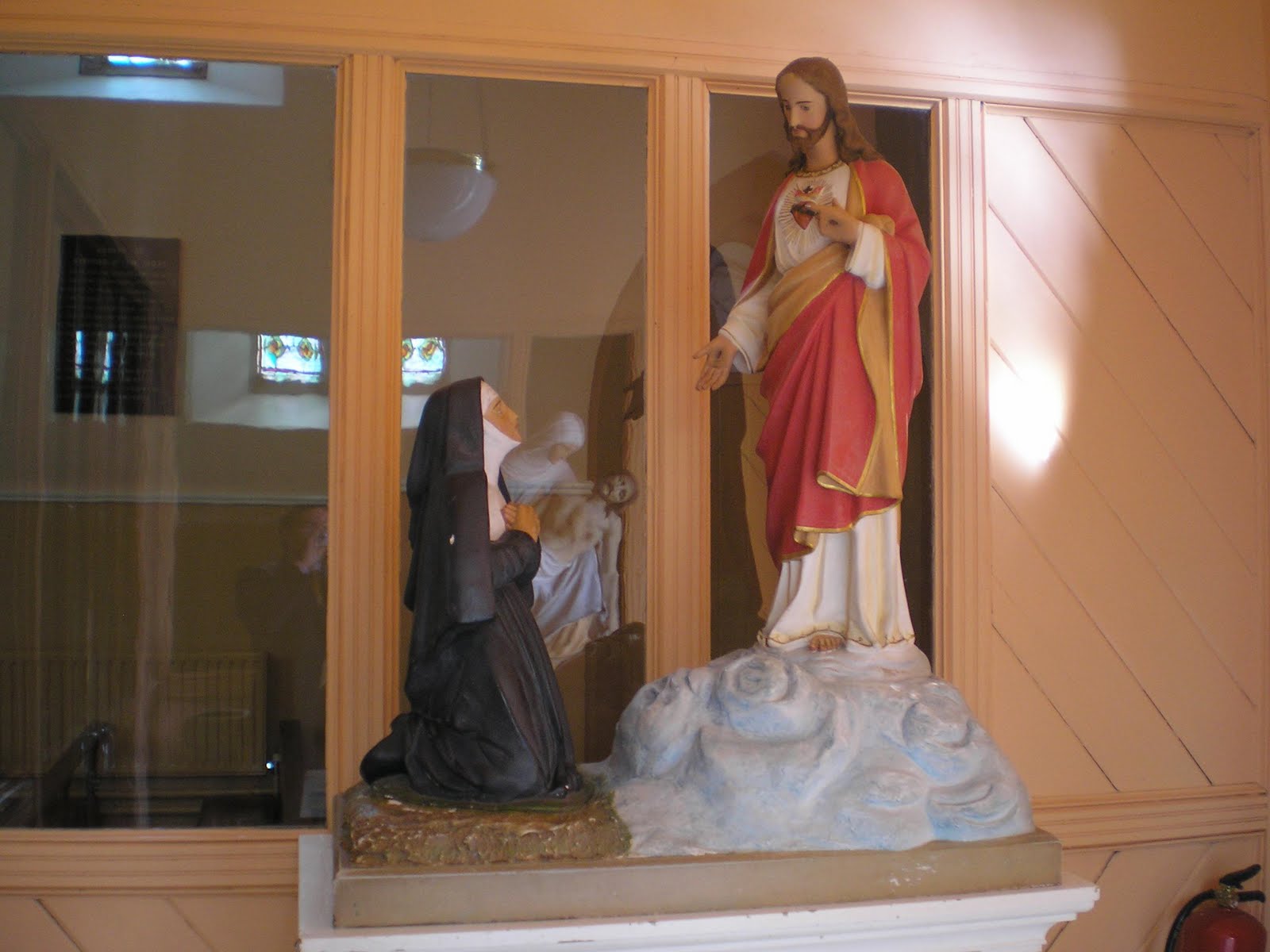
Inside the porch are two fine scenes in statuary, the Pieta to the left and the apparition of the Sacred Heart to St. Margaret Mary Alacoque to the right.


In the organ loft are two paintings flanking the west window - which is in white opaque glass - one of St. Patrick (Gospel Side) and the other of St. Brigid (Epistle Side). St. Patrick passed through Laois a few miles south of Emo and St. Brigid is Patroness of the Diocese.


The stained glass windows are also very fine. Advancing from door to Sanctuary, they are: 'Suffer the Little Children' (Gospel Side) and 'The Nativity' (Epistle Side); Angels with scrolls 'Laudate Angeli' and 'Sanctus, Sanctus, Sanctus' (Gospel Side) and Angels with scrolls 'Angelus Dei' and 'Ora Pro Nobis' (Epistle Side); 'Magdalene washes the feet of Christ' (Gospel Side) with no corresponding window; 'Revelation of the Sacred Heart to St. Margaret Mary' (Gospel Side) and 'The Annunciation' (Epistle Side), each to correspond with the side Altars.


In the Sanctuary, one window on the Epistle Side represents the instruments of the Passion and the window on the gable shows Ss. Peter and Paul flanking Our Lady and St. Joseph, popular Saints on the Diocese.


The Church is one of the most beautifully furnished in the Diocese and, almost uniquely, retains all the traditional features in situ. The two side Altars, dedicated to the Sacred Heart (Gospel Side) and to Our Lady (Epistle Side) remain as does the full expanse of the Altar rail, with access at either side of the Sanctuary but no gates at the centre. The pulpit is mirabile dictu both intact and in situ as is the fine High Altar. Everything about the Church is redolent of reverence for the things of God. This is a Church well deserving of a pilgrimage built by a lady of Faith who is deserving of our prayers.


Reports of the previous Mass in St. Paul's are available here and here.

May the soul of Aline, Countess of Portarlington, and the souls of all the faithful departed, through the mercy of God, rest in peace!

St. Paul, Patron of Emo, pray for us!